Everyone plans how the fans get in.
Nobody plans how the staff get to their posts.
A major festival can run on 800+ event staff and security. They hit the same sprawling-site problem the fans do — except at 6 a.m., before the gates open, and again every shift. In a labor market where 89% of organizers report staffing shortages, the walk to the post is a retention problem nobody budgets for.
Before a single fan walks through the gate, the event already has a population. Security at every perimeter. Vendors stocking compounds. Production crew on the stages. Medical staff in the tents. Parking attendants in the lots. Operations runners covering the gaps. For one weekend, an empty field becomes a small city — and that city has to be staffed.
At Coachella, the security and facility-services firm Allied Universal alone hires roughly 800 event-staff and security positions to help manage a site that handles 125,000 attendees a day. That's one vendor. It doesn't count production crew, catering, vendors, medical, or the festival's own operations teams. (Allied Universal / Premier Staff)
Catering operations at major festivals can run to 400 workers fed three meals a day during load-in alone. (Festival & Event Production) Add security, vendors, production crew, medical, and operations, and every one of them has to get from where they park to where they work — across the same hundreds of acres the fans cross, on the same sun-baked ground, except they do it before the gates open and again after they close.
The fan journey gets planned. There are maps, shuttles, rideshare zones, signage, and a small army dedicated to moving ticket-holders from the parking lot to the gate. The staff journey gets a wave toward the back lot and an instruction to find their post.
The event's entire workforce arrives before the fans, leaves after them, and crosses the site more times in a shift than any attendee will all weekend. And almost nobody plans how they move.
The workforce is in a labor market that punishes friction
This would be a footnote if event staff were easy to hire and easy to keep. They are neither.
The Event Industry Council has reported that 89% of event professionals say staffing shortages directly impacted their events (via The Ticket Fairy). In Europe, IQ Magazine's European Festival Survey found 53% of festivals were short-staffed — and of those, a quarter were running 26–50% below the staffing they needed.
And the people you do hire don't stay. Annual turnover in the hospitality and events sector runs north of 60%. Many seasoned crew left during the pandemic and never came back. (Premier Staff / HR Dive)
Here's the part that connects directly to transportation: staffing agencies report that rising housing costs are pushing event and hospitality workers farther from the venues, making each commute longer and costlier — and driving up no-show rates. The worker who already drove 90 minutes to get to the site is the worker most likely to decide the half-mile walk from the staff lot to their post isn't worth it tomorrow. (Premier Staff)
When every employer competing for the same workers offers the same pay, the same per diem, and the same signing bonus, the financial package stops being a differentiator. What's left is the daily lived experience of the job. We made that argument in full for construction and data-center labor — onsite transit is the cheapest, highest-leverage workforce amenity once the money is matched. The same logic applies to the security guard, the stagehand, and the parking attendant.
What the walk actually costs
The cost of an unplanned back-of-house isn't abstract. It shows up in four places.
The first and last impression of every shift is a walk. A worker clocks in, then walks fifteen minutes to their post. At the end of a ten-hour shift, in the dark, they walk it back. That walk is the bookend on every workday — the first thing they experience and the last. For a workforce you're fighting to retain, that's a daily reminder of friction you control and chose not to fix.
Coverage gaps open when relief can't get to post. Security and operations run on rotations. When the relief guard has to walk ten minutes across a site to take over a position, the post is either uncovered during the gap or the outgoing guard is held past their shift. Multiply that across every rotation, every post, all weekend, and the walk becomes a staffing math problem, not a convenience one.
Site response slows. Back-of-house movement isn't only commuting. It's the vendor running back to the compound for restock, the medical responder crossing the grounds, the operations lead getting from one fire to the next. On foot, every one of those trips takes as long as the site is wide. The bigger the event, the worse it gets — the same dynamic that has warehouse and distribution workers losing two hours a shift to walking.
The unmanaged golf carts don't fix it. Most large sites already have carts — scattered, keys-in-the-cup-holder, claimed by whoever grabbed one first, with no routes and no schedule. That's not a system; it's the absence of one. We've written about the hidden staffing math of running a cart fleet — the drivers you have to recruit, vet, and supervise to keep those carts moving. A pile of carts with no operating model is a liability with wheels, not a transportation plan.
Moving a workforce, not just an audience?
FlexTram runs back-of-house staff routes for festivals, stadiums, and large-site operations — from a single weekend to a full season. Equipment rentals, full-service operations with trained drivers, and turnkey plans available.
What a back-of-house system looks like
The fix isn't more carts. It's a system — the same thing the fan side of the operation already has, applied to the workforce.
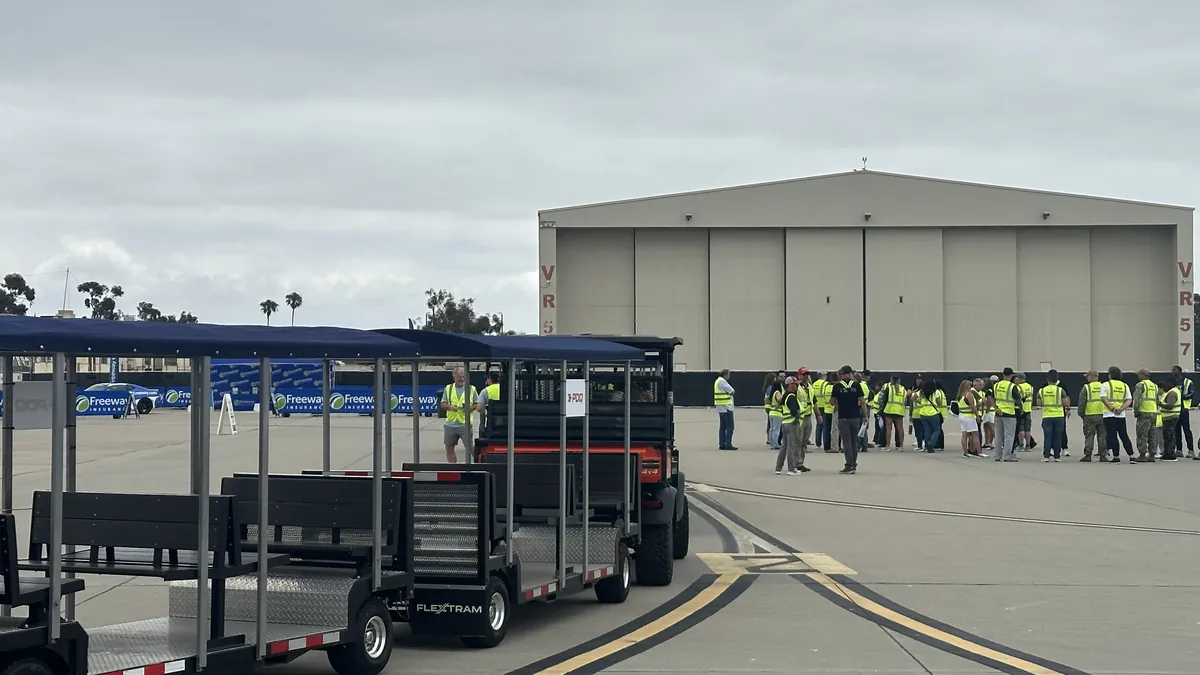
Staff parking and check-in to post. A fixed loop from the staff lot and crew check-in to the posts, stages, and compounds where people actually work. One FlexTram moves up to 27 staff per trip with one driver, on a route crews learn on day one. The fifteen-minute walk that bookends every shift becomes a two-minute ride.
Rotations that hold. A predictable route on a posted schedule means relief staff reach their positions on time. Coverage gaps close. Nobody gets held past their shift because the next person is still walking.
Vendor, medical, and operations movement. The same loop that moves the workforce moves the restock run, the medical responder, and the operations lead. Response time stops being a function of how far someone can walk.
ADA service by default. Event workforces include people with mobility limitations — and the industry is actively recruiting mature workers and reentry-program hires to fill the shortage. A system that includes accessible transport as standard widens the pool of people who can physically work the site, instead of quietly screening them out.
It deploys for the window and leaves. No permanent infrastructure, no construction. The trams arrive for load-in, run staff routes through show days and load-out, and leave at tear-down. The fleet scales to the size of the build — the same model that works at festivals, stadiums, and industrial campuses works for the back-of-house operation specifically.
The half-mile nobody put on a map
Every event obsesses over the fan journey — rightly. The fan's experience is the product, and the walk from the lot to the gate is part of it. But the workforce crosses that same ground more often than any fan, under more pressure, on a tighter clock, in a labor market that makes every one of them hard to replace.
The fan walks the site once or twice. The security supervisor walks it twenty times. The vendor walks it all day. The medical responder walks it at a run. And at the end of the night, the staff who built the whole thing walk back to a far lot in the dark while the fans are already gone.
You spent months planning how 100,000 people would get in. The 800 people who make that possible got a parking pass and directions.
The least you can do for the people running your event is give them a ride from the lot to their post.
— The FlexTram Team
Frequently asked questions
What is back-of-house transportation at an event or festival?
Back-of-house transportation is how an event's workforce — security, vendors, production crew, medical staff, volunteers, parking attendants, and operations teams — moves around the site, as opposed to how ticketed fans move. At a large festival or stadium, the staff footprint covers parking, staging areas, crew check-in, dressing rooms, vendor compounds, medical tents, and dozens of posts spread across hundreds of acres. Front-of-house transit (how fans reach the gate) gets planned and budgeted; back-of-house staff movement is usually left to walking, scattered golf carts, or personal vehicles.
How many staff does a large festival or event employ?
It runs into the hundreds or thousands. For Coachella, security and facility-services firm Allied Universal alone has hired roughly 800 event-staff and security positions, and that is one vendor among many — it excludes production crew, vendors, catering, medical, and operations. Catering teams at major festivals can feed several hundred workers three meals a day during load-in alone.A single large event's workforce is a small town that arrives before the fans and leaves after them.
How does staff transportation affect event staffing shortages and retention?
Event staffing is in a documented crisis: the Event Industry Council has reported that 89% of event professionals say staffing shortages directly impacted their events, and annual turnover in hospitality and events runs north of 60%. When the financial package — pay, per diem, bonuses — is matched across every employer competing for the same workers, the daily lived experience becomes the tiebreaker. A worker who clocks in only to walk a mile to their post in the heat, then walk it back at midnight, experiences friction every shift. Reducing that friction is one of the cheapest retention levers an organizer controls.
How can a tram system improve back-of-house event operations?
A tram running fixed back-of-house routes moves the workforce on a schedule instead of on foot: from staff parking and crew check-in to posts, vendor compounds, and staging areas. One FlexTram carries up to 27 staff per trip with a single driver, on a predictable loop crews can count on. It cuts the walk that eats the first and last part of every shift, gets relief staff to posts on time so coverage gaps close, speeds vendor restock and medical response across the site, and serves workers with mobility limitations by default. ADA access is standard, not a separate arrangement.
Can a back-of-house staff shuttle be deployed for a single event or festival weekend?
Yes. FlexTram deploys for single-day, single-weekend, and multi-week engagements without permanent infrastructure or construction. Vehicles arrive for the event window, run staff routes for load-in, show days, and load-out, and leave at tear-down. The fleet scales to the size of the workforce — add trams for a bigger build, return them when the contract ends. Equipment rentals, full-service deployments with trained drivers, and turnkey transportation plans are all available.
Related reading
Your event runs on people. Give them a ride from the lot to their post.
FlexTram runs back-of-house staff routes for festivals, stadiums, and large-site operations — from a single weekend to a full season. Equipment rentals, full-service operations with trained drivers, and turnkey transportation plans available.