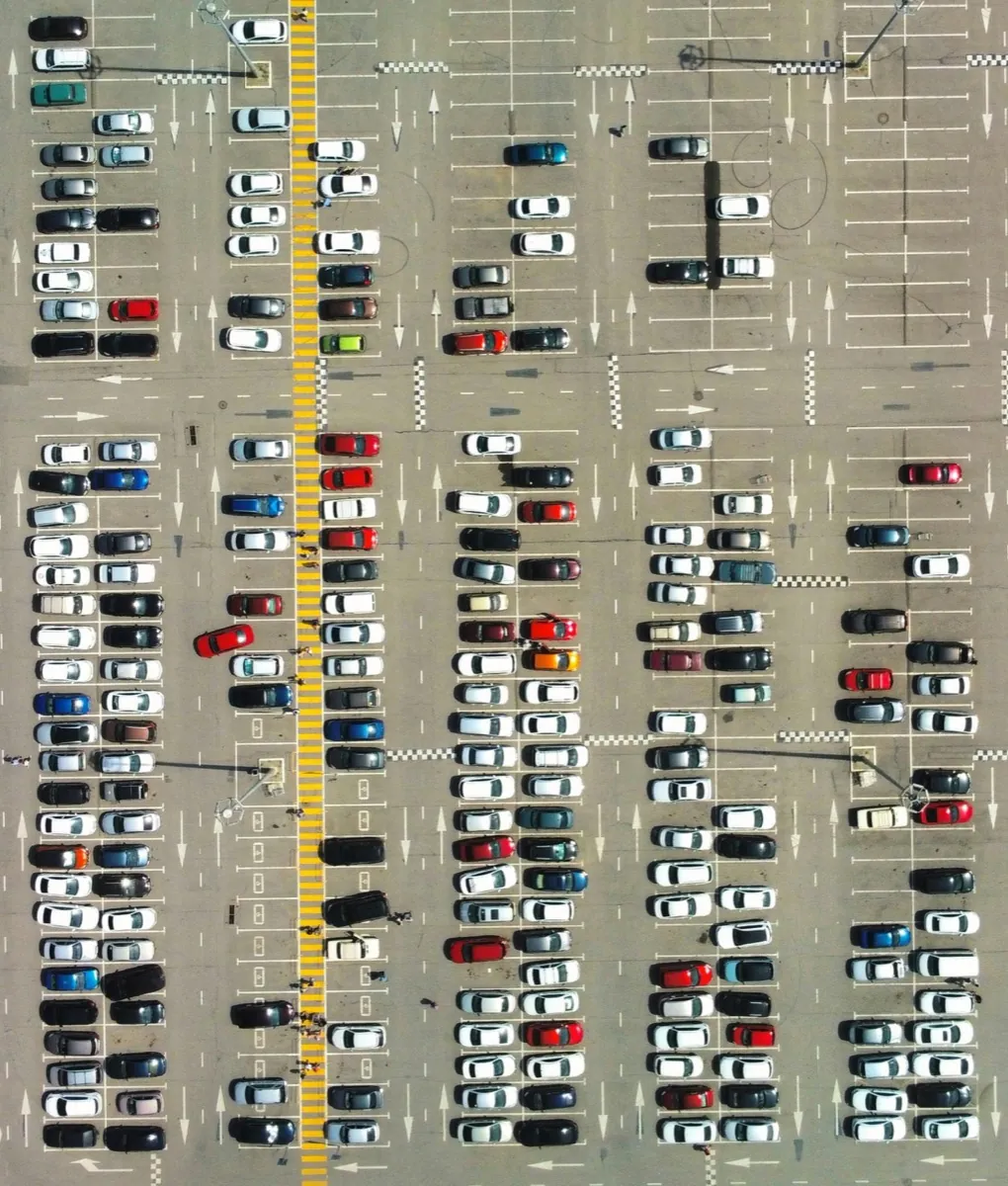
Curb to gate.
Why the fan journey became the product at live events.
Propark rebranded as Propark Mobility. LAZ Live! hit 100 venues. Metropolis bought SP+ for $1.5B. The largest parking operators in America are telling you the same thing with their own capital — the product isn't parking anymore.
Propark rebranded as Propark Mobility. Metropolis, an AI computer vision company, acquired SP+ and became the largest parking network in North America. LAZ Live! — LAZ Parking's venue and event services division — hit 100 venues in December 2025, managing everything from valet to shuttles to event staffing and traffic management. The August 2025 issue of Parking & Mobility magazine was entirely dedicated to "Destination and Event Management." At IPMI's 2025 conference, the education tracks listed "frictionless, touchless, EV/AV, curbside, technology, staffing, motivating, micro-mobility, transit" — and then, almost as an afterthought, "parking."
Something has shifted in the last eighteen months, and the trade press has been chronicling it in real time without quite naming it. Here's the name:
The product at live events is no longer parking. It's the fan journey from curb to gate.
That's a different product. It requires a different company to deliver it.
The fan doesn't buy parking. The fan buys "I got to my seat without a fight."
Ask any season-ticket holder what they're spending on when they pre-purchase a parking pass for a Sunday home game. They'll tell you "parking." They're wrong. What they're actually buying is the absence of a bad story: no circling the block, no arguing with the attendant, no sprinting from a remote lot in a suit, no standing on hot asphalt at 10:45 PM waiting for a shuttle that hasn't come, no walking twenty-five minutes to a rideshare pickup that's surging at 6x.
The word "parking" describes about 15% of that experience. The rest is traffic management, wayfinding, shuttle operations, curb logistics, post-event egress, ADA accommodation, and the general feeling that the venue has its act together.
Yet for forty years, the industry has been organized around the 15%. Parking companies were paid to manage spaces. Transportation vendors were paid to move buses. Event staffing agencies were paid to deploy ushers. Traffic management firms were paid to control intersections. Each vendor solved its slice, submitted its invoice, and went home. The fan, meanwhile, experienced one continuous journey — and when the journey broke, every one of those vendors could credibly claim it wasn't their fault.
That model is now dissolving, and fast.
The signals that the shift is already happening
The most concrete evidence isn't anything FlexTram is saying. It's what the largest parking operators in the country are doing with their own capital and their own brands.
Propark became Propark Mobility. Their event pitch now leads with "integrated parking and transportation management" — scalable shuttle and circulator systems explicitly designed, in their own framing, to move the fan from parking lot to seat. They didn't add "Mobility" to their name because it sounded nice. They added it because their clients stopped asking for parking and started asking for the whole journey.
LAZ Live! hit 100 venues in December 2025. The division's stated mission, in its own press release, is "beyond parking." Jon Applegate, VP of LAZ Live! Venue & Event Services, describes the goal as enhancing the fan experience — not managing spaces. The division's flagship reference is Truist Park and The Battery Atlanta, the 60-plus-acre mixed-use stadium district where parking, shuttles, district circulation, and event staffing operate as one coordinated system.
Metropolis acquired SP+ in May 2024 at an enterprise value of approximately $1.5 billion, with $1.8 billion in committed financing. That wasn't a parking company buying a parking company. It was an AI computer vision platform buying the infrastructure to deploy its tech at scale. The clearest read on where this industry is going: the acquirer isn't calling itself a parking company. (Metropolis subsequently closed a $1.6B financing round in November 2025 at a ~$5B valuation and announced a Joby Aviation vertiport partnership in December 2025 — the trajectory continues straight into the last 500 yards, where the parking-to-mobility product is still incomplete.)
Mercedes-Benz Stadium partnered with ParkHub in February 2025 to centralize fan arrival under one reservation platform — including 45 nearby third-party parking sites. The venue isn't treating parking as a standalone service. It's treating it as the first touchpoint in a journey it's orchestrating.
Hollywood Park around SoFi Stadium operates as a 298-acre mixed-use development where parking, shuttles, and intelligent guidance systems are integrated as one platform. Average parking search time dropped 32%. Circulation time within the garages dropped 40%. Customer satisfaction scores rose 25%. The numbers aren't the interesting part. What's interesting is that the operator tracked them under a single fan-experience metric — not a parking metric and a shuttle metric separately.
Five data points, five different companies, one direction of travel.
Why this particular industry, and why now
Three forces converged over the last five years and nobody can put them back in the box.
Mixed-use development made the venue bigger than the venue. The Battery Atlanta. Hollywood Park. Titletown next to Lambeau Field. Patriot Place outside Gillette. The old model — a single-purpose stadium surrounded by a sea of asphalt — is being replaced by 60-to-300-acre developments where the fan's journey doesn't begin at the parking gate. It begins three blocks away at a restaurant, an office, a hotel, an apartment that's part of the same property. The "venue" is now a district, and the district needs internal circulation.
This same shift is reshaping the parking lot itself. The parking lot has quietly absorbed six other transformations over the last few years — EV charging, micro-warehousing, vertiport staging, micromobility hubs, computer-vision platforms, ghost kitchens — and onsite human transportation is the seventh. The parking operators rebranding around mobility are responding to a property that has been changing under their feet for longer than most venue operators have noticed.
Fan tolerance for friction collapsed. Post-2020, fans who can watch the game at home in 4K on a 75-inch TV have stopped accepting a mediocre in-person experience. The complaints that dominate venue operators' inboxes and reach the trade press most consistently — traffic, parking, entry, exit, wayfinding — are all journey-related. None of those are about the game. Every dollar a venue spends fixing the product on the field is being undercut if the journey to and from the seat is broken.
The technology stack became table-stakes. License plate recognition, pre-booking platforms, real-time guidance systems, dynamic pricing, app-based reservations — these are now so standard that no major venue operator is building a new parking operation without them. But the moment you have a unified tech platform tracking fans from pre-arrival through departure, the artificial boundaries between "parking" and "transportation" and "event staffing" stop making sense. It's one dataset. One fan. One journey. Whoever owns the platform owns the product.
The consolidator is the parking operator, not the transportation vendor
Here's the counterintuitive thing: the company best positioned to own the curb-to-gate product isn't the shuttle bus company, the event staffing firm, or the traffic management contractor. It's the parking operator.
Why? Because parking is the widest, deepest beachhead in the venue. A parking operator at a major stadium already has hundreds of employees on site on event days. They already have hardware — gates, LPR cameras, payment infrastructure, signage networks. They already have direct contractual relationships with the venue, often multi-year, often for the parking asset itself as real estate. They already have the data: who arrived when, from where, into which lot, for which event. And they already have the customer touchpoint: the first human a fan interacts with on event day is usually the parking attendant directing them into a space.
The shuttle bus company shows up for four hours, runs its routes, and leaves. The traffic management firm sets up cones pre-event and breaks them down after. The event staffing agency deploys ushers for a single shift. None of those vendors has the venue relationship, the infrastructure, the data, or the continuity to own the whole journey.
The parking operator has all four.
What the parking operator historically lacked was the next product — the onsite mobility vehicle, the engineered route plan, the fleet of ADA-compliant trams, the last-500-yards solution that moves fans from a remote lot to a gate. Which is precisely the gap that's now being closed, either by building it internally (LAZ Live!) or by partnering with the companies that already have it (everyone else).
The category is consolidating around the operator with the widest surface area at the venue. Whoever finishes building the curb-to-gate product first wins the next decade of stadium contracts.
Building out a curb-to-gate offering?
We partner with parking operators, venue owners, and event producers to close the last 500 yards — the onsite mobility layer that completes the fan journey. Let's walk your footprint.
What this means for venue operators
For the people running venues — stadium presidents, festival producers, cruise terminal directors, raceway GMs — the implication is direct:
Stop procuring "parking" as a separate line item from "transportation" as a separate line item from "traffic management" as a separate line item. You are buying four slices of a product that the fan experiences as one thing. The operator model that gives you four invoices from four vendors is the operator model that gives you four finger-points when something breaks.
The better question to ask at the next RFP: who is going to own the entire journey from when the fan's car turns off the highway to when they sit down in their seat? The answer, increasingly, is going to be one company — the same company that owns the parking asset, but with a dramatically expanded service definition under it.
That's the shift. The parking operator is becoming the mobility operator. The mobility operator is becoming the fan-experience operator. And the fan-experience operator is the one the venue is going to write the check to, for everything that happens between the highway exit and the seat.
For venue operators who want to get ahead of this shift rather than get caught flat-footed by it, the move is clear: consolidate the vendor stack now, while there's still a competitive market of operators competing to own the full product. In eighteen months, there will be three or four players who have built the full stack. In five years, the market for standalone parking services at major venues will be a niche.
What this means for parking operators
For the operators themselves, the strategic question is also direct: what's the fastest way to round out the product?
Build internally — what LAZ Live! is doing, what Propark Mobility is doing. Buy — what Metropolis did with SP+, scaled up. Partner with specialist vendors who already own the pieces you don't — the onsite tram fleets, the route engineering capabilities, the fan-experience technologies that take the parking relationship from "transactional" to "experiential." Done right, that transit layer isn't just a cost of the experience — it's the most captive sponsorship audience at the event.
The right answer depends on the operator and the timeline. But the meta-answer is the same across all of them: single-service parking is over. The operators who accept this and move decisively are going to absorb the category. The ones who insist they're in the space-management business are going to find, in five years, that the space-management business has become a commodity rented by operators who are in the experience business.
The bottom line
The product at live events shifted from parking to curb-to-gate, and the industry is reorganizing around that shift right now. You can see it in the rebrands (Propark Mobility). You can see it in the milestone announcements (LAZ Live! at 100 venues). You can see it in the M&A activity (Metropolis / SP+). You can see it in the trade press (the August 2025 Parking & Mobility issue). You can see it in the conference tracks (IPMI 2025 putting "parking" last on the education list).
The fan has been buying the journey the whole time. The market is just finally catching up.
The companies that build the curb-to-gate product — whether through internal investment, acquisition, or partnership — are going to be the ones running the stadiums, arenas, festivals, and districts of the next decade. Everyone else is going to be a vendor to them.
Which side of that line a given parking operator ends up on is being decided right now. In meetings. In partnership decisions. In the next budget cycle.
The fan journey is the product. The only question is who owns it.
Frequently asked questions
What is the "curb to gate" fan journey?
Curb to gate is the complete fan journey from the moment a vehicle turns off the highway into a venue's orbit until the fan sits in their seat — encompassing traffic management, parking, wayfinding, shuttle operations, curb logistics, ADA accommodation, and post-event egress. Historically these were four separate vendor contracts. Increasingly they're being consolidated under a single operator.
Why are parking operators expanding into mobility?
Parking operators have the widest, deepest beachhead at venues — hundreds of on-site staff, hardware infrastructure, direct venue relationships, event-day data, and the first customer touchpoint. They were structurally best-positioned to expand into adjacent services like shuttles, traffic management, and event staffing. Propark Mobility, LAZ Live!, and Metropolis (post-SP+ acquisition) are all examples of this expansion.
What does Propark Mobility do differently from a traditional parking company?
Propark Mobility pitches integrated parking and transportation management — scalable shuttle and circulator systems designed to move fans from parking lot to seat — rather than just managing parking spaces. The rebrand reflected the shift in what venues are actually buying: the whole fan journey, not the parking asset alone.
How does FlexTram fit into the curb-to-gate shift?
FlexTram builds the onsite mobility layer that parking and venue operators need to complete the curb-to-gate product: the last 500 yards from parking to gate, campground to stage, paddock to grandstand. We partner with parking operators, venue owners, and event producers who are consolidating the fan journey into a single coordinated service.
What should venue operators do in response to this shift?
Stop procuring parking, transportation, traffic management, and event staffing as four separate line items from four separate vendors. Fans experience the journey as one product; sourcing it as one product eliminates the vendor finger-pointing that happens when any piece of it breaks. The next RFP should ask who will own the complete journey from highway exit to seat.
Explore solutions
Completing the curb-to-gate product?
FlexTram designs and operates the onsite mobility layer that parking operators and venue owners need to close the last 500 yards of the fan journey. Let's walk your footprint and build the plan.