The biggest construction boom in America
has a people-moving problem.
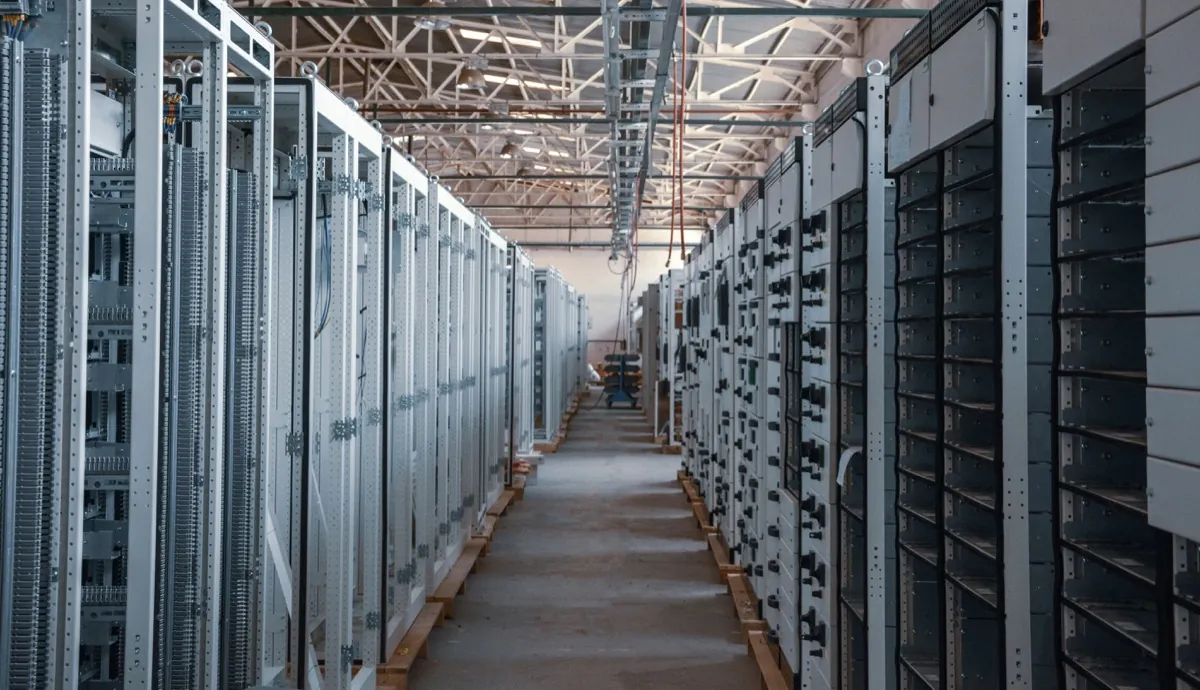
Right now, across the United States, the largest private construction boom in modern history is underway. It's not housing. It's not highways. It's data centers. Everyone is talking about the power, the chips, and the cooling. Almost nobody is talking about the people.
The scale problem nobody planned for
These aren't buildings. They're campuses. And increasingly, they're small cities.
Private spending on data center construction is running at an annualized rate of more than $41 billion. The average data center parcel grew by 144% between 2022 and 2024, reaching 224 acres. Meta's Indiana campus spans 800 acres. AWS reserved over 1,000 acres in Spain. Microsoft is expanding onto a second 500+ acre campus in San Antonio.
During construction, these sites are even more sprawling. A hyperscale campus under development might have active work zones spread across hundreds of acres, with thousands of workers — electricians, plumbers, HVAC specialists, ironworkers, concrete crews, commissioning engineers — moving between staging areas, building shells, temporary offices, and parking lots every day.
Now consider: how do those thousands of workers get from the parking lot to their work zone every morning? They walk.
Construction phase: thousands of workers, zero transit infrastructure
A large data center construction project can employ 2,000 to 5,000 workers at peak. These workers park in temporary gravel lots and walk to their assigned work zones across an active construction site. On a 200-acre campus, a worker might walk 15–20 minutes from their car to their reporting location, through areas with active heavy equipment, crane operations, and open excavation.
This creates three compounding problems.
First, lost productive time. If 3,000 workers each spend 15 minutes walking in and 15 minutes walking out, that's 1,500 hours of labor time per day consumed by walking — the equivalent of nearly 190 eight-hour shifts. On a project where skilled labor is already scarce and every day of delay costs millions, that's a structural inefficiency baked into the daily schedule. We've since put a name to it: internal site transit — the unbudgeted line item that grows with every acre added to the campus.
The labor shortage makes this worse. The National Association of Manufacturers projects a potential shortfall of 1.9 million workers by 2033. The Associated Builders and Contractors estimates that nearly half a million new construction workers will be needed in 2027 alone. Every minute of productive time you recover from transit waste is a minute you can't afford to lose — and in a market this tight, retention of the skilled trades you already have is as important as recruitment. (We've written about the same dynamic inside large warehouses and distribution centers — where workers lose up to two hours a day walking to and from their stations.)
Second, safety exposure. Workers are walking through zones with high-energy electrical infrastructure, heavy equipment operations, open trenches, and continuous material deliveries. Large data center developments often rely on thousands of rotating workers and subcontractors, making consistent safety management difficult across the project. When those workers are dispersed across hundreds of acres on foot, the safety exposure multiplies with every shift change.
Third, schedule compression. Data center developers are under extraordinary pressure to bring capacity online fast. The Stargate project in Abilene, Texas went from announcement to two live buildings in under a year, with six more scheduled by mid-2026. That kind of timeline means every operational inefficiency — including the 30 minutes per worker per day lost to walking — becomes a drag on the critical path.
Post-construction: the campus doesn't get smaller
The people-moving problem doesn't end when construction finishes. It changes shape.
Between construction handover and steady-state operations sits one specific moment that catches most operators off guard: the ribbon-cutting and facility-tour event. Elected officials, board members, investors, and media arrive on a property designed for servers, not visitors — and walk hundreds of yards across asphalt and gravel in business attire. The same transit problem that defined the construction phase reappears on the one day the campus is most visible to its stakeholders.
An operational hyperscale data center campus still employs hundreds of people — technicians, security personnel, facilities managers, network engineers, and operations staff. These workers are spread across multiple buildings on a campus that might be a quarter mile or more from end to end.
Many of these campuses are in rural or exurban locations — chosen for power availability, land cost, and tax incentives — which means there's no public transit, limited sidewalk infrastructure, and long distances from parking to the building entrance.
Security adds another dimension. Data center campuses operate under strict physical access controls. A fixed-route tram system running through established security corridors — with boarding points at credentialed stops — integrates cleanly into this model. It's easier to secure a single vehicle on a documented route than hundreds of individuals walking scattered paths across an open campus.
Planning a hyperscale site? Let's size the system.
We help data center operators turn a people-moving problem into a retention and safety win — ideally before ground breaks.
The weather variable
Data centers are being built where the power is — and increasingly, that means places with extreme weather.
Texas leads the nation in data center construction. But Texas also means summer construction in 100°F+ heat. Workers walking 15 minutes across an unshaded gravel lot in July aren't just losing time. They're arriving at their work zone already heat-stressed, which affects cognitive function, reaction time, and injury rates.
The same applies to winter conditions in Ohio, Virginia, and the upper Midwest — all active data center markets. Workers walking through mud, ice, or snow across an unfinished site are moving slower, falling more often, and burning energy before they start their shift.
When a weather event hits and you need to account for every worker on a 300-acre site, having them consolidated on a tram route with known boarding points is fundamentally different from having them dispersed on foot across the entire campus.
What FlexTram does here
FlexTram deploys as a fixed-route, scheduled tram loop — from parking areas to building entrances, between buildings on an operational campus, or from staging areas to active work zones during construction.
During the construction phase, the system runs on temporary routes that adapt as the site evolves. Gravel, dirt, unfinished pavement — our vehicles operate on all of it. The independently turning axles that let us navigate a festival campground or a stadium parking lot work equally well threading between construction trailers and laydown yards.
Once the campus is operational, the same vehicles transition to a permanent loop — connecting parking structures, data halls, cooling plants, administrative buildings, and security checkpoints. One driver, up to 27 passengers, running continuously during shift changes and at regular intervals between.
The math works the same way it does at every other FlexTram deployment: one tram replaces 5–10 golf carts and their drivers. Fewer vehicles, fewer operators, lower liability, and a predictable, documented transportation system instead of an ad hoc collection of carts and vans that nobody's tracking.
For general contractors managing the construction phase, it's a tool that recovers productive labor hours, reduces pedestrian-vehicle conflict on active sites, and demonstrates a commitment to worker safety that matters in a market where skilled trades workers can choose which project to show up to.
For data center operators managing the campus long-term, it's a permanent infrastructure layer that moves people efficiently across a large footprint — with security integration, ADA accessibility, and the kind of operational predictability that data center managers expect from every other system on their campus.
The opportunity is right now
The construction boom is accelerating, not slowing. AI data center power demand in the United States could reach 106 gigawatts by 2035. That means more campuses, more acres, more workers, and more of the same transit problem at every single site.
Right now, the industry is solving for power, cooling, fiber, and equipment supply chains. Those are the headliner problems. But the people-moving problem is the opening act that nobody rehearsed — and it plays out every morning at 6 AM when thousands of workers park their trucks in a gravel lot and start walking.
The companies building the infrastructure for artificial intelligence are engineering systems that can reason, create, and operate at superhuman speed. The least they can do is give the humans building those systems a ride from the parking lot.
— The FlexTram Team
Frequently asked questions
How does FlexTram work on active construction sites?
FlexTram deploys as a fixed-route, scheduled tram loop from parking areas to active work zones. The vehicles operate on gravel, dirt, and unfinished pavement, with routes that adapt as the site evolves. Independently turning axles let the trams navigate between construction trailers and laydown yards.
How much productive time does walking waste on a large construction site?
If 3,000 workers each spend 15 minutes walking in and 15 minutes walking out, that's 1,500 hours of labor time per day — the equivalent of nearly 190 eight-hour shifts. On projects where skilled labor is scarce, that's a structural inefficiency on the critical path.
Can FlexTram transition from construction phase to permanent campus operations?
Yes. During construction, FlexTram runs on temporary routes that adapt as the site evolves. Once the campus is operational, the same vehicles transition to a permanent loop connecting parking structures, data halls, cooling plants, and security checkpoints.
How does a tram system improve construction site safety?
Instead of thousands of workers walking unpredictable paths through active zones with heavy equipment, a fixed-route tram consolidates pedestrian traffic onto a single, documented corridor. This reduces conflict points and improves emergency management by having workers at known boarding locations.
How many passengers does a FlexTram carry?
Each FlexTram carries up to 27 passengers with one driver. One tram replaces 5–10 golf carts and their drivers, with fewer vehicles, fewer operators, lower liability, and a predictable, documented transportation system.
Explore solutions
Ready to solve the people-moving problem?
FlexTram offers rentals, long-term leases, and turnkey transportation plans for construction sites, data center campuses, and industrial facilities of any size.