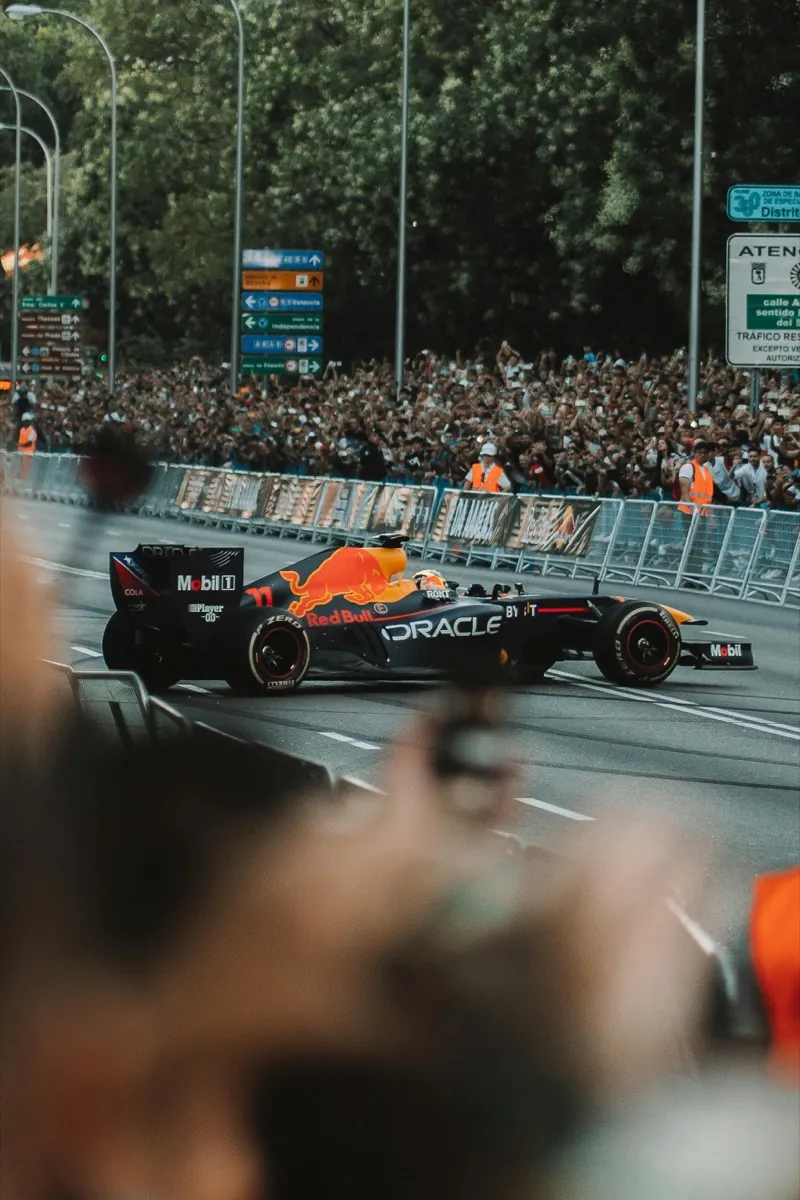
F1 has revolutionized everything about race day.
Except how fans get there.
Formula 1 is in the middle of the most successful commercial transformation in motorsport history. Race weekends draw 300,000 to 400,000 fans. Paddock Club sells out in hours at $20,000+ per ticket. Netflix's Drive to Survive pulled millions of new fans into the sport. The global broadcast reach exceeds 1.5 billion viewers per race.
The sport has been reinvented for a new generation. The cars are hybrid, running on 100% sustainable fuels, with active aero and manual boost buttons debuting in 2026. Sponsorship revenue is at all-time highs. The brand has never been stronger.
But walk into any Grand Prix weekend as a paying fan and you run into the same problem that's existed since the sport started: once you get to the circuit, you're on your own.
The circuit is bigger than you think
F1 circuits are not stadiums. They're not arenas. They're 3.5 to 4.5 miles of track wrapped around hundreds of acres of paddock, grandstand, hospitality, and fan zone infrastructure. COTA in Austin spans over 1,000 acres. The Las Vegas Strip Circuit stretches 3.8 miles through the heart of one of the busiest tourist corridors in the world. Suzuka has a capacity of 155,000. Shanghai International Circuit can hold 200,000.
These aren't venues you walk into. They're properties you navigate.
And that navigation almost always happens on foot. Fans holding tickets for Turn 11 grandstands at COTA walk a mile or more from the parking lots. Fans in general admission at Spa might hike between different sections of the forested Ardennes circuit across an entire weekend. Las Vegas fans, cut off from normal pedestrian patterns by race-weekend road closures, find that what would normally be a five-minute walk becomes "an unexpected half-hour loop around barriers."
As one guide notes about F1 circuits generally: "Comfortable shoes are essential, as most circuits require a fair amount of walking between viewing areas."
That's the polite version. The real version is that fans paying $800 for a Grandstand ticket — and $20,000 for a Paddock Club pass — are still walking 15–30 minutes through gravel, dust, and heat to reach their seats. Three days in a row. In July at Spa. In October in Austin. In November on the Las Vegas Strip.
COTA: when the tram exists but doesn't work
The most documented F1 onsite transportation failure is at Circuit of the Americas in Austin, where the problem isn't that there's no solution — it's that the existing solution can't handle the demand.
Rideshare passengers are dropped at the McAngus Lot. From there, they face "around 10–15 minutes to the Grand Plaza gate or take a free tram." That free tram exists on paper. In practice, according to one F1 travel guide, the tram "drops off at the McAngus Road depot which is at best a 15 minute walk, but it's down a narrow unlit single lane road. Hot in the day time and sketchy after dark." The same guide notes that in past years, "the queues were so long people just walked instead."
That's the scenario playing out at a circuit that draws 400,000+ fans across race weekend. A tram system that was built to solve the transit problem — but can't process the volume, so fans abandon it and walk instead, down an unlit road, in Texas heat or Texas dark.
The gap this creates is so significant that an entire industry of private parking operators has emerged specifically to circumvent it. Austin Race Parking markets itself with "Walk to Turn 11 in 5 mins... $350+ cheaper than official lots" and advertises a "15-minute fast exit" as its primary selling point. When fans are paying premium prices for private parking just to avoid the official transit system, the message is clear: the existing infrastructure isn't serving the audience it was built for.
Las Vegas: the luxury circuit with tiered accessibility
The Las Vegas Grand Prix was supposed to be F1's most polished fan experience. A premium night race through the Strip, with the infrastructure of a major tourism destination already in place. In some ways, it is. In others, it reveals the sport's uncomfortable relationship with fan transportation.
The official F1 Las Vegas A-Z guide states: "Parking is not available directly through the Event and guests are encouraged to walk from their hotel or use rideshare... Due to road closures, we encourage walking to the Event from the nearby hotels to the extent possible."
The advice is essentially: walk. And for many fans, walking is the genuine best option — the Strip is designed for pedestrians, and the hotels are close to the circuit. But the guide also acknowledges a critical limitation: "Accessible shuttles will be available to Paddock Club guests at each location."
Read that sentence again. Accessible shuttles — the transit option specifically for fans with mobility needs — are available only to Paddock Club guests. A general admission fan who uses a wheelchair, or a fan with a mobility-impaired family member who purchased a standard grandstand ticket, does not have access to that shuttle service. Their accessibility options are the Las Vegas Monorail (when it's running, with stations that "can become overcrowded, and access restrictions may delay boarding"), rideshare (with wait times that "spike" during F1 weekend and drops that require "several blocks" of walking from major hotels), or walking.
Tiering accessibility by ticket class isn't just a fan experience problem. It's an ADA concern that the sport is going to have to address sooner or later.
Miami: the multi-modal obstacle course
The Miami Grand Prix at Hard Rock Stadium has built one of the more elaborate transportation plans on the F1 calendar — and the elaboration itself is part of the problem.
Hard Rock offers "28 (expensive) official parking lots." Some of them are "so far away from the circuit that they include a complimentary shuttle bus service." Fans arriving via the Brightline high-speed rail system get dropped at Aventura station, where they catch a 30-minute shuttle to parking Lot 16, and then walk to Gate 3 at the circuit. Rideshare passengers have different drop-off options depending on which gate they're headed to — "walk option" lots or "free shuttle" lots at different addresses entirely.
This is the transit plan for a premium global sporting event. Fans are asked to string together multiple modes — rideshare or train → shuttle → walk → gate — with different routing depending on their ticket and their origin. There is no single system that gets them from their arrival point to their seat. There is no fixed tram loop connecting the parking structures to the circuit entrance. There is a patchwork of shuttles, walks, and contingencies that fans have to decode on their own.
The better F1 travel guides now include dedicated sections explaining the parking-to-gate logistics for each race. That fact alone — that you need a guide to figure out how to get from your car to your seat — is a signal that the system isn't serving the fan.
Race weekend ops planning already underway?
We're deploying at motorsport venues where circuit-scale footprints meet hospitality-scale expectations. Let's rough out what works for yours.
The experience gap within the circuit
Even when fans arrive successfully, the onsite transportation problem doesn't end. It shifts from external (parking-to-gate) to internal (grandstand-to-grandstand).
F1 tickets are zone-based. A grandstand ticket gets you a specific seat, but many fans — particularly multi-day pass holders — want to move between different vantage points across the weekend to experience different parts of the track. At COTA, that might mean walking from Turn 1 to Turn 11 to see different overtaking zones. At Spa, it might mean navigating the forested elevation changes to get from Eau Rouge to the Bus Stop Chicane. At Silverstone, it's moving across hundreds of acres to experience Becketts, Stowe, and Maggotts.
There is currently no onsite transportation system at most F1 circuits that connects grandstands to each other. Fans who want to experience multiple sections of the circuit walk. In heat. Through crowds. On surfaces designed for cars, not people. And for fans with mobility limitations, large sections of the circuit are functionally inaccessible — not because the grandstands aren't ADA-compliant, but because the path to them isn't.
The most premium fans — Paddock Club, Wynn Grid Club, F1 Experiences package holders — do get some internal shuttle support. For everyone else, moving around the circuit is a self-service exercise.
The post-race collapse
Pre-race, fans arrive over a 2–3 hour window. Post-race, every fan leaves simultaneously.
In Las Vegas, post-race rideshare "can require a lot of patience as well as deep pockets. Wait times spike, and a trip that would normally take five minutes can stretch to 45." The monorail queue is so long after the race that at least one travel guide advises: "avoid using the monorail after the race and head back to your hotel on foot (trust us – you'll get there quicker!)."
At COTA, post-race traffic from the circuit can stretch into a 1–2 hour wait just to reach the main road. Private parking operators market their "fast exit" systems as a premium feature because escaping the circuit has become a known pain point in the industry.
This is the final touchpoint of the weekend — the last interaction a $1,200 grandstand ticket holder has with the sport — and for many fans, it's the worst part of the entire experience. A fan who sat through a great race leaves remembering the 90-minute walk back to their hotel, or the 45-minute rideshare wait, or the monorail line that snaked through the parking lot.
F1 has the audience. It needs the infrastructure.
The audience F1 has built over the last decade is the most premium motorsport audience in the world. Paddock Club access at Las Vegas or Monaco is a $15,000–$30,000+ experience. Grandstand tickets at major races run from $300 to $1,200 for a three-day pass. Hospitality packages exceed $40,000 for the ultra-premium tier at Montreal.
This audience expects sophistication. They get it on track — the cars are the most technologically advanced sporting equipment in the world. They get it in hospitality — Gordon Ramsay is cooking trackside in Las Vegas. They get it in broadcast — every camera angle, every telemetry feed, every driver radio clip is optimized for the global audience watching at home.
What they don't get is a plan for how to move from their car to their seat. And the gap between the premium on-track experience and the amateur-hour off-track experience has become one of the sport's most visible operational vulnerabilities.
A FlexTram (also known as FlexTrolley) deployment at a Grand Prix circuit looks like this: fixed-route tram loops from parking structures to the main entrance gates, running continuously during ingress and egress. Secondary loops connecting major grandstand clusters to each other for in-weekend fan movement. Dedicated accessible routing for fans with mobility needs — as standard service, not as a tiered premium offering. ADA-compliant vehicles running on posted schedules with clear boarding points. Capacity to handle the surge volumes that only a Grand Prix generates.
We've deployed at some of the largest events and facilities in the United States — at NASCAR venues, festivals, stadiums, and cruise terminals. The problem at an F1 circuit isn't fundamentally different from the problem at any other premium live event. It's just more visible — because the audience is bigger, the tickets are pricier, and the global media attention turns every operational gap into a viral moment.
The sport's next competitive advantage
F1 has spent the last decade reinventing itself. The cars changed. The broadcast changed. The hospitality changed. The audience changed.
The one thing that hasn't changed is the assumption that fans will figure out how to get from their car to their seat on their own. And in a market where the sport's premium pricing has created premium expectations, that assumption is the last piece of infrastructure that hasn't caught up.
The circuits that solve it first — with real onsite transportation systems, not ad hoc shuttles and apologetic FAQ pages — are the ones that will define the next era of F1 fan experience. The rest will still be asking fans to walk down unlit gravel roads to catch a tram that can't handle the line.
— The FlexTram Team
Frequently asked questions
How big are F1 circuits and why is transportation a problem?
F1 circuits are 3.5 to 4.5 miles of track wrapped around hundreds of acres. COTA spans over 1,000 acres. Suzuka holds 155,000. Shanghai holds 200,000. Fans walk 15-30 minutes through gravel and heat to reach their seats — three days in a row.
What's the problem with the COTA shuttle system?
The free tram at COTA exists but can't handle the volume. Fans report the tram drops off at a depot that's still a 15-minute walk down a narrow unlit road. Queues get so long that people just walk instead. Private parking operators now market fast-exit systems as a premium feature to circumvent the broken official transit.
Are F1 circuits ADA accessible?
Partially. The Las Vegas Grand Prix official guide states that "accessible shuttles will be available to Paddock Club guests" — meaning fans with mobility needs who bought standard grandstand tickets don't have access to the accessibility shuttle. Tiering accessibility by ticket class is an ADA concern the sport will need to address.
What does the Miami Grand Prix transportation look like?
Miami requires fans to string together multiple modes: rideshare or Brightline train to Aventura station, 30-minute shuttle to Lot 16, then walk to Gate 3. Different routing for different gates and ticket classes. No single fixed tram loop — just a patchwork of shuttles and walks.
What does a FlexTram deployment at an F1 circuit look like?
Fixed-route tram loops from parking structures to main entrance gates, running continuously during ingress and egress. Secondary loops connecting major grandstand clusters. Dedicated accessible routing for fans with mobility needs — as standard service, not as a tiered premium offering.
Explore solutions
Ready to fix the race-day commute?
FlexTram offers rentals, long-term leases, and turnkey transportation plans for motorsport circuits, raceways, and major sporting events of any size.