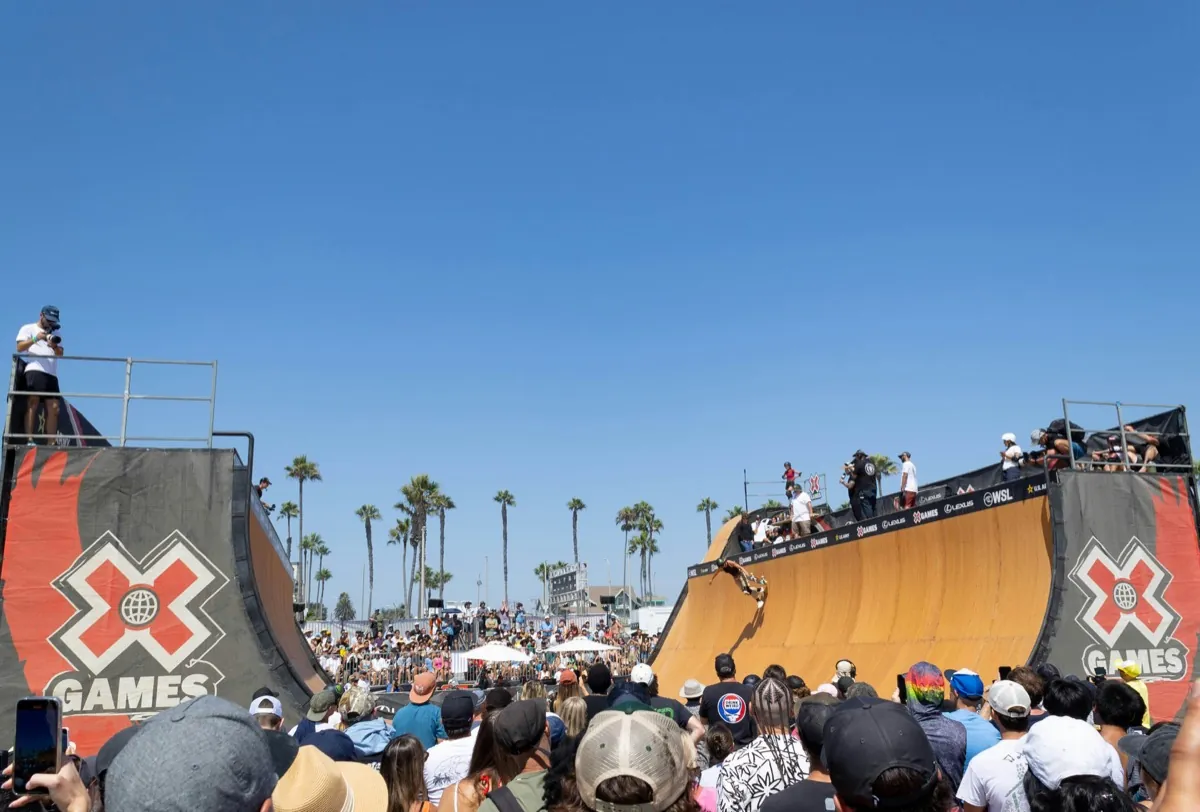
Your event isn't at a stadium.
It's at a park, a beach, or a street.
Stadiums are designed to be venues. Parks, beaches, and downtown streets aren't. When 200,000 people show up anyway, the transportation plan isn't an add-on — it's the one thing holding the event together.
FlexTram is a close-proximity onsite system. We don't run the bus from downtown Los Angeles to Huntington Beach. We don't run the shuttle from a satellite park-and-ride to a Grand Prix circuit. Those are charter bus and city transit jobs. What we do is everything that happens after the spectator arrives at the venue — on the boardwalk, along the pier, through the festival grounds, across the park. Close-proximity, short rides, inside the event footprint.
Each summer, the X Games arrive at a venue that wasn't a venue the week before. Forty-foot vert ramps are bolted together on a beachfront lot, a downtown plaza, or a stretch of city land cleared for the occasion. Grandstands rise around them. Sponsor activation zones, broadcast compounds, media risers — a full action-sports festival takes shape in three days of pre-event build, hosts tens of thousands of spectators across a long weekend, and is gone by the following week. The venue was never a venue. It was a piece of public space the city allowed to become one for seventy-two hours.
A few miles of Pacific Coast Highway south of that kind of setup, Huntington Beach hosts one of the largest surf events in the world. The US Open of Surfing pulls six-figure attendance across a nine-day run, with the pier as its beating heart and PCH functioning as the front door. The venue is a public beach. The infrastructure is the same infrastructure that serves joggers, dog walkers, and tourists the other 356 days of the year.
A few miles up the coast, the AVP Pro Beach Volleyball Tour returns to Alamitos Beach for the Long Beach Open. A temporary stadium goes up on the sand. Grandstands, hospitality tents, broadcast compounds — all bolted together in the week before the first whistle and disassembled the week after. The playing surface is sand. The spectator flow moves along the boardwalk and the beachfront bike path. Parking is a collection of neighborhood lots and meter streets.
And down in the port, four months earlier, the Acura Grand Prix of Long Beach takes over 12 blocks of downtown. A 1.97-mile street circuit loops past the Aquarium of the Pacific, the convention center, and the Long Beach Arena. Published attendance tops 180,000 spectators across the weekend. The grandstand seats fold up on Monday morning and the streets reopen to traffic. Somewhere between 8 AM Friday and 6 PM Sunday, a downtown turns into a racing venue, then turns back.
None of these events are at stadiums. None of them have gates, perimeter fencing, permanent concourses, or the ten-thousand-space parking structures that define every NFL and college football venue in America. And yet they each move crowds that would fill most pro stadiums to capacity.
This is the category nobody named: events on public infrastructure. And the transportation problems they share are categorically different from the stadium playbook.
The venue that wasn't built to be a venue
A stadium is engineered. Its gates are in the right place. Its concourses are sized for the capacity on the ticket. The parking lot has a legal capacity that matches the seating chart. ADA access is mandated, inspected, and documented.
A public beach is not engineered for 500,000 people over nine days. A downtown street is not engineered to be closed for a race weekend. A city park is not engineered to host a motorsport festival. These are spaces that were designed for something else — and which are being asked, temporarily, to host something they were not designed for.
That doesn't mean the events are bad. It means the operator is absorbing a set of constraints that the stadium playbook doesn't even recognize as constraints.
Six things that make a non-stadium venue brutal
The rules change when the venue is public. Here's what the stadium-first playbook gets wrong.
1. No perimeter, no gates, no funnel
At a stadium, fans approach from a defined direction — the parking lot or the transit station. They pass through a security gate. The operator knows, within a fifteen-minute window, when the crowd is going to hit the concourse.
On a public beach, fans arrive from eight directions. Some drive in and walk from street parking. Some Uber to the pier. Some walk up from the beach path with their surfboards. Some live two blocks away and strolled over. There is no gate. There is no funnel. There is no single metric the operator can watch to know "the crowd is arriving."
That changes the transportation problem fundamentally. A stadium shuttle runs from a defined origin to a defined destination. A beach shuttle — or a park shuttle, or a street-circuit shuttle — has to operate inside the crowd, not outside it, moving people along the spine of the venue as they enter and exit from every side.
2. The venue exists 365 days a year for something else
Schenley Park in Pittsburgh is a 450-acre public park used daily by joggers, dog walkers, golf players, picnickers, and commuters cutting through. One weekend a year, it's also the site of a vintage motorsport festival that draws roughly 100,000 spectators.
The waves at Huntington Beach are surfed every morning. The boardwalk at Long Beach is biked every evening. The streets the Grand Prix runs on are commuter arteries every other weekend of the year.
This creates a political layer that stadium operators never face. The local residents who live next to the venue have standing. The city council that issues the permit is elected by them. The neighborhood impact — noise, parking, traffic, trash — shows up at public meetings long before the event does, and again long after.
Baltimore learned this the hard way. The Baltimore Grand Prix ran from 2011 through 2013 on a downtown street circuit, drew large crowds, and was quietly discontinued after the city declined to renew the event agreement. Residents, businesses, and city services had had enough of the weekend-long disruption. A stadium would never have faced that problem. A public street did.
3. Terrain you can't brute-force
A stadium parking lot is asphalt. A beach is sand. A city park is a mix of paved paths, gravel, dirt, and turf. A downtown street is pavement, but it's interrupted by streetcar tracks, manhole covers, curb cuts, and temporary event barriers.
You cannot solve a terrain problem by ordering more buses. A 54-passenger motorcoach cannot operate on sand, cannot navigate a park trail, and cannot safely crawl through a temporary street-circuit fan zone. The tools that work at a stadium — big buses, long shuttle loops, dedicated transit lanes — simply don't apply.
This is where the small-footprint, ADA-compliant tram earns its position in the toolkit. It operates on boardwalks. It handles hills. It navigates temporary pavement. It fits through gaps a coach cannot.
4. The spine is linear — the pier, the boardwalk, the trail
A stadium concourse is a loop. A pier is a line. A boardwalk is a line. A park trail is a line. A street circuit is a line that turns back on itself.
That linear circulation constraint changes everything about how a transportation system has to be built. You can't put pickup stops on the "north side" and "south side" of a beach — the beach has one side. You can't loop around a pier — there's only one way out. The system has to move in both directions along a single spine, with enough capacity to absorb surges when an event ends or a wave window peaks.
Stadium transit planning rarely deals with linear-only circulation. Temporary-venue transit planning deals with almost nothing else.
Planning an event on public infrastructure?
We build close-proximity transportation systems for temporary venues — parks, beaches, streets, and public spaces where the stadium playbook doesn't apply. Let's walk your footprint.
5. The permit stack is a second full-time job
Before a single transportation vehicle turns a wheel, the operator of a public-infrastructure event is dealing with a permit stack the stadium playbook never touches. City transportation departments. Police departments. Fire marshals. Coastal commissions, at beach events. Parks and recreation boards, at park events. Neighborhood councils. Business improvement districts. State DOTs, when the event touches a state highway.
Each of them has a checklist. Each checklist has a transportation component. The Coastal Commission wants to know what the shuttle staging plan does to beach access. The neighborhood council wants to know where the Uber pickup zones go. The fire marshal wants to know where the emergency vehicles can get through.
A system that's been planned before permits get written fares much better than a system that gets bolted on after the event date is locked. The operators who win the multi-year event contracts tend to be the ones who show up at the planning table with a transportation plan already documented — because the city officials have already raised the questions the plan answers.
6. ADA compliance is exponentially harder
At a stadium, ADA compliance has thirty years of built infrastructure behind it. Dedicated parking. Elevators. Ramps. Wayfinding signage. Usher-staffed mobility assistance programs. All of it inspected and documented.
At a temporary venue, none of that exists. Sand is not ADA-accessible. A grass field is not ADA-accessible. A narrow boardwalk crowded with 50,000 spectators is barely pedestrian-accessible, let alone wheelchair-accessible. The mobility-impaired guest planning to attend a beach festival or a city-park event faces obstacles that simply don't exist at a stadium — and the operator who hasn't solved for those obstacles in advance is going to have a rough 72 hours.
This is why every FlexTram is ADA-compliant as standard. Not as an upgrade, not as a special request, not as a separate fleet. The same vehicle carrying general-admission spectators also carries mobility-impaired guests. There is no 48-hour advance notice. There is no "mobility shuttle in the outer lot." There is one fleet, doing one job, serving everyone.
What a transportation system looks like when there's no permanent anything
Building a transit plan for a temporary venue starts from a different blank page than building one for a stadium. There is no existing transit map. There is no existing parking structure. There are no existing ADA routes. Everything is designed around the event and torn down after it.
Which means the event operator is, for the duration of the event, the transit authority for the venue. That's a responsibility the stadium playbook never prepares you for.
The system that works tends to share a few traits:
Arrival data, not capacity assumptions. You don't know when a crowd is going to hit a beach event the way you know when an NFL gate is going to open. You have to study patterns — tide charts at surf events, heat forecasts at park events, street closure schedules at motorsport events — and plan the system around the actual shape of the crowd, not the total number on the attendance projection.
Linear route architecture, not looped concourses. The spine of the event — the pier, the boardwalk, the trail, the closed street — becomes the primary transit route. Vehicles move in both directions with posted stops at each major activation zone. Fans learn the rhythm of the system in the first half-hour and rely on it for the rest of the event.
ADA as the default, not the exception. If every vehicle is accessible, the planning problem disappears. No routing around wheelchair users. No separate dispatch. No 48-hour notice. A beach festival that can carry any spectator on any vehicle is a beach festival that just solved its hardest operational problem.
Sponsorship inventory that didn't exist before. A branded tram running a seven-mile daily loop on the Huntington Beach boardwalk is one of the highest-impression advertising surfaces in Southern California during the week of the event. The operator who packages that into the title-sponsor deal recovers a meaningful share of the transportation line item. The operator who runs unmarked golf carts does not.
Wayfinding built into the vehicle. At a stadium, the signage budget has thirty years of institutional memory behind it. At a public beach, the operator is putting up signs that come down on Sunday night. A branded tram running a predictable route is itself a sign — the most effective sign, in many cases, because it's moving along the exact path the spectator needs to follow.
The category nobody has named yet
Event operators working at stadiums have a vocabulary. They have vendors. They have trade publications. They have conferences with other stadium operators. The problems are known, the solutions are documented, and the playbook passes from one venue to the next.
Event operators working at public beaches, city parks, downtown streets, and waterfront venues have much less of that. The events they run are wildly different from each other — a surf festival is not a Grand Prix is not a vintage motorsport weekend is not a volleyball open — but the operational constraints they share are remarkable.
No perimeter. No permanent infrastructure. 365-day coexistence with the public. Political permit stack. Unusual terrain. Linear circulation. ADA built from scratch.
That's a category. It just hasn't been named yet. Call it "public-infrastructure events" or "temporary venues" or "non-stadium outdoor events" — the label matters less than the recognition that these events share a problem set the stadium industry doesn't write about.
The operators who start treating it as its own category — with its own playbook, its own transit model, its own sponsorship economics, and its own vendor set — tend to run smoother events, win multi-year permit renewals, and avoid the Baltimore Grand Prix ending.
The system is still the product
Last week, we wrote about the difference between buying a fleet of vehicles and engineering an event site. That distinction matters everywhere, but it matters twice as much when the venue itself is temporary.
At a stadium, you can get away with a generic shuttle plan because the venue carries half the weight. The gates are in the right place, the parking is structured, the concourses funnel the crowd. A mediocre transportation plan still produces a functional event because the building does most of the work.
At a public beach, a city park, or a downtown street circuit, the venue carries none of the weight. The building is absent. The transportation plan is the venue, for the 72 hours the event exists. If it doesn't work, the event doesn't work — and the city council notices.
Your event isn't at a stadium. The stadium playbook isn't going to save you. The operators running the best public-infrastructure events in the country aren't copying the NFL. They're building the playbook for the venue they actually have.
A bus shows up at your event. A FlexTram system is designed into it.
Frequently asked questions
What's the difference between planning onsite transportation for a stadium vs. a public park or beach?
A stadium has permanent gates, a defined perimeter, fixed parking lots, and existing ADA infrastructure. A public park, beach, or street circuit has none of that. Spectators enter from every direction, the venue doubles as public space the other 364 days of the year, and transportation has to be built in and torn down around permits, city councils, and residents.
Can FlexTram operate at events on sand or unpaved surfaces?
FlexTrams operate on firm surfaces — paved roads, boardwalks, packed gravel, event paving. We don't drive on loose sand. At beach events, the tram typically runs along the boardwalk, pier approach, or adjacent paved access routes — moving spectators along the linear spine that connects the beach to parking, transit, and hospitality zones.
How does ADA compliance work at a temporary venue with no permanent infrastructure?
It's exponentially harder than at a stadium — and that's exactly why it matters. Every FlexTram is ADA-compliant as standard, which means the same vehicle carrying spectators to the event also serves mobility-impaired guests. No separate fleet, no 48-hour advance-notice rule, no "mobility assistance shuttle" available only in the outer lot.
Does FlexTram replace the city shuttle from downtown to a park or beach event?
No. FlexTram is a close-proximity onsite system — we operate within the event footprint, not between downtown and the venue. Getting fans from a hotel block or a remote transit hub to the park or beach is a charter bus or municipal transit job. Once they arrive, FlexTram handles the last 500 yards.
Is temporary venue mobility its own category?
It's becoming one. Events held on public parks, beaches, streets, and waterfronts share a distinct set of operational constraints that don't apply at stadiums or purpose-built venues. The mobility systems that work for them look different from the ones used at permanent facilities — and the operators who plan for that specifically tend to run better events.
Explore solutions
Running an event where the venue isn't a building?
FlexTram builds close-proximity transportation systems for parks, beaches, street circuits, and every other venue that wasn't designed to be one. Let's walk your footprint and design a plan that fits the space you actually have.