The largest U.S. city without public transit
is hosting more World Cup matches
than any other city in North America.
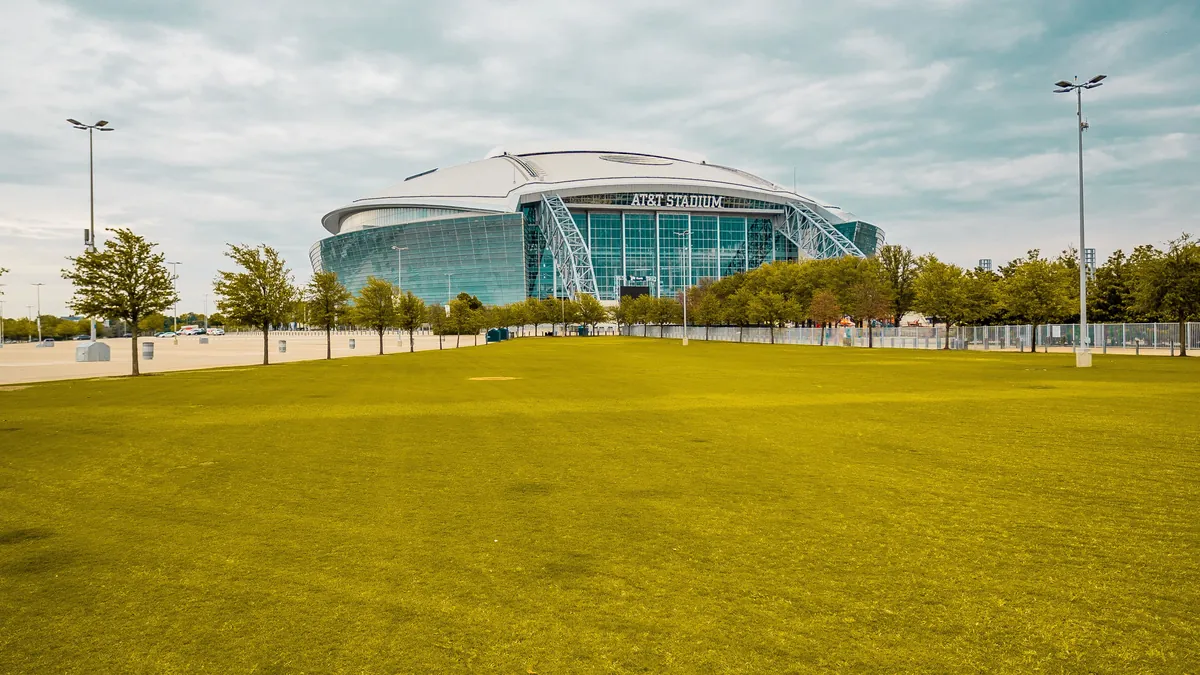
Arlington, Texas has no bus lines and no rail — yet it's hosting nine World Cup matches and a semifinal at the tournament's biggest venue. An $18 million temporary transit network gets fans to the stadium perimeter. The last half mile across a sun-baked parking lot is still a walk.
Arlington, Texas is the largest city in the United States without fixed-route public transportation. Not a single bus line. Not a single rail connection. The city has a publicly subsidized on-demand rideshare service called Via and a shuttle for older adults called Handitran — but no buses, no trains, no transit network. One urban planning analysis graded it simply: F. The stadium, the writer noted, "sits in a landscape that looks exactly how you'd expect: vast parking lots, wide arterial roads, and development designed entirely around driving." (David William Rosales)
This city is hosting nine FIFA World Cup matches this summer — more than any other city in North America. Including a semifinal. At a stadium with a World Cup capacity of 92,967 — the largest single venue in the tournament. (KickoffAdventures)
An estimated 1.2 million international visitors are expected to pass through North Texas during the tournament. Fans from Munich, London, São Paulo, Buenos Aires, and Tokyo — cities with some of the most sophisticated transit systems on Earth — are arriving in a city that was built around the automobile so completely that it never built a single bus line. (FOX 4 Dallas)
Arlington Mayor Jim Ross framed the challenge directly: "How do you get people in and out? You have people coming from all over the world to the area, and they're not familiar with here." (CBS News Texas)
The answer the region has assembled: a temporary, multi-agency transit system built from scratch for the tournament — trains, charter buses, a "bus bridge" on I-30, a dedicated transit lane, upgraded traffic signals, and a repaved parking lot with shade structures, restrooms, and water stations for fans waiting for the next shuttle.
It's an extraordinary logistical achievement. And it still ends the same way every other World Cup venue's plan ends: with the fan standing in a parking lot, half a mile from the gate, walking.
The transit plan gets you to Arlington. Then what?
Here's what the regional transportation plan looks like for match day at AT&T Stadium — renamed "Dallas Stadium" by FIFA for the tournament:
Trinity Railway Express trains run from Victory Station in Dallas and Fort Worth Central Station to CentrePort Station — the nearest rail stop, located about 6–8 miles north of the stadium. Longer trains with capacity for up to 2,400 passengers per train. From CentrePort, fans transfer to charter buses for the ride to the stadium. (NBC DFW / DART)
Charter bus shuttles carry fans from the CentrePort transfer point to a Bus Hub near the stadium. DART estimated the cost of the transit operation at $18 million. A "bus bridge" of 50 DART buses will run a directional express lane on I-30 between Victory Station and the stadium parking lot to accommodate an additional 4,000 fans if the TRE reaches capacity. (NBC DFW / DART)
Rideshare drop-off is at the Esports Stadium Arlington lot — approximately 0.7 miles from the stadium. A 10-to-15-minute walk. (CBS News Texas / NCTCOG)
Total estimated door-to-door time from Victory Station or Fort Worth Central Station to the stadium: approximately 1.5 hours. That includes 15 minutes for boarding at the TRE station, a 30-minute train ride, a 15-minute wait for the charter bus, a 20-minute bus ride to the Bus Hub, and the walk from the Bus Hub to the gate. Officials are advising fans to begin their journey up to four hours before the match. (CBS News Texas / NCTCOG)
Four hours. To travel from downtown Dallas to a stadium 20 miles away.
The regional plan is impressive in its complexity and coordination. Multiple agencies — DART, Trinity Metro, the TRE, the North Central Texas Council of Governments, the City of Arlington, and the FIFA Host Committee — have spent years assembling a temporary transit network for a city that has never had one.
But every one of these transit modes delivers the fan to the edge of the AT&T Stadium complex. From there, the fan walks. Through the parking lot. Past the Bus Hub staging area. Past the shade structures and water stations that Arlington installed specifically because they know the walk is long enough and hot enough to require them. Half a mile to the gate. In June and July. In Texas.
Arlington already told us how this ends
Here's the detail that makes this story uniquely relevant to the onsite transportation conversation: Arlington has already lived the failure of unmanaged onsite transit. And it voted 8-0 to shut it down.
In January 2020, the Arlington City Council unanimously voted to terminate its pedicab and golf cart for-hire program in the entertainment district surrounding AT&T Stadium and Globe Life Field. The program had operated for roughly a decade. It collapsed under exactly the problems that unmanaged onsite transit always produces. (CBS Texas)
Keith Brooks, Arlington's Assistant Director of Public Works and Transportation, told the council that operators were picking up and dropping off in restricted locations, driving between cars, driving on sidewalks, and that there were constant reports of verbal altercations and inappropriate behavior between operators. Both the Texas Rangers and the Dallas Cowboys formally complained. Seventy-nine citations were issued over five years. (NBC DFW)
But here's the part that matters most: after the vote, multiple council members said they were open to reconsidering the program — but only under a fundamentally different model. Several members suggested contracting with a single operator, or having the Rangers or Cowboys manage the program directly. (CBS Texas)
What they described — without using these words — was a system. A single accountable operator. Managed routes. Controlled vehicles. Venue oversight. The exact model they'd need now, six years later, for the World Cup.
As we documented in our analysis of the Arlington pedicab ban and fleet liability, the city didn't have a transportation problem. It had an operational control problem. The demand was real — pedicabs had moved over 2 million people to Rangers games alone since 2009. The service was wanted. But the model was unmanageable.
Now that same entertainment district — the same streets, the same stadium, the same complex — is hosting 92,967 fans per match for the World Cup. Nine matches. A semifinal. International visitors from 48 countries. And the city's onsite transit history is a program it voted 8-0 to kill.
The half-mile walk in the Texas heat
The regional plan gets the fan to the AT&T Stadium complex. The last half mile is the fan's problem. Let's be specific about what that half mile looks like in June and July in Arlington, Texas.
The average high temperature in Arlington in June is 94°F. In July, it's 97°F. Heat index values regularly exceed 105°F. The National Weather Service issues heat advisories for the Dallas–Fort Worth area multiple times every summer.
The walk from the Bus Hub to the stadium gate crosses a parking lot — one of the largest in professional sports. The surface is asphalt. In direct sun, asphalt surface temperatures can exceed 150°F. There is limited shade between the Bus Hub and the gate. Arlington has installed shade structures, water stations, and restrooms at the Bus Hub specifically because officials know the wait-and-walk experience will be physically demanding.
For the 92,967 fans making this walk — many of them international visitors unaccustomed to Texas heat, many of them families with children, many of them elderly — the half-mile crossing of a sun-baked parking lot isn't a minor inconvenience. It's a heat exposure event.
And post-match, the same walk happens in reverse — 92,967 fans walking half a mile back to the Bus Hub, the rideshare lot, or the parking areas, after sitting in a stadium for three hours, in the evening heat, needing to reach a shuttle that will take them to a train that will take them to Dallas. The total return journey: another 1.5 hours. Officials are advising fans to plan for four hours of total transit time per match — eight hours round trip on match days.
Planning a mega-event transportation system?
FlexTram deploys onsite transit systems for major events, tournaments, and mega-venue operations — from single-day deployments to month-long engagements. Equipment rentals, full-service operations with trained drivers, and turnkey transportation plans available.
The pattern repeats at every scale
The AT&T Stadium World Cup situation is the same pattern we've documented across every major event category — at Coachella, the Kentucky Derby, the Super Bowl, and F1. And it's the same pattern playing out simultaneously at MetLife Stadium across the country — at Hard Rock Stadium in Miami, where the rideshare lot is a 25-minute walk in triple-digit heat index, and at Houston's NRG Park, where the best regional transit of any host city still left a 350-acre campus to cross.
The event grows beyond the infrastructure. Extraordinary resources are deployed to get fans TO the venue. The last half mile — the distance between the transit node and the gate — is left to the fan's feet.
At MetLife, they spent $100 million on transit infrastructure. The last half mile is still a walk. At AT&T Stadium, multiple agencies spent $18 million on a temporary transit network built from scratch. The last half mile is still a walk.
The investment asymmetry is the story. Millions of dollars and years of planning to move fans from downtown to the stadium perimeter. Zero dollars and zero planning to move fans from the perimeter to the gate.
What a system looks like at AT&T Stadium
A tram system running inside the AT&T Stadium complex during World Cup matches addresses the gap that the $18 million regional transit plan doesn't:
Bus Hub to gate. A continuous loop from the Bus Hub — where charter buses and the DART bus bridge deliver fans — to the stadium gates. Instead of a half-mile walk across a sun-baked parking lot, the fan steps off the charter bus and onto a tram. The heat exposure drops from 15–20 minutes of walking to 2–3 minutes of riding.
Rideshare zone to gate. A dedicated route from the Esports Stadium Arlington rideshare lot — 0.7 miles away — to the stadium entrance. The fan who paid for a rideshare to avoid the 1.5-hour train journey doesn't then walk 15 minutes across a parking lot in 97-degree heat.
Post-match egress. After the final whistle, 92,967 fans need to reverse the journey — back to the Bus Hub, the rideshare lot, the parking areas. A tram running continuous post-match sweeps from the gates to every transit node keeps fans moving on a visible, scheduled route instead of streaming across a darkening parking lot trying to find a shuttle they can't see.
ADA service as default. International visitors with disabilities, elderly fans, families with young children and strollers — the populations for whom a half-mile walk in 97-degree heat is a genuine health risk — board the same vehicle as every other fan. No request. No wristband. No phone number. The system serves everyone by default.
Heat mitigation. The tram itself is the most effective heat-mitigation strategy available for the last half mile — it reduces pedestrian heat exposure from 15–20 minutes of walking on sun-baked asphalt to minutes of riding in a vehicle. No amount of shade structures and water stations in the parking lot substitutes for simply not being in the parking lot.
The system deploys for the nine-match window and leaves when the tournament ends. No permanent infrastructure. No construction. The same deployment model that works at festivals, stadiums, cruise terminals, and data center campuses works at the World Cup.
A city without transit, hosting the world's biggest event
Arlington is the most car-dependent major city in America. It has never built a bus line. It voted 8-0 to ban the only onsite transit alternative it ever had. And it's hosting more World Cup matches than any other city in North America.
The irony isn't lost on anyone. A transit analysis gave Arlington an F. The mayor himself asked the fundamental question: "How do you get people in and out?" The regional planning agency assembled a temporary transit system from scratch — trains, buses, dedicated lanes, charter services — at a cost of $18 million. All of it gets the fan to the edge of the parking lot.
The last half mile — across the same entertainment district where the pedicabs were banned, in the same Texas heat that requires shade structures and water stations just to make the walk survivable — is the gap nobody closed.
As Fortune wrote about the World Cup transit situation nationally: "not a transportation solution but a metaphor of a country improvising because it never built the thing it actually needed."
Arlington improvised at every scale. The last half mile is still waiting.
— The FlexTram Team
Frequently asked questions
What is the transportation plan for the 2026 World Cup at AT&T Stadium?
Arlington has no fixed-route public transit, so a temporary multi-agency system was built for the tournament. Trinity Railway Express trains run from Dallas and Fort Worth to CentrePort Station — 6 to 8 miles north of the stadium — where fans transfer to charter buses to a Bus Hub near the venue. A 50-bus DART "bus bridge" runs a directional express lane on I-30. Rideshare drop-off is at the Esports Stadium Arlington lot, about 0.7 miles away. DART estimated the operation at $18 million. Officials advise fans to begin their journey up to four hours before kickoff.
Why doesn't Arlington, Texas have public transportation for the World Cup?
Arlington is the largest city in the United States without fixed-route public transportation — no bus lines, no rail. It has a publicly subsidized on-demand rideshare service called Via and a senior shuttle called Handitran, but no transit network. The city was developed almost entirely around the automobile. For the World Cup, the region assembled a temporary transit system from scratch through DART, Trinity Metro, the Trinity Railway Express, the North Central Texas Council of Governments, the City of Arlington, and the FIFA Host Committee.
How far do World Cup fans have to walk at AT&T Stadium?
Every transit mode delivers fans to the edge of the AT&T Stadium complex — and from there they walk roughly half a mile across one of the largest parking lots in professional sports to reach the gate. Rideshare drop-off alone is about 0.7 miles, a 10-to-15-minute walk. Arlington installed shade structures, water stations, and restrooms at the Bus Hub specifically because the wait-and-walk in June and July Texas heat — highs of 94 to 97°F, asphalt surface temperatures over 150°F in direct sun — is physically demanding.
How could an onsite tram system improve fan experience at AT&T Stadium?
A tram running continuous loops inside the complex closes the gap the $18 million regional plan doesn't. Fixed routes from the Bus Hub and the rideshare lot to the gates turn a half-mile walk across sun-baked asphalt into a 2-to-3-minute ride. Post-match sweeps keep 92,967 fans moving on visible, scheduled routes to every transit node instead of streaming across a darkening parking lot. ADA service is the default — elderly fans, families with strollers, and international visitors with disabilities board the same vehicle as everyone else. The tram is itself the most effective heat-mitigation strategy available for the last half mile.
Can a tram system be deployed temporarily for the World Cup at AT&T Stadium?
Yes. FlexTram deploys onsite transit systems for single-event, single-week, and multi-month engagements — without permanent infrastructure, construction, or disruption to the venue's normal operations. The same deployment model that runs at festivals like Coachella and Bonnaroo, at NASCAR weekends, at golf tournaments, and at industrial campuses works for the nine-match Arlington window. Vehicles store onsite during the tournament and leave at tear-down. Equipment rentals, full-service deployments with trained drivers, and turnkey transportation plans are all available.
Related reading
The last half mile is the gap between getting to the event and being at the event.
FlexTram deploys onsite transit systems for major events, tournaments, and mega-venue operations — from single-day deployments to month-long engagements. Equipment rentals, full-service operations with trained drivers, and turnkey transportation plans available.