You can't buy availability
one cart at a time.
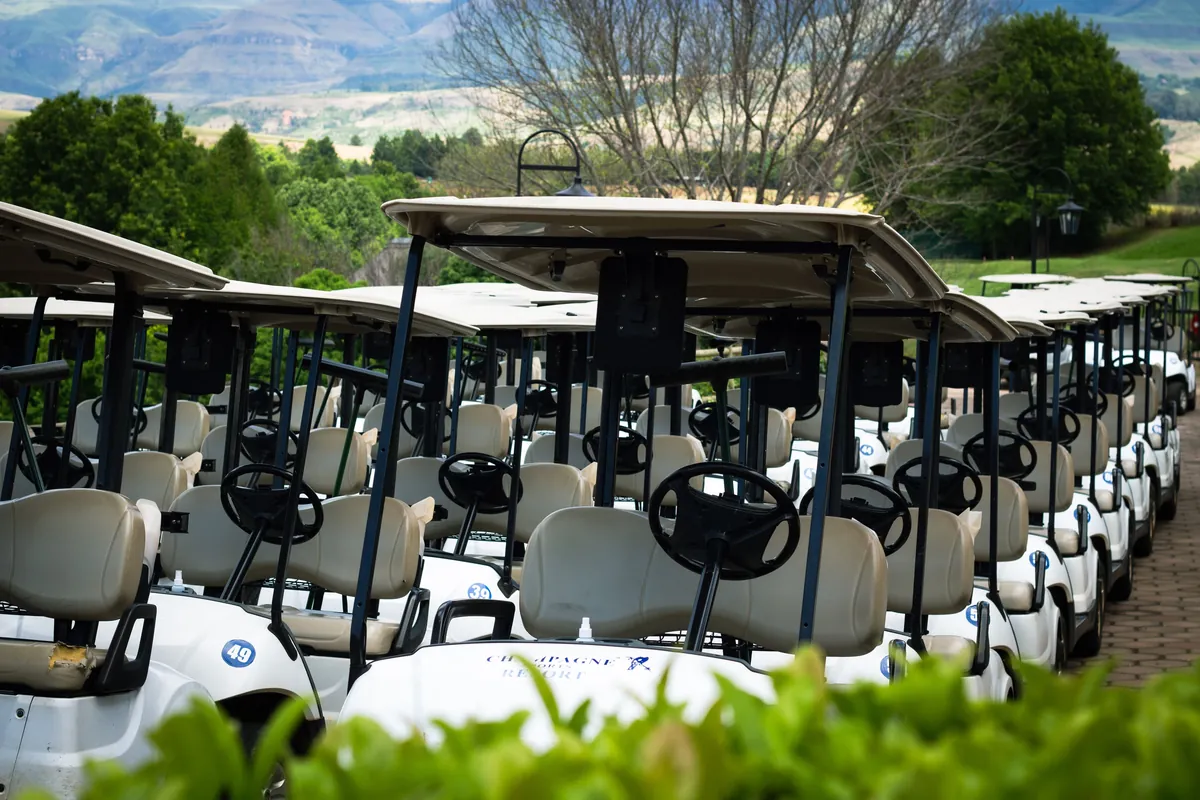
Most cart fleets aren't a capacity decision. They're a ghost — the accumulated residue of every complaint the property ever tried to answer one vehicle at a time. And you cannot accumulate your way to availability.
At one Southern California mega festival, the golf cart inventory had grown to over 1,300 vehicles.
Nobody decided that. There was never a meeting where someone proposed a 1,300-cart fleet. It accumulated — a cart at a time, each one added for a good reason. A department needed its own. A guest complained about a wait. An ADA request went unfilled on a Saturday and somebody said let's add two more. Over years, that's how you get to 1,300.
We took 8 FlexTrams onto that site and supplanted roughly 300 of those carts.
Not because our vehicles are 37 times bigger. They aren't — the honest vehicle math is about five carts to one tram. On a pure capacity swap, 300 carts is 60 trams. It wasn't 60. It was 8.
The other 52 didn't exist because of the vehicle. They disappeared because someone finally ran a program efficiency study on that site — parking data, ingress and egress modeling, actual paths of travel, and where people genuinely needed to board — and built an operations plan from what it found. Most of that fleet segment was never moving anyone. It was moving air, on trips nobody had ever measured, from places nobody had ever mapped.
That's the finding. Most cart fleets are not a capacity decision. They're a ghost — the accumulated residue of every complaint the property ever tried to answer one vehicle at a time.
The complaint arrives at the wrong desk
Here's how the ghost gets built.
Guest expectation rises — and it should. Properties got bigger. The population aged. And the property itself made a promise: just call us and we'll take care of it. So guests call.
The complaint lands at guest services. At a resort, it lands at the concierge desk. At a stadium, it lands at the ADA services line. And the complaint is almost always the same one:
Why isn't this more available?
Now watch what happens next, because this is the whole story. The person receiving that complaint has exactly one lever. Dispatch — the call-and-wait model — has precisely one way to increase availability: add another vehicle.
Ten carts become twenty. Twenty become thirty. Thirty become forty. Every cart is a driver you have to recruit, vet, train, insure, schedule, supervise, fuel, store, and maintain. Every cart is a unit of liability moving through a pedestrian crowd. And as we documented in The Labor Problem Nobody Talks About, every driver is a hiring problem that recurs every single season — against a 15% no-show rate and 63% annual churn.
And here's the trap: it still isn't available at peak.
Because dispatch has a wait-time floor that no fleet size can beat. When 4,000 people want the same trip in the same 30-minute window, a bigger fleet of individually dispatched vehicles doesn't produce a shorter wait. It produces more vehicles in the same congestion, competing for the same lanes, driven by more people you couldn't properly train because there were forty of them.
So you bought forty carts, hired forty drivers, and the complaint didn't go away.
That's not a failure of execution. It's the model working exactly as designed. You cannot accumulate your way to availability.
Wondering what your real number is?
FlexTram begins every deployment with a program efficiency study — parking data, ingress and egress modeling, paths of travel, and boarding placement — and delivers an operations plan before a single vehicle arrives. Equipment rentals, full-service deployments, and turnkey plans available.
The transit industry settled this decades ago
Here's the part that should stop every venue operator: this isn't a novel problem. It's one of the most thoroughly measured questions in American public transportation, and it has a name.
Dispatch is paratransit. Scheduled routes are fixed route. And the economics are not close.
The GAO's analysis of ADA paratransit found the estimated cost of an ADA paratransit trip was $29.30, against $8.15 for a fixed-route trip — a difference the GAO noted was statistically significant. (U.S. Government Accountability Office, GAO-13-17) Those figures are from 2012; more recent National Transit Database reporting puts demand-response service well above that range, so the gap has held or widened, but the ratio is the point.
The FTA found something more alarming. Between 1999 and 2012, demand for ADA paratransit grew from 68 million trips per year to 106 million. Over that same period, the average nationwide cost per trip rose from $13.76 to $32.74. (Federal Transit Administration, Accessible Transit Services for All)
Read that twice. Demand went up. And the cost of serving each individual trip went up with it.
That is the availability trap, measured at national scale, in federal data. In a scheduled system, rising demand lowers your cost per trip — you're filling seats you were already running. In a dispatch system, rising demand raises it. Growth makes scheduled service more efficient. Growth makes dispatch more expensive.
And the load it puts on the operation is wildly out of proportion to the people it serves. Eric Gonzales, a civil engineering professor at UMass Amherst, summarized the NTD data plainly: paratransit customers represent five to seven percent of overall demand but twenty to twenty-five percent of operating costs. He also described demand-responsive door-to-door service as "the most expensive service provided by public transit agencies today." (Northwestern University Transportation Center)
Now here's the crucial part. Transit agencies still run paratransit — because federal law requires it as a complement to fixed-route service. Not as a replacement for it. Never as the whole system. No transit planner alive would design a network where demand-response dispatch was the only way to move anyone.
That is precisely what most venues have built.
Your ADA cart program is paratransit. Your on-request guest cart is paratransit. You've made the most expensive mode in transportation into your primary mode — and then you're surprised that scaling it is unaffordable.
Three venues. Three ways it breaks.
Dispatch fails everywhere, but it fails differently depending on what the property asks of it.
At resorts, it fails on duration. The guest isn't there for four hours — they're there for four days. Room to breakfast. Room to pool. Pool to lunch. Room to convention wing. Room to dinner. That's eight or ten trips per guest, per stay, repeated across every guest on property. Atlantis Paradise Island spans 154 acres with four separate hotel towers, a waterpark, a marine habitat, and a casino. A guest sleeping in one tower and eating in another makes that trip every day of their stay. No concierge desk on earth dispatches that. So it doesn't — and the property quietly outsources the problem to the guest's wallet, renting them a scooter by the day and calling it accessibility.
At stadiums, it fails on simultaneity. Everyone needs the identical trip in the identical 90-minute window, and then again in a 30-minute window after the whistle. The Buffalo Bills' ADA program asks guests to call or text a number for a golf cart ride from one of five pickup locations — and post-game, service runs to "a limited number of designated drop-off locations on the North and South side of the stadium only." (Buffalo Bills Accessibility Guide) Clemson runs ADA bus shuttles that "make multiple runs until all ADA fans with wristbands have been delivered," departing "as soon as buses are full." (Clemson Athletics) That is an organization telling you, in writing, that it cannot say when the service ends. Not because they're careless — because dispatch genuinely cannot answer that question.
At convention centers, it fails on repetition. The attendee makes the same trip four times a day for four days. Sixteen trips. Nobody calls a services desk sixteen times. So they don't call at all. They walk — and they skip the exhibitor at the far end of the hall, and they arrive late to the breakout, and they eat at the food court instead of the restaurant they wanted.
Duration. Simultaneity. Repetition. Three failure modes, one cause: dispatch is demand-response, and every one of these properties has entirely predictable demand. You don't dispatch against predictable demand. You schedule against it. That's not an opinion — it's the first thing you learn about moving people.
Dispatch undercounts its own demand
Now the most dangerous part, and the reason this never gets fixed.
Dispatch systematically hides how much demand it's failing to serve.
The guest who called the ADA line, waited twenty minutes, and walked instead does not appear in your ridership data. The attendee who never called because they weren't going to call sixteen times does not appear. The 78-year-old who didn't want to explain her knees to a stranger at a desk does not appear. The guest who asked the concierge how to get to the restaurant, got a map, and made the walk does not appear.
Your ADA program shows 40 trips per event. Leadership looks at 40 trips and concludes the program is correctly sized.
It isn't. Forty is not your demand. Forty is your capacity — and in a dispatch model, those numbers are indistinguishable, because the only demand that gets recorded is the demand you happened to be able to serve.
This is where the concierge desk becomes the most important data source on the property — and the least equipped to act on it. The concierge knows exactly how big the on-property mobility problem is, because the question lands on them all day long. And their toolkit is built for the wrong geography: they can put a car at the door for a restaurant ten miles away in four minutes. They cannot get that same guest to the restaurant four hundred yards away, except by pointing.
So: the concierge has the demand signal and no vehicle. ADA services has the vehicle and a mandate narrow enough that only people willing to self-identify can use it. Neither one has a system.
Two desks. Two budgets. Two queues. One problem that neither can see whole.
What merging them actually looks like
Put one route network underneath both.
The ADA guest and the guest who simply doesn't want to walk a quarter mile to dinner board the same vehicle, at the same stop, on the same posted schedule. Not a special service. The general service — which happens to be accessible, because as we argued in 28 Million People Will Need Accessible Transportation by 2030, accessibility as a standard feature is the only version that scales with the demographics headed our way.
That collapses the dignity problem entirely. Nobody self-identifies. No wristband, no phone number, no explaining your mobility to a stranger. The 82-year-old and the guy running late take the same tram. Compliance stops being a service you provide on request and becomes a property of your infrastructure.
The concierge stops being a dispatcher and goes back to being a concierge — recommending the restaurant instead of arranging the cart to it.
And ADA services stops being a fleet operator. Their job becomes making sure the system is accessible, which is a far better use of that team than driving the exception vehicle.
Two half-funded programs — each too small to work, each hitting the same ceiling from a different direction — become one system that costs less than the sum and does more than either. As we detailed in You're Already Paying for Transportation, You're Just Calling It Something Else, the money is on the P&L already. It's just scattered across two departments that have never compared notes.
The product isn't the tram. It's the operations plan.
Here's what the 300-cart festival actually taught us, and it's the least self-serving thing in this entire post:
Nobody knows their real number until someone measures it.
The property that thinks it needs 40 carts might need 6 trams. Or it might need 4 trams and a boarding location moved 200 feet. Or it might discover that a third of its fleet exists to serve a path of travel that stopped being used when a gate was relocated two seasons ago.
You cannot find that out by adding carts. Adding carts is the ritual that produced the 300 in the first place — each one a local fix for a global problem, each one making the number worse and the wait the same.
You find it out with a program efficiency study. Where does parking actually fill, and in what order? What does ingress look like in the first 40 minutes versus the last 40? Where are people genuinely walking, as opposed to where the map says they walk? Where should someone be able to board so the route serves the demand instead of the org chart?
What comes out of that study isn't a recommendation to buy vehicles. It's an operations plan — routes, schedules, boarding placement, vehicle count. The vehicle count is the last thing you learn, not the first thing you decide.
Eight trams supplanted 300 carts at that festival. Five to one was the vehicle. The operations plan was everything else.
The ceiling is structural
Every property that keeps adding carts is having the same conversation on a loop. Availability isn't good enough. Add vehicles. Availability still isn't good enough at peak. Add vehicles. Repeat until you own 300 carts and a recruiting crisis and an insurance premium nobody has unpacked and the exact same complaint you started with.
The ceiling isn't a budget problem or an execution problem. It's structural. Dispatch cannot produce availability at peak, at any fleet size, because that is not what dispatch does. It answers one request at a time — beautifully, when there are few requests, and never, when there are many.
The transit industry has known this since before any of us were born. Cities run paratransit as a complement and fixed route as the system, because a century of data says that's the only arrangement that works.
Your property has predictable demand, known origins, known destinations, and a peak you could set your watch by.
Stop dispatching against it. Install a system underneath it.
— The FlexTram Team
Frequently asked questions
Why do venue and resort golf cart fleets keep growing?
Because dispatch — the call-and-wait model — has exactly one lever for increasing availability: add another vehicle. Every guest complaint about wait times, every unfilled ADA request, every department that wants its own cart is answered the same way, one vehicle at a time. Nobody decides to build a 300- or 1,300-cart fleet; it accumulates over years, each cart added for a locally good reason. The result is a fleet sized to the number of complaints the property has tried to answer, not to measured demand.
What is the difference between paratransit and fixed-route service, and why does it matter for venues?
Paratransit is demand-response, door-to-door dispatch — a rider requests a trip and a vehicle is sent. Fixed route is a scheduled service running set routes on a posted timetable. The cost difference is large and well documented: the GAO estimated an ADA paratransit trip at $29.30 versus $8.15 for a fixed-route trip. A venue's on-request ADA cart program and on-demand guest cart are structurally paratransit — the most expensive mode in public transportation — used as the primary system. Transit agencies run paratransit only as a legally required complement to fixed route, never as the whole system.
Why can't a bigger golf cart fleet fix availability at peak times?
Dispatch has a wait-time floor that no fleet size can beat. When thousands of people want the same trip in the same 30-minute window, a larger fleet of individually dispatched vehicles doesn't shorten the wait — it puts more vehicles in the same congestion, competing for the same lanes, driven by more people who couldn't be properly trained because there were so many of them. Growth makes scheduled service cheaper per trip because you fill seats you were already running; growth makes dispatch more expensive per trip. You cannot accumulate your way to availability.
What is a program efficiency study?
It is the measurement step that comes before any vehicle decision: parking data and the order lots actually fill, ingress and egress modeling, real paths of travel versus where a map assumes people walk, and where guests genuinely need to board. The output isn't a recommendation to buy vehicles — it's an operations plan: routes, schedules, boarding placement, and vehicle count. The vehicle count is the last thing you learn, not the first thing you decide. It's how a property discovers whether it needs 40 carts, 6 trams, or 4 trams and a boarding location moved 200 feet.
How did 8 FlexTrams replace 300 golf carts at one venue?
At one Southern California mega festival with an accumulated fleet of over 1,300 carts, 8 FlexTrams supplanted roughly 300 of them. The honest vehicle math is about five carts to one tram, so a pure capacity swap of 300 carts would be about 60 trams — not 8. The other 52 vehicles didn't disappear because of the tram; they disappeared because a program efficiency study found that most of that fleet segment was never moving anyone. It was running trips nobody had measured, from places nobody had mapped. Five-to-one was the vehicle. The operations plan was everything else.
Related reading
Stop dispatching against predictable demand. Install a system underneath it.
FlexTram begins every deployment with a program efficiency study — parking data, ingress and egress modeling, paths of travel, and boarding placement — and delivers an operations plan before a single vehicle arrives. Equipment rentals, full-service deployments with trained drivers, and turnkey transportation plans available for resorts, stadiums, convention centers, and campuses of any size.