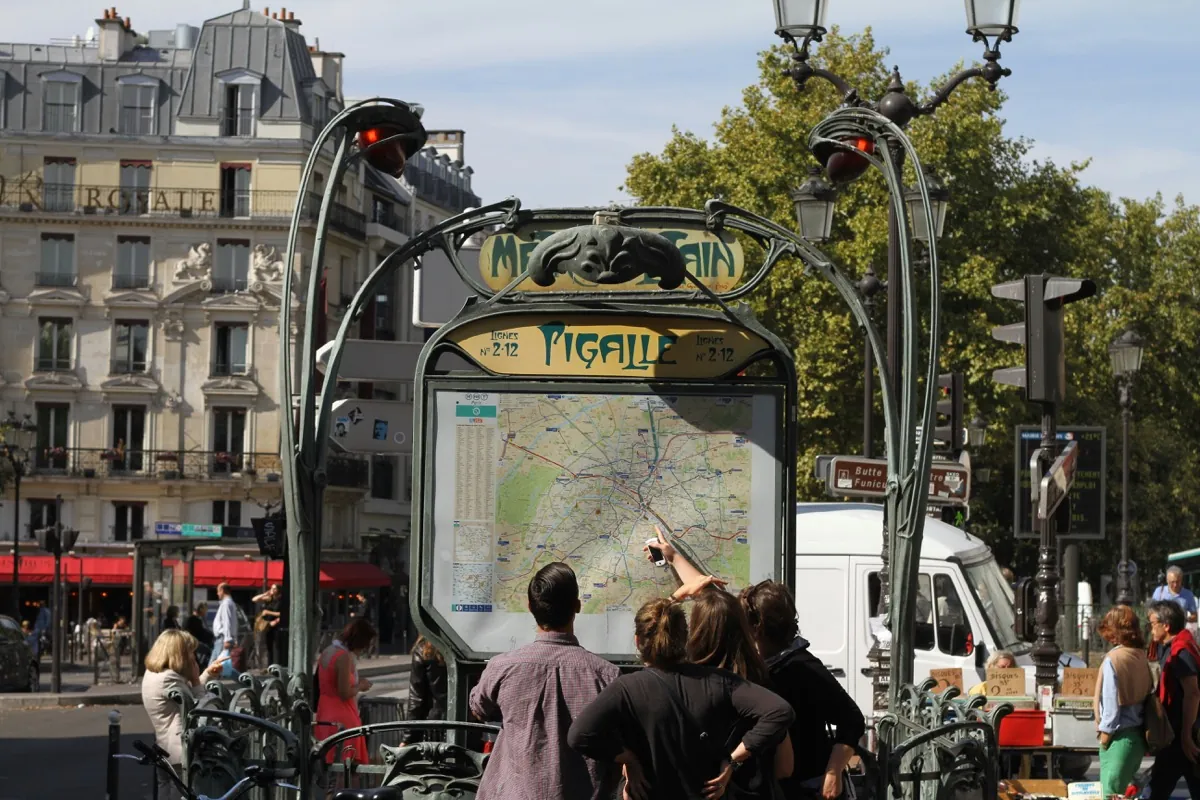
Cities solved this 100 years ago.
Why haven't venues?
In 1897, Boston opened the first subway tunnel in America. The problem it solved was simple: too many people needed to move across the same geography at the same time, and the existing approach — individual vehicles on shared roads — couldn't handle the volume.
That principle hasn't changed in 130 years. Every city in the world that works — that moves millions of people daily without gridlock consuming the entire system — does so because someone, at some point, made a decision: we need to stop asking everyone to move themselves individually, and start moving them collectively, on fixed routes, with posted schedules, at predictable intervals.
Fixed-route transit is, as one industry analysis describes it, "the backbone of a healthy mobility ecosystem." It provides "unparalleled efficiency, and boasts the ability to move masses of people while cutting through crowded corridors." (TransLoc)
The design principles are well understood. You study where people need to go. You identify the highest-demand corridors. You deploy vehicles with enough capacity to serve the volume. You run them on predictable schedules so riders know when the next one is coming. You place stops at logical boarding points. You make the system accessible to everyone. And you do all of this instead of asking every individual to figure out their own way from Point A to Point B.
These aren't controversial ideas. They're the foundation of how every functioning city on Earth moves people.
Now walk into any live event venue, any racing circuit, any festival ground, any stadium campus, any cruise terminal, any data center construction site — and ask: where's the transit system?
The venue is a city. It just doesn't know it yet.
Consider the numbers.
A major NASCAR weekend draws 150,000+ fans to a facility spanning 1,000+ acres. A music festival puts 100,000 people on a temporary campus for three to four days. A cruise terminal processes 10,000 passenger movements in six hours. A data center construction site has 3,000–5,000 workers arriving and departing across shift changes on a 200-acre campus. A stadium hosts 70,000 fans who park in satellite lots half a mile from the gate.
These aren't small gatherings. These are temporary cities — with populations that rival mid-sized towns, compressed into footprints that demand the same mobility planning any urban environment would require.
And yet, the transportation approach at most of these venues looks nothing like what a city planner would design. It looks like what happens when nobody plans at all.
Instead of fixed routes, there are ad hoc golf cart dispatches. Instead of posted schedules, there's a radio call to someone who may or may not be available. Instead of high-capacity vehicles running efficient loops, there are fleets of 4-seat carts making individual trips — the transportation equivalent of putting everyone in a taxi instead of building a bus line. Instead of accessible service as standard, there's a courtesy cart that "may involve a wait during peak times."
The principles that make cities work — consolidation, predictability, capacity, accessibility — are completely absent from the venues that need them most.
The transit planner's toolkit, applied to a parking lot
Urban transit planning uses a handful of core concepts that translate directly to venue-scale transportation. Every city planner in the world would recognize these. Almost no venue operator has applied them.
Fixed routes along high-demand corridors
In a city, that's a bus line connecting a residential neighborhood to a business district. At a venue, it's a tram loop connecting the remote parking lot to the main entrance, or the campground to the stage, or the parking garage to the terminal building. The corridor is defined by where the most people need to go. The route is fixed so riders know where to find it. The vehicle runs the same path every time so the system is predictable.
Scheduled frequency, not on-demand dispatch
Urban transit works because you know the next bus is coming in 8 minutes, not "whenever someone radios for one." The reliability of the schedule is what makes people use the system instead of walking or driving. At a venue, the same principle applies: a tram that arrives every 5 minutes at a posted stop is a system people trust. A golf cart that might show up if you can find someone to call is not a system — it's a hope.
High-capacity vehicles replacing low-capacity individual trips
A city bus carrying 40 passengers replaces 30+ single-occupancy vehicles. That's the entire economic and efficiency argument for public transit. At a venue, a tram carrying 27 passengers replaces 5–10 golf carts and their drivers. The math is identical. The consolidation ratio is identical. The reduction in vehicle congestion, driver payroll, and operational complexity is identical.
Accessibility built into the system, not bolted on
The ADA requires that public transit systems be accessible. Buses have ramps. Trains have level boarding. The accessibility isn't a special service you request — it's how the system works for everyone. At most venues, accessibility is a separate operation: a dedicated cart, a different phone number, a different wait time. Building accessibility into the primary system — the way every city transit agency is required to — eliminates the two-tier experience.
Consolidated pedestrian flow reducing conflict
One of the fundamental benefits of urban transit is that it consolidates pedestrian movement. Instead of thousands of people walking dispersed, unpredictable paths through vehicle traffic, riders board and alight at designated stops. The conflict points between pedestrians and vehicles are reduced because foot traffic is channeled through the system. At a venue — where pedestrian-vehicle conflict is a real safety concern during shift changes, post-event egress, and loading dock operations — the same principle applies with the same results.
Why golf carts are the equivalent of everyone driving their own car
The parallel is almost too clean.
In urban transit terms, a golf cart fleet at a venue is the equivalent of a city with no bus system where everyone drives their own car. Every trip is individual. Every vehicle carries a fraction of its potential passengers. The roads (or paths, or lots) are clogged with low-capacity vehicles making redundant trips. Nobody knows where anyone else is going. There's no coordination, no consolidation, no system — just units pretending to add up to one.
Transit planners have a term for what happens in that environment: they call it "congestion caused by excessive reliance on single-occupancy vehicles." The solution, universally, is to introduce higher-capacity shared transit on fixed routes.
That's exactly what replacing a golf cart fleet with a tram system does. It's the venue-scale version of introducing a bus line into a car-dependent city. The fleet size shrinks. The vehicle count drops. The driver count drops. The capacity per trip increases. The coverage becomes predictable. And the system serves more people, more efficiently, with fewer resources.
The transit world has been optimizing this math for a century. The event and venue world hasn't applied it yet — not because the math is different, but because nobody framed the problem in these terms.
With one notable exception. The biggest national parks did apply it — Zion made an internal shuttle the mandatory way to see its canyon in 2000, and 95 million boardings later the case is closed. What hasn't happened is right-sizing that model for the hundreds of state and regional parks that will never see a federal transit grant.
Ready to plan your venue like a transit system?
We work with venues, events, and campuses to replace ad-hoc golf-cart fleets with fixed-route, posted-schedule transit systems — designed around demand corridors, not around vehicle count.
The "last mile" problem — except it's the first mile
Urban planners spend enormous energy on what they call the "last mile problem" — the gap between where public transit drops you off and where you actually need to be. It's the walk from the bus stop to your office. The distance from the train station to your apartment. The stretch that transit doesn't cover because the infrastructure ends before the destination does.
At venues, the problem is inverted. It's the first mile — the gap between where you park and where the experience begins. The walk from the remote lot to the gate. The trek from the campground to the stage. The distance from the shuttle drop-off to the grandstand.
Cities solve the last mile with circulators, microtransit, bike-share, and pedestrian infrastructure. They study the gap, measure it, and deploy solutions scaled to the demand.
Venues mostly just accept it. "The walk is part of the experience." "Fans don't mind." "We have golf carts if someone really needs one." These are the venue equivalents of a city saying "we don't need a bus system — people can just drive."
The urbanist who studies the last mile problem and the venue operator who manages a 150,000-person campus are working on the same problem at different scales. The difference is that the urbanist has a century of institutional knowledge, design principles, and proven solutions to draw on.
The venue operator has a fleet of golf carts and a radio.
What a transit-designed venue looks like
Imagine applying real transit planning principles to a venue campus.
You start with a demand study. Where do people arrive? Where do they need to go? What are the peak volumes and when do they occur? What are the accessibility requirements? These are the same questions a transit planner asks when designing a new bus route.
You design fixed routes along the highest-demand corridors — parking to entrance, entrance to key destinations within the venue, destinations to each other. The routes are mapped, posted, and visible. Every patron knows where to board and where they'll be dropped off.
You deploy vehicles sized to the demand — not 4-seat golf carts making individual trips, but 27-passenger trams running continuous loops during peak periods. One vehicle, one driver, replacing five carts and five drivers while moving more people per hour.
You publish a schedule. The tram runs every 5 minutes during ingress, every 8 minutes during the event, and every 3 minutes during egress. Riders can plan around it. They don't have to call anyone or flag anyone down.
You build accessibility into the route, not into a separate program. The tram is accessible. The stops are accessible. Every patron, regardless of mobility, uses the same system.
And you brand it. You turn it into an asset — a sponsorable, photographable, experience-enhancing piece of infrastructure that generates revenue instead of just consuming it.
That's not futuristic. That's just transit planning applied at venue scale. Cities have been doing this for over a century. The principles are proven. The math works. The only thing that's been missing is a vehicle designed specifically for the spaces where venues operate — the gravel, the grass, the tight turns, the temporary surfaces, the pop-up deployments that go live in hours and store when the event ends.
The vehicle cities don't have — and venues need
Here's where the parallel between urban transit and venue transit diverges: the vehicles are different.
A city bus is 40 feet long, weighs 30,000 pounds, and requires paved roads with curb infrastructure. It's engineered for urban streets. It doesn't work in a parking lot, on a festival campground, across a construction site, or through a cruise terminal dock area.
A golf cart works in those spaces — but it's not a transit vehicle. It carries 4–6 people. It has no fixed route capability. It's dispatched individually. It's the venue equivalent of a taxi, not a bus.
What was missing — until recently — was the vehicle that bridges the gap: high enough capacity to function as transit (not individual dispatch), small enough to operate in venue-scale spaces (not urban roads), and flexible enough to deploy on temporary surfaces without permanent infrastructure.
That's what FlexTram builds. A 27-passenger vehicle with independently turning axles that operates on asphalt, gravel, dirt, grass, and sand. It runs fixed routes with posted schedules. It's ADA-accessible as standard. It deploys in hours and stores compactly when the event ends. It's the transit vehicle that venues have needed but cities never had to build — because cities have roads, and venues have parking lots.
The design principles of urban transit are a century old. The vehicle that makes those principles work at venue scale is new. The combination of the two is what turns a parking lot full of golf carts into an actual transportation system.
Frequently asked questions
What is fixed-route transit and why does it matter for venues?
Fixed-route transit runs predetermined paths on posted schedules with high-capacity vehicles. It's the backbone of every functioning city in the world. At a venue, the same principles apply: a tram running a defined loop between the parking lot and the gate, every 5 minutes, with known capacity, is a system guests can plan around. A dispatched golf cart is not. The urban transit design principles — consolidation, predictability, capacity, accessibility — translate directly to venue-scale campuses that move 70,000 to 150,000 people.
Why are venues described as "temporary cities"?
A major NASCAR weekend draws 150,000+ fans across 1,000+ acres. A music festival puts 100,000 people on a campus for three to four days. A stadium hosts 70,000 fans who park half a mile from the gate. These are population densities that rival mid-sized towns, compressed into footprints that demand the same mobility planning any urban environment would require. The scale is cityscale. The transportation planning usually isn't.
What is the "first mile" problem at a venue?
Urban planners call it the "last mile" — the gap between where transit drops you off and where you actually need to be. At venues, the same gap exists but inverted: the first mile is the distance between where you park and where the experience begins. The walk from the remote lot to the gate, from the campground to the stage, from the shuttle drop-off to the grandstand. Cities solve the last mile with circulators, microtransit, and pedestrian infrastructure. Most venues accept the first-mile gap as "part of the experience" instead of designing against it.
How is a golf cart different from a transit vehicle?
A golf cart is the venue equivalent of a taxi. It carries 4 to 6 people, is dispatched individually, has no fixed-route capability, and requires a driver per trip. A transit vehicle — like a FlexTram — carries 27 passengers, runs a fixed route on a posted schedule, consolidates demand into predictable cycles, and is accessible as standard. One transit vehicle replaces five to ten golf carts and their drivers. The consolidation math is identical to replacing single-occupancy cars with a city bus line.
Why hasn't venue transportation been designed like city transit?
Partly because the vehicle was missing. A 40-foot city bus doesn't operate on gravel, grass, or festival campgrounds. A golf cart operates in those spaces but isn't a transit vehicle. Until recently, no vehicle bridged the gap: high enough capacity to function as transit, small enough to run in venue-scale spaces, and flexible enough to deploy on temporary surfaces. FlexTram's 27-passenger vehicle runs fixed routes on asphalt, gravel, dirt, grass, and sand, deploys in hours, and stores compactly when the event ends. The design principles of urban transit are a century old. The vehicle that makes them work at venue scale is new.
Related reading
Plan your venue like a transit system.
FlexTram offers rentals, long-term leases, and turnkey transportation plans for venues, events, campuses, and operations of any size. Tell us about your footprint and we'll walk the corridors.