Power. Water. Wifi. Restrooms. Security.
Why isn't transportation on the list?
Open any venue operations manual in America — a stadium, a convention center, a festival site, a cruise terminal, a university campus — and you'll find detailed plans for every essential system. Power distribution. Water supply. Waste management. Restrooms. Security staffing. ADA compliance. Fire suppression. Communications infrastructure. Food and beverage. Wifi.
These aren't optional. They're assumed. Nobody opens a 70,000-seat stadium and says "we'll figure out the restrooms next year." Nobody produces a 100,000-person festival and decides that power can wait. These systems are specified in the design phase, budgeted in the pro forma, and operational on day one.
Now find the section on onsite transportation — the plan for moving people between the parking lot and the gate, between buildings on a campus, between the dock and the terminal, between the remote lot and the entrance.
In most cases, it isn't there.
Not because the distance doesn't exist. Not because the problem hasn't been identified. But because for decades, the answer to "how do people get from their car to the building?" has been the same: they walk. And if someone complains, you rent a few golf carts.
That default has persisted so long that it's stopped feeling like a gap. It just feels like how things work. But it is a gap — and it's one of the most expensive, most overlooked, and most solvable operational problems in the built environment.
How did we get here?
There's no single reason onsite transportation isn't standard. There are five, and they compound.
The golf cart created a false sense of solved. For decades, whenever a venue operator raised the question of moving people across a large property, the answer was "we have golf carts." That answer was good enough to end the conversation without actually solving the problem. Golf carts gave the appearance of a transportation plan without the function of one. They're designed for individual, on-demand dispatch — not for moving large numbers of people on a schedule. But because they existed, nobody looked further. The presence of a few carts in the parking lot became the institutional equivalent of checking the box.
Walking is free, so the cost is invisible. There's no invoice for "fans walking." No line item. No purchase order. The cost is real — reduced per-capita spending because patrons arrive exhausted, early departures because fans don't want to face the walk back, negative post-event reviews, ADA exposure, pedestrian-vehicle safety incidents — but it's distributed across categories that nobody aggregates. If you're not measuring it, you're not managing it. And if you're not managing it, it doesn't exist in the budget conversation.
The infrastructure was designed for vehicles, not people. Parking lots are engineered for cars. Traffic flow studies model vehicle counts. Ingress and egress plans focus on road networks. The entire ground-level transportation infrastructure at most venues is built around the assumption that the human becomes a pedestrian the moment they leave their vehicle — and that pedestrians are self-managing. The infrastructure literally stops at the parking space. Everything after that is the patron's problem to solve.
There was no product category to specify. Architects and venue planners include transit solutions in urban projects because urban transit systems exist. But for the specific space between a parking lot and a building entrance at a large venue? There was nothing to put in the blueprint. You can't specify a solution that hasn't been built yet. The category didn't exist — so it wasn't in the RFP, the design package, or the operations plan.
Nobody owns the problem. The parking company manages the lot. The venue manages the building. The event producer manages the experience inside. The space in between falls between jurisdictions. Nobody's KPIs are tied to the walk from the car to the gate. Nobody's bonus depends on reducing the transit time from the remote lot to the entrance. When a problem doesn't have an owner, it doesn't get solved — it gets normalized.
The same problem, everywhere
What's remarkable is how consistent this gap is across industries that otherwise have nothing in common.
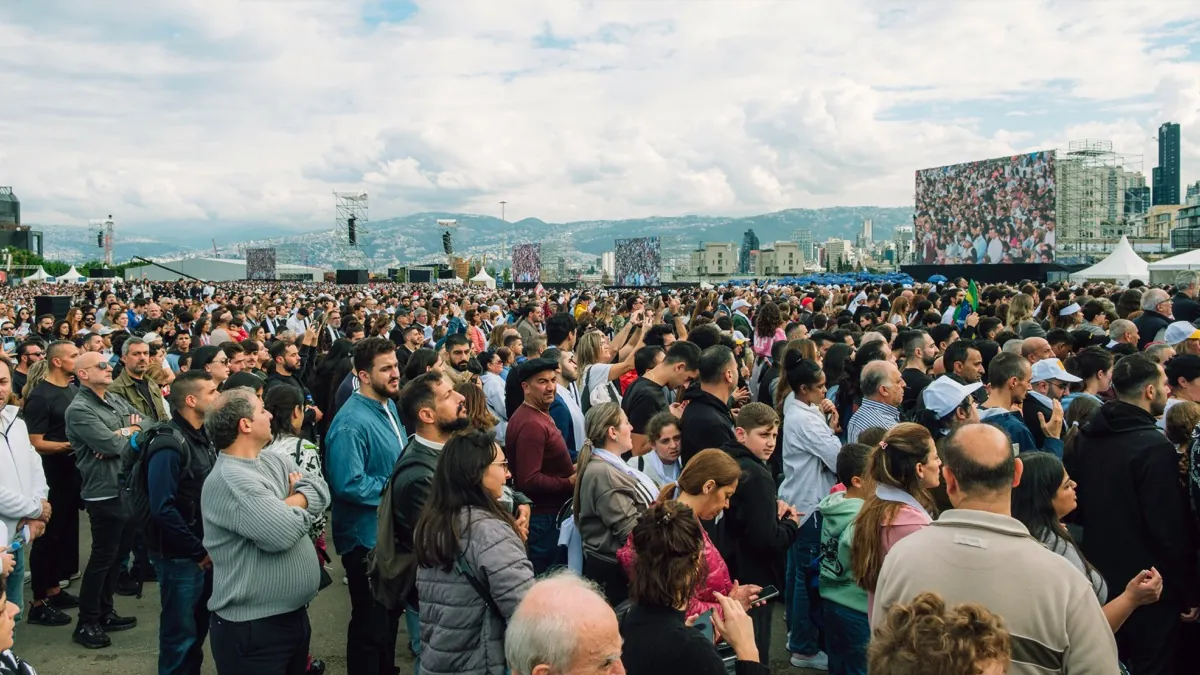
At festivals, fans walk a mile through dust and heat from the parking lot to the gate. At Coachella, a first-timer's guide warns that the walk to the grounds is "not for the faint of heart" — and estimates that the average attendee walks 15 to 20 miles over the course of the weekend.
At stadiums, 60,000 fans pour into dark parking lots simultaneously after the final whistle, walking through active vehicle traffic to reach remote lots while phased lot releases manage the cars around them.
At cruise terminals, 5,000 passengers disembark and another 5,000 embark in a six-hour window — many of them elderly, many with mobility limitations — navigating between parking structures, terminal buildings, and gangways with ad hoc wheelchair service that the cruise line itself admits may involve a wait during peak times.
At golf tournaments, 200,000 spectators across the week arrive at venues with zero on-site parking. The PGA Championship director publicly acknowledged that the scale of the event means only players and caddies can park on the grounds. Everyone else takes a shuttle from a remote lot — and the tournament's own accessibility page warns of 30-minute waits for disability transport.
At warehouses and factories, workers walk 5 to 10 miles per shift — and a meaningful portion of that is simply getting from the parking lot to the workstation and back. One shift supervisor was documented losing two hours per day to walking.
At data center construction sites, 3,000 workers park in temporary gravel lots and walk 15 to 20 minutes across active construction zones — past cranes, excavation, and high-voltage infrastructure — to reach their reporting location. A safety executive described the challenge of managing thousands of workers moving across campuses spanning hundreds of acres with constantly changing schedules.
At airports and FBOs, passengers transit between terminals, remote parking, and fixed-base operations on a combination of shuttle buses and long walks through facilities designed around aircraft, not pedestrians.
At resorts, guests move between lobbies, pools, restaurants, and parking on properties that can span dozens of acres — often served by aging sprinter van fleets that run on no fixed schedule.
Different industries. Different stakeholders. Different economics. The same gap.
And the failure mode plays out the same way every time. Coachella, the Kentucky Derby, the Super Bowl, F1, and the Arlington pedicab ban are five different events in five different industries with the same root cause — the event was designed, the transportation wasn't.
The cost nobody's counting
Every venue operator reading this has a version of the same mental calculation: "Our fans walk. It's not great, but it's not costing us anything."
It is. You're just not measuring it.
The research from adjacent industries paints a consistent picture. A Boldyn Networks fan experience study found that for half of all fans, wait time to enter a venue is one of the top three factors in whether they enjoy the event. A Deloitte stadium experience survey found that app-driven improvements to the arrival flow generated $2 million in additional revenue for a single NFL team. The warehouse industry has documented that walking consumes up to 50% of a worker's productive time in some facilities, and that reducing unnecessary movement directly improves throughput, reduces errors, and lowers injury rates.
The costs are real. They're just hiding in other budget lines — in lower concession revenue attributed to "slow start" days, in early departures coded as "normal attrition," in ADA complaints filed with guest services, in negative reviews that mention the walk but get categorized under "parking," in workers' comp claims from pedestrian-vehicle incidents in the loading zone, in retention problems attributed to "culture" when the real issue is that the walk from the lot to the floor in August heat is the worst part of the job.
We've documented these hidden costs in detail elsewhere — the lost concession revenue, the early departures that look like normal attrition, the negative reviews categorized under the wrong cause, the workers' comp claims that were really walking-distance claims.
When you aggregate the hidden costs of not having an onsite transportation plan, the number is almost always larger than the cost of implementing one.
Tired of transportation being an afterthought?
We work with operators who want to move it from the last line on the spreadsheet to the first — because it turns out transportation is the guest experience.
What "assumed" would look like
Imagine a world where onsite transportation is treated the same way as every other essential venue system.
In the design phase, the architect specifies tram routes the same way they specify utility corridors. The parking lot includes designated boarding points. The site plan shows fixed loops connecting remote lots to entrances, entrances to key venues, and key venues to each other.
In the operations budget, onsite transportation has its own line item — not buried under "misc. vehicles" or "golf cart rentals," but planned, staffed, and managed as a system with routes, schedules, utilization targets, and KPIs.
In the fan experience plan, the journey starts at the parking space — not at the gate. The patron gets off their car and onto a tram. They arrive at the entrance cool, rested, and ready to engage with the experience they paid for. The walk is eliminated. The friction is gone. The first impression is set by the venue, not by the weather and the distance.
In the sponsorship deck, the tram system is a named asset — a captive-audience activation that runs all day, every day, with thousands of daily impressions and a grateful audience that associates the sponsor with a service that made their day better.
In the ADA compliance plan, accessible transportation isn't a courtesy cart dispatched on request. It's a scheduled, accessible vehicle on a fixed route — available to every patron as standard service, not as a special accommodation with a 30-minute wait.
That's what "assumed" looks like. It's not complicated. It's not futuristic. It's just the logical extension of a principle the industry already believes: that the patron experience matters from the first moment to the last, and that every touchpoint should be designed, not defaulted.
The category exists now
FlexTram (also known as FlexTrolley) builds proprietary micro-mobility vehicles designed for the space between the parking lot and the building — the space that venue design has ignored, that operations budgets have overlooked, and that patron experience strategies have treated as someone else's problem.
We didn't set out to create a category. We set out to fix a problem we'd seen a thousand times, at events and venues across the country, where the most dynamic, creative, technologically sophisticated operators in the world were still moving people on six-seat golf carts with no routes, no schedules, and no accountability.
Our vehicles carry up to 27 passengers with a single driver. They run on fixed routes with posted schedules. They operate on asphalt, gravel, dirt, grass, and sand. They deploy in hours and store when the season ends. They're ADA accessible as standard. And they're supported by an operations planning methodology — heat maps, event schedules, ingress and egress modeling — that turns a fleet of vehicles into a transportation system.
We're deployed at Coachella, Lollapalooza, Bonnaroo, and EDC. At NASCAR venues. At NFL venues and university campuses. At cruise terminals and data center construction sites and warehouse operations.
The problem was always there. The category just needed someone to build it.
— The FlexTram Team
Frequently asked questions
Why isn't onsite transportation a standard venue system like power or wifi?
Five reasons compound: golf carts created a false sense of solved, walking is free so the cost is invisible, infrastructure was designed for vehicles not people, there was no product category to specify, and nobody owns the problem across parking, venue, and event teams.
What does the hidden cost of walking at venues actually look like?
It shows up across budget categories nobody aggregates: lower concession revenue blamed on slow start days, early departures coded as normal attrition, ADA complaints, negative reviews categorized under parking, workers' comp claims from pedestrian-vehicle incidents, and retention problems blamed on culture.
How is this the same problem across festivals, stadiums, cruise terminals, and data centers?
Every industry has a version of the same gap — the space between where people park or arrive and where they need to be. Different stakeholders, different economics, but the same default answer: they walk. And if someone complains, rent a few golf carts.
What does a properly designed onsite transportation system look like?
A fixed-route tram loop with posted schedules, designed into the site plan alongside utility corridors, with dedicated boarding points at parking structures and major venues. ADA accessible as standard, sponsorable as a captive-audience asset, and budgeted as its own line item.
What is FlexTram?
FlexTram (also known as FlexTrolley) builds proprietary micro-mobility vehicles designed for the space between the parking lot and the building entrance. Each tram carries up to 27 passengers with a single driver, operates on asphalt, gravel, dirt, grass, and sand, deploys in hours, and is ADA accessible as standard.
Explore solutions
Ready to assume transportation?
FlexTram offers rentals, long-term leases, and turnkey transportation plans for venues, events, campuses, and operations of any size.