Your courtesy shuttle is doing more work
than your org chart admits.
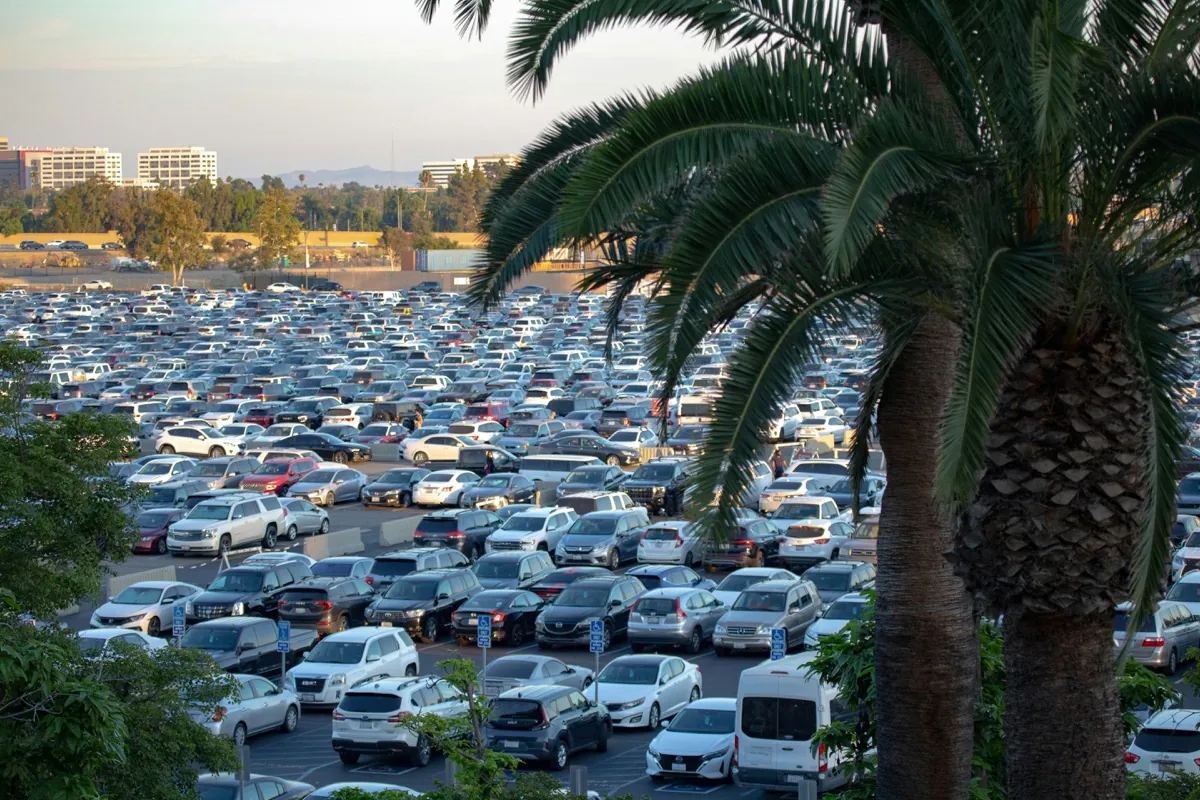
Walk out to Silver Lot 5 at AT&T Stadium on a 98° September Sunday about two hours before a 3:25 PM kickoff. You'll see them: the courtesy shuttle carts moving the guests who can't — or shouldn't — walk 12 minutes across a parking lot to reach the gate.
Every major NFL stadium in America has some version of this setup. Some run golf carts. Some run repurposed food-service trams. Some run pickup-truck-and-trailer rigs during concerts. The vehicles differ. The function doesn't. These courtesy shuttles are moving the guests who can't — or shouldn't — walk twelve minutes across a parking lot to get to the gate.
And here's the part that rarely makes it into an operations review:
That shuttle is load-bearing infrastructure. The venue is still buying it like it's equipment.
The gap between what it does and how it's budgeted
A courtesy shuttle at a modern stadium is the bridge between two things the venue has already invested heavily in: the parking plan and the gate experience. On paper, it's a "guest amenity." In practice, it's the back half of the arrival journey for thousands of ticket holders every event — including the mobility-impaired guests whose ability to attend at all depends on it.
But most venues procure these shuttles the way they procure housekeeping carts. A few golf carts. A few drivers pulled from another department or contracted out. A rough schedule that starts "when the lots open." A radio and a vest.
That approach made sense when courtesy shuttles were genuinely optional — a small convenience for a small subset of guests. It stopped making sense when the math of modern venues changed underneath it.
Stadium footprints expanded. Parking lots moved further from the gates. The guest demographic aged. ADA expectations became sharper. Post-event egress tightened. The NFL's clear bag policy added a 10-minute security line on top of the walk. Concerts run later than games and end in the dark. What used to be "nice to have" quietly became "thousands of guests per event are counting on this and we haven't restructured around the fact."
Arlington learned a version of this lesson the hard way — not at AT&T Stadium itself, but a few hundred yards away, in the broader Entertainment District. For a decade, the city ran a permit program for pedicabs and neighborhood electric vehicles to fill the lot-to-gate gap around Globe Life Field and AT&T Stadium. By 2020, after escalating safety complaints — operators weaving through traffic, driving on sidewalks, physically fighting each other in front of fans, per reporting from NBC 5 Dallas-Fort Worth — the city council voted unanimously to let the program expire. The Cowboys and the Rangers had both complained.
The pedicabs weren't the problem. The permit model was the problem. Fragmented close-proximity transit, run by independent operators with no shared accountability, always ends the same way.
The current courtesy-shuttle model inside most venues isn't as fragmented as a pedicab permit — but it lives on the same spectrum. Mixed vehicles. Mixed operators. Mixed training. A function that's doing more work than the budget line admits.
Four things that change when the shuttle becomes a system
When a venue moves from "we have courtesy carts" to "we operate a standardized close-proximity transit system," four operational levers move at once.
1. Throughput becomes forecastable
A mixed fleet of golf carts moving ad-hoc through a parking lot can't be modeled. You don't know trips per hour. You don't know average wait time. You don't know how many guests you can move between gate-open and kickoff. You know it when you see it — and you see it go wrong when a complaint hits the guest services desk.
A standardized system inverts that. Known vehicle capacity (27 passengers in the FlexTram case). Known route length. Known cycle time. Multiply, and you get trips per hour, guests per hour, and a forecasted throughput that can be planned against actual ticket counts and weather projections. You can promise a wait time. You can staff a gate to match shuttle arrival cadence. You can tell the ADA coordinator, with numbers, how many mobility-impaired guests the system can move per hour at peak.
Modelable throughput is the thing that turns a shuttle from an amenity into an infrastructure line item — which is where its budget and its accountability belong.
2. Liability and training consolidate
Every courtesy cart on a stadium property carries liability. A mixed fleet, operated by rotating staff from multiple departments or sub-vendors, multiplies that liability across every combination of vehicle and driver. Maintenance records live in different systems. Training standards vary by shift. Insurance posture gets negotiated piece by piece.
A turnkey system collapses that into one stack. One vehicle specification. One maintenance protocol. One training curriculum. One insurance posture. One radio channel. One accountable operator.
The venue still owns the guest experience. But it no longer owns the operational complexity of reconciling a fleet of non-standard equipment that was never designed to function as a transit system in the first place.
3. The vehicle becomes part of the venue brand
A golf cart with a handwritten sign taped to the windshield is a logistics solution. A branded, consistent vehicle running a posted route is part of the venue's guest experience — visually, operationally, and commercially.
That's not cosmetic. In practice it means three things:
A venue-branded tram is a wayfinding asset. Guests who see the tram know where the gate is, because the tram is going there. The vehicle itself is signage.
It's also sponsorship inventory. Title sponsors, category sponsors, and local-market partners all pay for visible, repeatable, high-dwell-time impressions. A tram running a 400-yard loop from Silver Lot 5 to the North Gate for six hours on a game day is exactly that. An unmarked golf cart is not.
And it's a signal to the guest that the venue thought about the arrival experience before they got there. That signal shows up in guest surveys, in renewal rates, and — at the margin — in the decision a multi-event customer makes about whether to come back for a concert next month.
4. Flexibility lives inside the standard, not outside it
This is the part that gets missed in most standardization conversations. The assumption is that standardization reduces flexibility. In a transit system, the opposite is true.
A standardized fleet can flex route, vehicle count, and schedule event by event because the underlying system is predictable. A Cowboys game gets six vehicles on a fixed loop. A Monster Jam gets four on a shortened loop. A Taylor Swift concert gets eight with extended post-show service. A stadium tour on a Tuesday gets one vehicle on a slow cycle. Same fleet. Same training. Same vendor. Different profile.
This is the difference between a subway that can add trains during rush hour and a taxi stand that hopes enough cabs show up. A venue running an ad-hoc courtesy fleet can't meaningfully flex up for a sold-out concert — it can only add more of the same unstandardized vehicles and hope. A venue running a planned system flexes by adjusting the parameters of the plan.
Rethinking the courtesy shuttle at your venue?
We work with venues to replace mixed courtesy-shuttle fleets with standardized close-proximity transit systems — ADA-compliant, venue-branded, and built to be planned against ticket counts rather than improvised around them.
What this looks like in practice
At a major Southern California venue, FlexTram replaced a fleet of roughly 300 golf carts with 8 FlexTram vehicles by redesigning the courtesy-transit plan around heat maps, event schedules, and ingress/egress modeling rather than around vehicle count.
The headline number — 300 carts to 8 trams — isn't the point by itself. The point is what the replacement made possible. A predictable system. A single operator. ADA service on every vehicle, without a separate fleet or a 48-hour advance-notice rule. Branded surfaces that could be sold into sponsorship inventory. A fixed route posted on the venue map that guests could actually rely on.
The golf carts weren't failing. The model around the golf carts was failing. The venue was running a transit system without calling it one — and paying the cost of that mismatch in staffing complexity, guest friction, and forfeited sponsorship revenue.
The operator's real question
Most VPs of venue operations already know their courtesy shuttle is working harder than the org chart admits. They know it because the radio traffic tells them. They know it because the ADA complaints land in their inbox. They know it because every new event type — concert, Monster Jam, graduation, non-football event — stresses the ad-hoc system differently and nobody has a good answer for why.
The real question isn't whether to keep running courtesy shuttles. Every modern venue is going to run close-proximity transit in some form, because the parking lot is too far from the gate and the guest demographic demands it.
The question is whether to keep running them as a loose collection of equipment, or to start running them as a system — under the venue's direct purview, with standardized vehicles, forecasted capacity, and a single accountable operator.
The courtesy shuttle has already earned a budget line. It hasn't yet been given the operational model that matches the work it's doing.
The venues that close that gap first won't just run smoother events. They'll unlock sponsorship inventory, tighten their ADA compliance posture, and be able to tell a guest — with a number — how long they're going to wait for a ride. None of that is available to a fleet of ad-hoc carts. All of it is available to a system.
Frequently asked questions
What is a courtesy shuttle at a stadium?
A courtesy shuttle is the close-proximity transit service that moves guests from the parking lot to the gate at a stadium, arena, or large venue — typically for mobility-impaired guests, elderly attendees, or anyone who can't comfortably walk the distance between the lot and the gate. Most major NFL stadiums run some version of this service, using golf carts, repurposed trams, or ad-hoc pickup-and-trailer setups.
Why is the courtesy shuttle considered load-bearing infrastructure?
Because the ability of thousands of guests to attend the event — particularly mobility-impaired guests whose ADA accommodation depends on it — rests on the courtesy shuttle working. Stadium footprints expanded, parking lots moved further from gates, the guest demographic aged, and post-event egress tightened. What was once a minor convenience became infrastructure without the budget line or operational model to match.
What changes when a courtesy shuttle becomes a standardized system?
Four operational levers move at once: (1) throughput becomes forecastable with known vehicle capacity and cycle time, (2) liability and training consolidate into a single operator, vehicle spec, and insurance posture, (3) the vehicle becomes part of the venue brand — wayfinding, sponsorship inventory, and a guest-experience signal — and (4) the fleet can flex by event type (game vs. concert vs. stadium tour) precisely because the underlying system is standardized.
Can FlexTram replace an existing courtesy-cart fleet?
Yes. At a major Southern California venue, FlexTram replaced roughly 300 golf carts with 8 FlexTram vehicles by redesigning the close-proximity transit plan around heat maps, event schedules, and ingress/egress modeling — rather than around vehicle count. The result: a predictable system, a single operator, ADA service on every vehicle without a separate fleet or 48-hour advance-notice rule, and branded surfaces that convert to sponsorship inventory.
How does a standardized tram system help with ADA compliance at a stadium?
When every vehicle in the fleet is ADA-compliant by default, mobility-impaired guests don't have to call ahead, request a special dispatch, or wait for the one accessible cart to cycle around. ADA service becomes a property of the system, not an exception. Venues gain a defensible accessibility posture and mobility-impaired guests get the same arrival experience as everyone else.
Related reading
Turning your courtesy shuttle into a system?
FlexTram offers rentals, long-term leases, and turnkey transportation plans for stadiums, arenas, festivals, motorsports facilities, and every other venue where the last 500 yards matter. Let's walk your footprint.