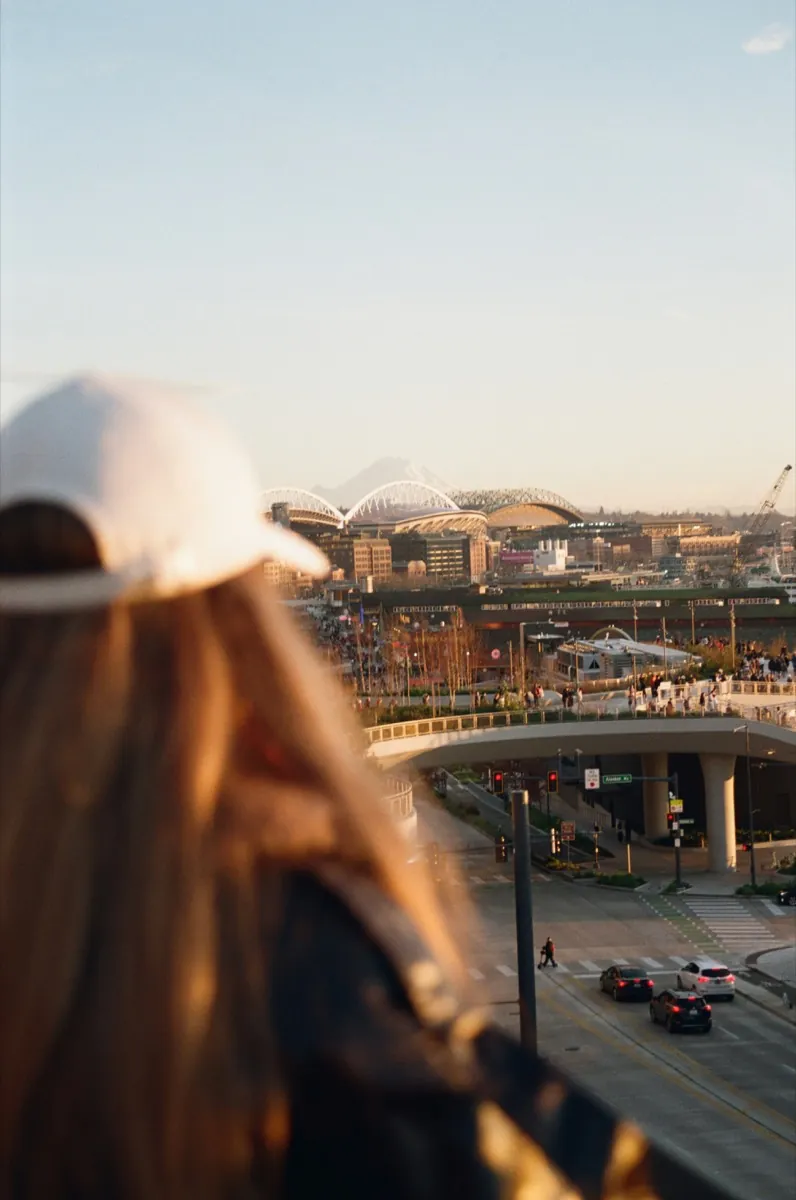
Stadiums are becoming neighborhoods.
The transportation plan hasn't caught up.
Something fundamental is changing in how stadiums and arenas are built, operated, and valued. The standalone venue — activated 40 days a year and dark the other 325 — is becoming obsolete. In its place: the stadium district. A mixed-use, year-round destination where the venue is the anchor, not the entire story.
The stadium district isn't coming — it's here
Across the United States, the pipeline for sports-anchored mixed-use districts is projected to attract tens of billions of dollars in investment over the next 15 years. These aren't speculative concepts — they're under construction. The investment intensity inside these projects is staggering — but as we've documented elsewhere, the parking-to-gate corridor remains the one fan-experience category that hasn't been touched. Stadium districts are an opportunity to fix that during the design phase, before the asphalt sets.
The Atlanta Braves' Battery district turned a greenfield site outside city limits into a year-round destination with over a million square feet of commercial space, 500+ residential units, and a full-service hotel. Property values in and around the development jumped from $5 million to over $700 million in under a decade. In San Francisco, Thrive City — the 11-acre mixed-use complex surrounding the Warriors' Chase Center — runs a year-round calendar of events, corporate offices, and luxury retail that generates consistent foot traffic whether or not there's a game. The Dallas Cowboys' Star complex in Frisco has become a prototype for how a franchise headquarters can anchor an entire mixed-use neighborhood, with sponsors integrating directly into the daily life of the district through branded hospitality spaces and year-round activation zones.
And the next wave is even bigger. The Chicago Bears are planning a $4.7 billion lakefront stadium designed as a mixed-use hub. The Denver Broncos announced Burnham Yard — a 100-acre, privately funded stadium district with housing, hotels, office space, retail, and multi-modal transportation built in from the start. In Miami, Inter Miami's Nu Stadium opened this year as a purpose-built urban sports district with extensive public park space, designed from day one for 365-day activation. Even overseas, from Manchester United's 100,000-seat redevelopment with mixed-use surroundings to Lisbon's precinct upgrades, the same pattern is playing out.
"One of our goals is to make sure that we are engaging community members 365 days a year in the area around the stadium. So, it's not something that will just have a large parking lot all around it, but really creating some place that's special."
— Carrie Walton Penner, Owner, Denver Broncos
The consistent thread: stadiums are no longer just venues. They're the anchor tenants in year-round neighborhoods.
Why this matters for onsite transportation
Here's the shift that venue operators, district developers, and property managers need to internalize: when a stadium becomes a neighborhood, the transportation problem changes fundamentally.
A traditional stadium has a simple transportation profile. People arrive. They park. They walk to the gate. They watch the event. They walk back. They leave. The transportation demand is concentrated in two narrow windows — 90 minutes before and 60 minutes after — and it's zero the rest of the time. Golf carts and ad hoc shuttles were designed for exactly this kind of spike-and-idle pattern. They're clumsy during the spike and they sit unused the rest of the year. But nobody noticed because there was nothing else happening.
A mixed-use stadium district has a completely different profile. There are residents who need to move around the campus daily. There are office workers commuting in the morning and leaving in the evening. There are hotel guests arriving and departing at all hours. There are restaurant patrons, retail shoppers, concert-goers, fitness members, and casual visitors using the public spaces. On top of all of that, there are still 40+ event days per year where tens of thousands of fans arrive and depart within a narrow window.
The transportation demand isn't a spike anymore. It's a continuous baseline with periodic surges. And that changes everything about how you plan for it.
The baseline problem: daily campus circulation
Most mixed-use stadium districts span significant acreage. The Battery in Atlanta covers 60 acres. Hollywood Park in Los Angeles — home to SoFi Stadium — spans 300 acres. The Denver Broncos' Burnham Yard project covers more than 100 acres. These are not campuses you cross on foot in two minutes. They're small towns — and the foot-only assumption that worked when the property was a quarter of the size doesn't survive the scale shift.
When these districts were pure parking lots, there was no need to move people around the campus on a Tuesday afternoon. Now there is. A resident needs to get from their apartment to the retail village. A hotel guest needs to reach the restaurant cluster on the other side of the district. An office worker parks in a remote structure and needs to reach their building. A visitor arrives via light rail and wants to explore the public spaces.
Some districts are designing for walkability, and that's essential. But walkability has limits — especially across 60, 100, or 300 acres, especially in extreme weather, and especially for visitors with mobility challenges. What's missing is a persistent, low-speed circulation system that moves people around the campus continuously, the same way a theme park or a resort moves guests between zones.
Theme parks figured this out decades ago. A compact, high-capacity tram on a fixed loop. One driver. Passengers always know where to board and when the next one arrives. The route is visible. The schedule is predictable. It's not a ride-hail or an on-demand dispatch — it's infrastructure. Stadium districts need the same thing.
"Mobility: The design should move people efficiently using creative infrastructure and technology. Experience: The inspiring architecture and public spaces should bring 24/7/365 vitality to the neighborhood."
— HOK, on five strategic design pillars for St. Louis CITY SC's Energizer Park stadium district
The surge problem: game day on top of everything else
The baseline circulation challenge is new. But the surge problem is the old challenge made harder.
In a traditional stadium, game-day transportation had the luxury of starting from zero. The lots were empty. The roads were clear. Ingress and egress could be planned in isolation. In a mixed-use district, game day happens on top of an already-active campus. Residents are home. Restaurants are open. Office workers may still be at their desks. The district already has traffic, pedestrians, and operational complexity before a single fan arrives.
Now layer 60,000 fans onto that. The parking structures that serve office workers during the week need to absorb game-day demand on Saturday. The pedestrian pathways designed for casual foot traffic need to handle crowd-density flows. The restaurant patios and retail storefronts that front the main promenades are suddenly in the middle of a crowd management operation.
For venue operators, this means the game-day transportation plan can't exist in a vacuum anymore. It has to integrate with the district's daily operations. The onsite transportation system needs to flex — running a baseline circulation loop during normal operations, then scaling up to handle game-day surges with additional vehicles, modified routes, and higher frequency. After the event, it needs to wind back down to baseline without disrupting the residents and businesses that are still there.
Golf carts can't do this. They don't run a baseline loop. They don't scale predictably. They don't integrate with a district's daily transportation pattern because they were never designed to be a system — they're individual vehicles dispatched on demand. Shuttle buses are too large for the internal campus roads that characterize mixed-use districts, and they require permanent stop infrastructure that conflicts with the multi-use nature of the shared spaces.
"To be successful, future developments must be dynamic centers of interconnectedness, which adapt to seasons and even time of day to reach optimal year-round use. Advanced technology, automation, transportation, population density, and diversity of options are rapidly changing the way we envision sports and entertainment developments."
— Burns & McDonnell, Thinking Beyond the Stadium: The Future of District Development
The resident factor
Here's a dimension that traditional stadium operations teams have never had to consider: some of the people on campus live there.
Mixed-use stadium districts increasingly include residential towers — apartments and condos whose tenants chose to live in a vibrant, activated neighborhood anchored by a major venue. These residents are not fans arriving for a game. They're stakeholders who experience every operational decision the district makes, 365 days a year.
When the transportation system fails on game day — when parking lots are gridlocked, when pedestrian routes are overwhelmed, when there's no clear way for a resident to reach their building through a crowd of 60,000 — that failure has consequences beyond fan satisfaction scores. It affects lease renewals, property values, community support for the district, and the political capital that developers need for future phases.
A visible, predictable tram system serves residents and fans simultaneously. Residents see it running daily and know it's reliable. On game days, it gives residents a way to navigate the campus without fighting through crowds. It signals to the community that the district is professionally managed — that someone thought about what happens when a neighborhood is also a venue. That matters when the next zoning approval comes up.
Building a mixed-use district? Start the movement plan early.
We work with district developers, venue operators, and property managers on circulation systems that handle both baseline and surge — every day of the year.
Sponsorship shifts from event-day to year-round
In a traditional stadium, sponsorship is concentrated around game day — signage, naming rights, in-game activations, hospitality packages. The parking lot has never been a sponsorship platform because there's nothing to attach a brand to. A scattered fleet of unmarked golf carts doesn't have a captive audience or a predictable touchpoint.
In a mixed-use district, the value proposition flips. Sponsors aren't looking for 40 days of exposure anymore — they want integration into the daily life of a district that generates four to six million visitors annually. A branded tram system running a continuous campus loop delivers exactly that. Vehicle wraps, branded tram stops, in-ride digital displays, and co-branded ride programs create a sponsorable asset that operates every day, not just on game days.
We're already seeing this at festivals and stadiums where our tram systems run fixed routes: sponsors approach venues asking to be part of the transportation experience. In a mixed-use district with year-round foot traffic, that sponsorship revenue isn't seasonal — it's recurring. What was a pure cost line on 40 event days becomes a revenue-generating asset on 365.
ADA compliance in a 365-day environment
Traditional stadium ADA transportation is reactive — a courtesy cart dispatched on request from accessible parking to the nearest gate, available only on event days. In a mixed-use district where people live, work, and visit daily, ADA-accessible transportation isn't a game-day courtesy. It's an infrastructure requirement.
Residents with mobility challenges need reliable campus transportation to reach amenities, transit connections, and building entrances. Hotel guests with disabilities need accessible transport from the parking structure to the lobby. Office workers recovering from injuries need a way to get from the remote lot to their desk. The demand is continuous, not episodic.
A scheduled, ADA-accessible tram on a fixed loop — accessible as standard, not as a special configuration — meets this requirement by design. Every resident, worker, guest, and fan knows where to board and when the next one arrives. It's not accommodation. It's transportation.
The operational reality: who owns this?
In a traditional stadium, the ops director owns game-day transportation. It's part of the event operations plan. In a mixed-use district, the question of who owns onsite transportation gets complicated fast.
Is it the venue operator? They control the stadium and its immediate surroundings on event days. Is it the property management company? They manage the residential, office, and retail components. Is it the district developer? They designed the master plan and may control the common areas. Is it a transit authority? They might operate a light rail station at the district's edge.
In practice, the answer is usually: nobody owns it comprehensively. The venue operator handles game-day shuttles. The property manager handles building-to-parking transport. The developer handles common-area wayfinding. And the gaps between those jurisdictions — the spaces where a fan becomes a pedestrian becomes a resident becomes a customer — are where the experience breaks down.
A district-wide tram system cuts across all of those boundaries. It serves the venue on game days. It serves the property manager daily. It serves the developer's vision of a connected, walkable campus. It serves the transit authority by solving the last-half-mile problem between the rail station and the district's interior. One system, one operator, one experience — regardless of who the passenger is or why they're on campus.
The window is now
The stadium district boom is accelerating. Projects that break ground in the next two to three years will define the next generation of sports-anchored development. The design decisions being made right now — site plans, circulation patterns, infrastructure commitments — will determine whether these districts have integrated onsite transportation or whether they'll be retrofitting it in five years at ten times the cost.
"Mixed-use is the way the stadiums are going to succeed, and the way the developments in their neighborhoods are going to succeed."
— Brad Chambers, quoted in JLL/Bisnow reporting on stadium-anchored mixed-use development
For venue operators, district developers, property managers, and city planners involved in any of the dozens of major stadium district projects currently in planning or under construction: the onsite transportation conversation needs to happen now. Not after the first residents complain. Not after the first game-day gridlock. Not after the first ADA issue surfaces. Now — while the site plan is still flexible and the infrastructure budget is still being allocated.
FlexTram is deployed at some of the largest, most operationally complex live events in the country — Coachella, Stagecoach, Lollapalooza, EDC, Bonnaroo, NASCAR, and dozens more. We've replaced 300+ golf cart fleets with 8 trams at a single site. We deploy on asphalt, dirt, grass, and gravel. We run daily baseline loops and scale for event-day surges. And we're having conversations right now with district developers who understand that the transportation plan for a year-round neighborhood is fundamentally different from the transportation plan for a 40-day stadium.
If you're building the next generation of stadium districts, let's talk about what moves people once they arrive.
— The FlexTram Team
Common questions
What is a mixed-use stadium district?
A mixed-use stadium district is a development where a sports venue serves as the anchor tenant within a broader neighborhood that includes residential housing, hotels, offices, retail, restaurants, entertainment venues, and public spaces. Unlike traditional standalone stadiums surrounded by parking lots, these districts are designed for year-round activation — generating foot traffic and economic activity every day, not just on game days.
Why does mixed-use development change the onsite transportation problem?
Traditional stadiums have a spike-and-idle transportation demand — intense for a few hours on event days, zero the rest of the time. Mixed-use districts have continuous transportation demand from residents, workers, hotel guests, and daily visitors, with periodic surges on event days. This requires a system that runs a baseline circulation loop daily and scales up for events — something golf carts and ad hoc shuttles were never designed to do.
How does FlexTram serve a year-round stadium district?
FlexTram runs a fixed, predictable campus loop — like a micro transit system — that serves residents, workers, and visitors daily. On event days, additional vehicles are added to existing routes, and supplementary routes can be deployed in hours to handle game-day surges. After the event, the system scales back to baseline. One system, one operator, continuous service.
Can FlexTram handle both daily circulation and game-day surges?
Yes. FlexTram's core advantage in a mixed-use district is scalability. A baseline fleet of two or three trams handles daily campus circulation. On event days, additional trams are deployed on the same routes with increased frequency, or new routes are added to connect remote parking to gates. The system flexes with demand rather than starting from scratch every game day.
Why should district developers plan for onsite transportation now?
Onsite transportation is far cheaper and more effective when integrated during the design phase — route corridors, tram stop locations, and circulation patterns can be built into the site plan. Retrofitting transportation into a completed district means working around fixed infrastructure, established pedestrian flows, and existing tenant expectations. The planning window for most major projects underway is the next 12-24 months.
Explore solutions
Building a stadium district? Let's talk.
We're working with district developers, venue operators, and property managers on year-round onsite transportation plans.