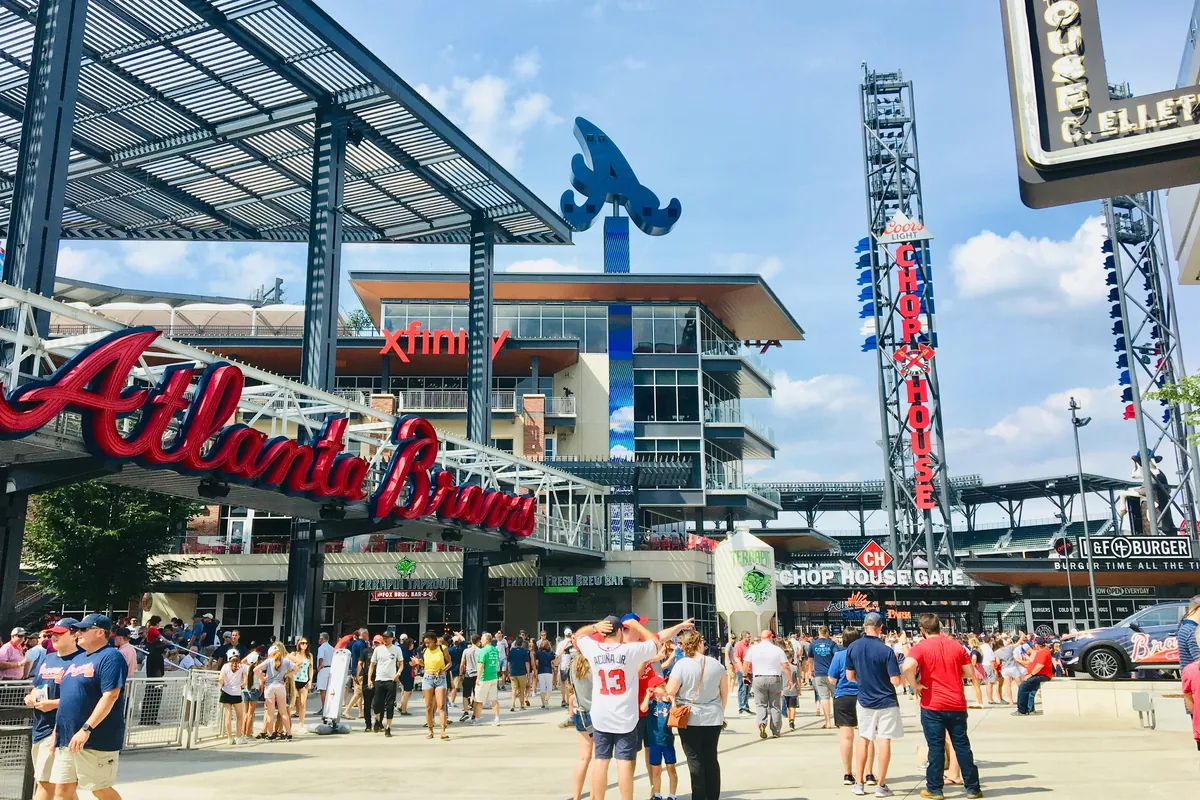
The properties got bigger.
The plan didn't.
Stadiums became districts. Cruise terminals became airports. Data center campuses became small cities. The built environment outgrew the human body's ability to navigate it on foot — and the assumption that people walk hasn't been updated.
Hollywood Park in Inglewood, California spans 300 acres. At its center sits SoFi Stadium — 3.1 million square feet, the largest venue in the NFL. Around it: YouTube Theater, NFL Media headquarters, 2,500 residential units, 900,000 square feet of retail, 890,000 square feet of office space, a 300-room hotel, a six-acre artificial lake, and a future movie studio that will host the International Broadcast Center for the 2028 Olympics. The managing director of the development describes it as "about 15 million square feet of entitlements." (LA Business Journal / Hollywood Park)
Nashville's East Bank will cover 338 acres of city-owned land along the Cumberland River. At its center: a new $2.1 billion domed stadium for the Tennessee Titans, opening in 2027. Around it: 22 million square feet of new mixed-use development across four walkable districts, a new Tennessee Performing Arts Center, a "Mobility Hub" transit center, 12 acres of parks, an Oracle campus for 8,500 employees, and a 1.5-mile multimodal boulevard. Over 1,000 construction workers are on site every day. (Perkins Eastman / Planning Magazine / CoStar)
DataBank's Red Oak data center campus sits on 292 acres in Ellis County, Texas. Eight two-story buildings totaling 3.4 million square feet and 480 megawatts of power. At peak construction: 4,000 to 5,000 workers. DataBank's VP of Construction says workers lose two hours daily just commuting within the site. (DataBank)
Carnival's Celebration Key occupies the western tip of Grand Bahama Island. Five themed portals. Two freshwater lagoons totaling 275,000 square feet of water. A second pier under construction to dock four ships simultaneously. Projected capacity: close to 4 million annual visitors by 2028. (TravelAge West / Carnival)
These aren't stadiums. They aren't terminals. They aren't campuses. They're districts — self-contained environments where tens of thousands of people need to move between multiple destinations across hundreds of acres, multiple times per visit.
And at most of them, the plan for how those people move is the same plan that worked when the property was a quarter of the size: they walk.
The tipping point nobody acknowledges
There is a size threshold — a tipping point — beyond which a property can no longer function well without an onsite transit system. Below that threshold, people walk and it's fine. The distances are manageable. The demographics can handle it. The walking time is a reasonable fraction of the total visit.
Above that threshold, walking stops being a reasonable expectation and starts being a design failure. The distances become barriers. The walking time consumes a meaningful portion of the visit window. The ADA gaps multiply. The pedestrian-vehicle conflicts increase. The guest experience degrades not because of any single decision, but because the property outgrew the assumption that people would walk.
Most of the properties being built right now crossed that threshold years ago. They just haven't acknowledged it — because "people walk" has been the default assumption for so long that nobody has stopped to ask whether it still applies at this scale.
When did the properties get this big?
The scale shift happened gradually, then all at once.
Stadiums became districts. Twenty years ago, a stadium was a building surrounded by parking lots. The fan drove to the lot, walked to the gate, watched the game, and walked back. The distances were manageable because the property had one destination — the stadium.
Today, SoFi Stadium is the anchor of a 300-acre mixed-use development with residential, retail, office, entertainment, and hospitality components. The fan isn't walking to a stadium. They're navigating a neighborhood — one with restaurants, bars, retail, a concert venue, a lake, and residential buildings, all spread across a property larger than many downtowns. Hollywood Park is so large that the development team is actively building a People Mover system for the 2028 Olympics. (LA Business Journal)
Nashville's East Bank will be even larger — 338 acres across four districts, with a "Mobility Hub" as a foundational element of the master plan. The planners aren't adding transit as an afterthought. They're designing it as infrastructure because the property is too large to function without it. (Perkins Eastman) We've covered this stadium-to-district shift in depth — it's the most important structural change in the live-events industry since the suite revolution.
Cruise terminals became airports. PortMiami's newer terminals exceed 500,000 square feet. Royal Caribbean's Galveston terminal is purpose-built for the largest cruise ships on Earth. These buildings have multi-level parking garages, ground transportation centers, and passenger processing facilities that rival airport terminals in scale. And then the ship sails to a private island that's 125 acres with five themed zones — where the cruise line runs a complimentary tram service because the property is too large to navigate on foot. (Carnival Cruise Line)
Airports pushed parking further while removing walkways. Nashville's BNA is mid-construction on an 18-month Central Core Enhancement. Austin is building new remote parking lots with "shuttle bus shelters" as the default solution. And multiple major airports — Chicago, Las Vegas, Orlando, Dallas, Cincinnati — have removed their moving walkways, making interior walks longer while exterior distances grow. (CNBC)
Data center campuses went from buildings to small cities. Five years ago, a large data center construction site had 750 workers. Today, DataBank's Red Oak will have 4,000 to 5,000. The campus is 292 acres. The Stargate initiative plans campuses spanning hundreds of acres across Texas, Ohio, and the Midwest — and by 2026, Vantage's 672-acre Lighthouse campus made Red Oak look mid-sized.
Convention centers expanded into multi-building complexes. The largest convention centers now sprawl across dozens of acres with multiple exhibit halls, meeting rooms, hotels, and parking structures connected by walks that can exceed a quarter mile. $13 billion in convention center construction is underway across the country — and almost none of it addresses how attendees move through the expanded footprint.
Hotels grew into self-contained resort campuses. Gaylord Opryland has 2,888 rooms, 9 acres of indoor gardens, and 750,000 square feet of meeting space. Atlantis Paradise Island spans 154 acres. Dorado Beach stretches across 1,400. The Broadmoor sits on 5,000. These properties grew into campuses too large to walk — and the reactive solutions (wheelchair rentals, golf-cart-on-request, bell-attendant escorts) confirm the problem rather than solving it.
In every category, the pattern is the same: the property got bigger. The number of destinations within the property multiplied. The distances between those destinations increased. And the plan for how people move between them didn't change.
The infrastructure that's always assumed — and the one that isn't
When you build a 300-acre mixed-use development, you assume certain infrastructure from day one. Nobody questions whether it's needed. The conversation is about how to design it, not whether to include it.
Power. Every building has an electrical system. The campus has a grid. The substations are planned as part of the site work.
Water. Every building has plumbing. The campus has water mains, stormwater management, and irrigation.
Roads. The internal road network is designed as part of the master plan. Fire lanes, service roads, delivery routes — all planned before construction begins.
Security. The perimeter is defined. Access points are controlled. Camera systems are specified. The security operations center is designed into the building program.
Telecommunications. Fiber runs. Wi-fi infrastructure. Distributed antenna systems for cellular coverage. All planned, all assumed.
Restrooms. Code-required minimum capacities. Planned, located, and plumbed before the first wall goes up.
Onsite transportation? Not on the list.
We wrote about this gap in "Why Isn't Transportation on the List?" two years ago. At the time, the argument was philosophical — transportation should be treated as core infrastructure. Today, the argument is physical. The properties have gotten so large that transportation isn't a nice-to-have that forward-thinking operators should consider. It's a mathematical requirement driven by square footage, acreage, and the number of buildings, destinations, and venues that people need to reach.
A 300-acre property with 15 million square feet of development across multiple districts, a 70,000-seat stadium, a concert venue, retail, residential, office, and hospitality — this property can't function at acceptable service levels without a system that moves people through it. The built environment has outgrown the human body's ability to navigate it on foot in a reasonable amount of time.
Hollywood Park knows this — they're building a People Mover. Nashville's East Bank knows this — they're designing a Mobility Hub into the master plan. The question is whether the hundreds of other large-scale properties across the country — the ones that have already been built or are being built right now — will recognize the same reality before the guest experience tells them.
Designing or operating a property at this scale?
FlexTram offers scalable onsite transit systems for stadium districts, mega-campuses, mixed-use developments, and any property that has outgrown the walking plan. Equipment rentals, full-service operations, and turnkey transportation plans — deployed in hours, scaled to demand, stored when not in use.
A system, not just vehicles
Here's where the scale of these properties creates a specific requirement that smaller venues don't face: the transportation solution has to be a system, not a collection of vehicles.
We explored this principle in depth in "Systems Over Units," but it bears repeating in the context of properties this large:
A 300-acre mixed-use district can't be served by golf carts. Not because golf carts are bad vehicles — they work fine for short distances and small properties. But because 50 golf carts making 50 independent routing decisions across 300 acres, with no fixed routes, no posted schedules, and no centralized coordination, don't create a transit system. They create traffic.
And traffic is only the visible failure mode. The invisible one is what we've called demand suppressed by friction — the fans who leave early, the residents who stop attending, the workers who don't make the trip. The bigger the property, the larger that quiet loss compounds.
A property of this scale needs the same elements that any effective transit system requires: fixed routes connecting the highest-demand origins and destinations, posted schedules with predictable frequency, high-capacity vehicles that consolidate movement, designated boarding points that passengers can find and rely on, and trained operators on documented routes.
These are the principles that have governed effective mass transit for over a century. They apply at the city level. They apply at the campus level. And they apply at the 300-acre mixed-use development level — because at that scale, the property is a small city.
The system has to scale
And here's the requirement that separates onsite transit from permanent urban infrastructure: the system has to flex.
A city transit system runs the same routes on the same schedule year-round. The demand is relatively consistent. The 7 AM bus runs whether there are 40 passengers or 10.
A stadium district doesn't work that way. On a Tuesday afternoon, the property has 5,000 people — office workers, residents, restaurant patrons. On a Sunday game day, it has 75,000. On a concert night, it has 40,000. During the World Cup, it might have 100,000. During an off-week in January, it might have 2,000.
The transit system has to match all of those demand patterns — not with separate infrastructure for each one, but with a single platform that scales up and down based on what the property needs that day.
On a quiet Tuesday: Two trams running a 15-minute loop between the parking structure, the retail district, and the residential buildings. Enough to provide reliable service for the daily population without overinvesting in a system designed for peak.
On a game day: Eight trams running a 5-minute loop that adds stops at the remote parking lots, the tailgate zones, and the stadium gates. The route expands. The frequency increases. The vehicle count multiplies. The system surges to meet the demand, then contracts when the event ends.
During a multi-day event like the World Cup or the Olympics: The full fleet deployed on continuous operations with extended hours, supplemental routes to transit hubs and hotel corridors, and coordination with the regional transportation system.
During off-season maintenance: The system is stored. No permanent infrastructure sitting idle. No maintenance costs on a system that isn't running. The vehicles are compact enough to store onsite and deploy in hours when the next event arrives.
This is the deployment model that makes onsite transit viable at properties with variable demand. You don't build permanent infrastructure for peak day and let it sit empty most of the year. You deploy a system that matches the day — turnkey, scalable, and reversible.
As we wrote in our piece on turnkey mass transit: the system gives you the same operational outcomes as permanent infrastructure — fixed routes, posted schedules, high-capacity consolidated movement — without the permanence. And for properties with event-driven demand, the absence of permanence isn't a limitation. It's the design.
The properties that already know
The most sophisticated property developers in the country have already arrived at this conclusion.
Hollywood Park is building a People Mover for the 2028 Olympics — because they know 100,000 people can't navigate 300 acres on foot. Nashville's East Bank is designing a Mobility Hub as foundational infrastructure — because the planners understand that 22 million square feet across four districts requires a transit spine. Celebration Key runs complimentary tram loops with pickups every five minutes — because Carnival understands that a 4-million-visitor destination needs a system, not a walking path.
These projects didn't add transit as an afterthought. They designed it in from day one — because at this scale, transit isn't optional. It's infrastructure. Just like power. Just like water. Just like roads.
The question for every other large-scale property — every stadium district, every mega-campus, every expanding terminal, every multi-building complex — is whether they'll recognize the same reality before the property outgrows the walking plan.
Because the properties got bigger. And the plan has to catch up.
Frequently asked questions
What is the size threshold above which an onsite transit system is required?
There is no single number, but the practical threshold is the point at which the longest internal walk consumes a meaningful fraction of the visit window. For a stadium fan with a 4-hour window, that's typically when the parking-to-gate walk exceeds 10–15 minutes. For a cruise destination with a 6–10 hour window, it's when pier-to-amenity walks exceed 15–20 minutes. For a construction worker with an 8-hour shift, it's when site-internal walks exceed 30 minutes per day. Most of the new mega-properties — 200+ acres, multiple buildings, multiple destinations — have crossed all three thresholds. Hollywood Park, Nashville East Bank, DataBank Red Oak, and Celebration Key are explicit examples.
Why is onsite transit treated differently from power, water, and roads?
Historical accident, mostly. Power, water, roads, restrooms, security, and telecommunications became required assumptions during eras when properties were small enough that walking handled the people-moving question by default. The category "onsite transit" didn't need to exist because the property was small enough that transit happened on foot. Today's mega-properties are large enough that the foot-only assumption breaks — but the assumption-list hasn't been updated. The most sophisticated developers (Hollywood Park, Nashville East Bank) have started designing transit infrastructure into the master plan from day one, treating it like power and water. Most operators are still treating it like a nice-to-have.
What's wrong with using golf carts on a 300-acre property?
Nothing is wrong with golf carts on properties they were designed for. The problem is using them as the people-moving solution at scale. Fifty golf carts making fifty independent routing decisions across 300 acres — with no fixed routes, no posted schedules, no centralized coordination — don't create a transit system. They create traffic. They consume drivers. They create unpredictable wait times. They duplicate trips. A property of this scale needs the same elements that any effective transit system requires: fixed routes, posted schedules, high-capacity vehicles, designated boarding points, and coordinated dispatch. Those are mass transit principles, applied at property scale.
How does an onsite transit system handle event-driven demand swings?
By scaling the same platform up and down based on what the property needs that day. On a quiet Tuesday, two trams might run a 15-minute loop covering the daily population. On a game day, eight trams might run a 5-minute loop with expanded routes covering remote parking and tailgate zones. During a multi-day event like the World Cup or Olympics, the full fleet runs continuous operations with extended hours. During off-season maintenance, the system is stored entirely. The vehicles are compact enough to be staged and deployed in hours — no permanent infrastructure sitting idle most of the year, no maintenance burden on a system that isn't running.
Which large-scale developments are already designing transit into the master plan?
Hollywood Park (300 acres, building a People Mover for the 2028 Olympics), Nashville East Bank (338 acres, designing a Mobility Hub as foundational infrastructure), and Carnival's Celebration Key (already running complimentary tram loops with five-minute pickup frequency) are the cleanest examples. These developers recognized that at their scale, transit isn't optional — it's infrastructure on the same priority tier as power, water, and roads. The question for every other large-scale property — the stadium districts, mega-campuses, expanding terminals, and multi-building complexes being built right now — is whether they'll recognize the same reality before the property's guest experience tells them.
Related reading
The properties got bigger. The plan has to catch up.
FlexTram offers scalable onsite transit systems — from single-event deployments to permanent campus installations — with equipment rentals, full-service operations, and turnkey transportation plans for properties of any size.