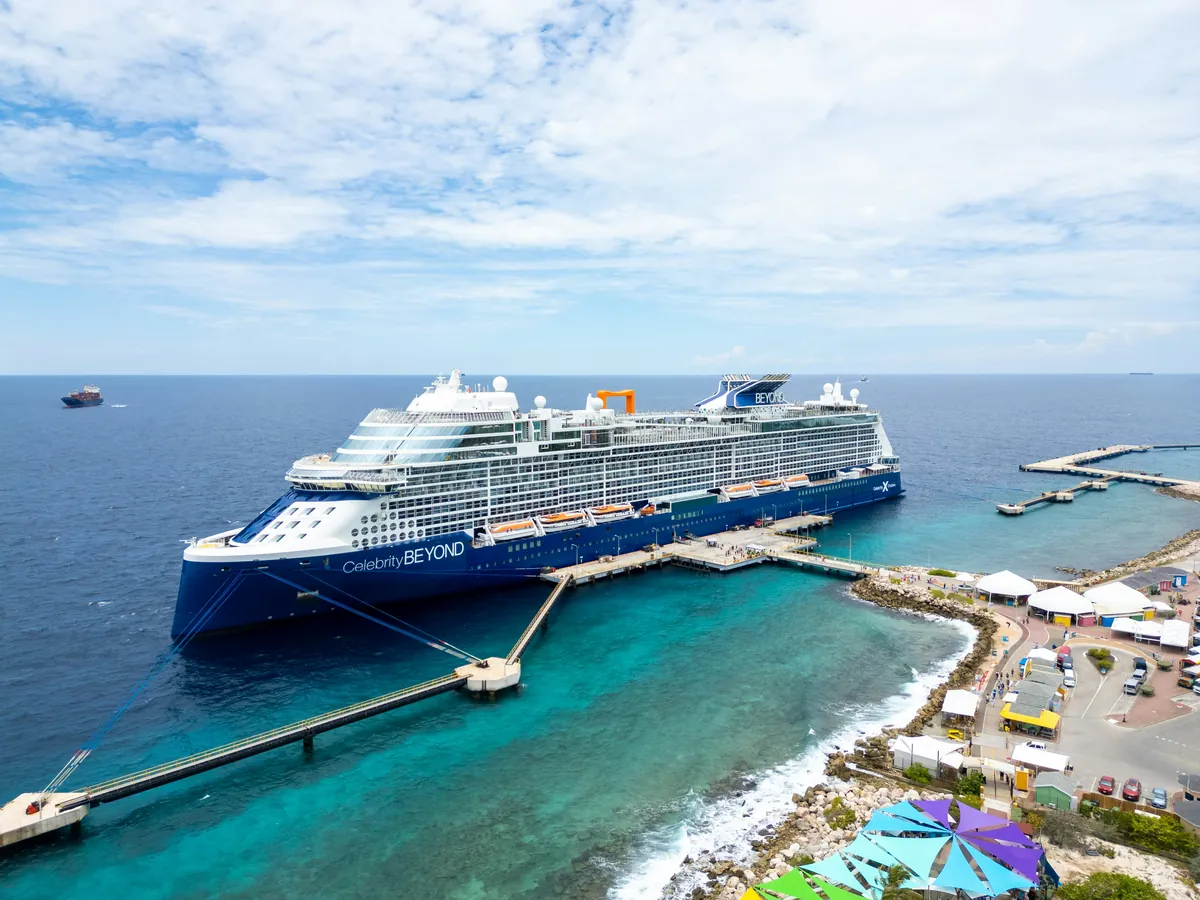
You built the island. You built the beach club.
Who built the ride between them?
The cruise industry's most important strategic shift of the last decade isn't a bigger ship. It's a piece of real estate. The cruise line designed the ship. It designed the island. The ride between them is the last piece of the experience that hasn't been designed yet.
Royal Caribbean owns Perfect Day at CocoCay — 125 acres in the Berry Islands with a waterpark, a beach club, overwater cabanas, zip lines, and a helium balloon ride. The island welcomes approximately 2 million visitors per year, with a daily capacity of 6,000 guests. Ships dock directly at the pier. Guests walk off and into a destination that Royal Caribbean designed, built, and operates entirely. (Royal Caribbean)
Carnival spent $600 million building Celebration Key on Grand Bahama Island — five themed "portals" arranged around the two largest freshwater lagoons in the Caribbean, totaling over 275,000 square feet of water. Twelve ships from eight homeports visit on itineraries ranging from 3 to 14 nights. A second pier — another $100 million — is already under construction to handle four ships simultaneously. Carnival projects close to 4 million annual visitors by 2028. (TravelAge West / Carnival Cruise Line)
MSC built Ocean Cay Marine Reserve. Carnival operates Half Moon Cay. Royal Caribbean runs Labadee in Haiti and recently opened the Royal Beach Club in Nassau. Disney has its own Castaway Cay and is building Lighthouse Point on Eleuthera. (Full operational catalog of the 16 cruise-line-owned private destinations in the FlexTram atlas — acreage, berth count, daily capacity, and current transit status per entry, updated August 2026.)
These aren't sponsorship deals or day-pass partnerships. They're owned assets — beaches, restaurants, bars, retail shops, cabanas, waterparks, and entertainment venues — all generating revenue directly for the cruise line. The ship is the hotel. The island is the resort. And the cruise line controls both ends of the guest experience.
Or almost both ends.
The six-hour window
Here's the math that drives everything at an owned destination: the guest has somewhere between 6 and 10 hours on the island. That's it. The ship docks in the morning. Guests disembark. They explore, eat, drink, rent cabanas, ride waterslides, buy souvenirs, book excursions. And by mid-to-late afternoon, they're back on board.
Every minute of that window matters — not because the cruise line is trying to extract maximum spend from every guest, but because the entire destination was designed to deliver a specific experience, and the guest's ability to actually have that experience depends on how much of the window they can use.
A family that spends 20 minutes walking from the pier to the waterpark has 20 fewer minutes at the waterpark. A couple that turns back from the beach club because the grandparents can't make the walk doesn't have the experience the destination was built to provide. A guest who skips the shopping portal at the far end of the island because their feet hurt after walking through the lagoon area doesn't see the Bahamian artisan market that the cruise line invested in specifically to enrich the port call.
The constraint isn't the destination. The constraint is how efficiently guests can move through it.
Both CocoCay and Celebration Key already know this
Here's what's telling: the two largest owned destinations in the cruise industry already run complimentary tram services. They've already validated the concept.
At Perfect Day at CocoCay, a free tram service runs every 15 minutes with stops across the island — connecting the pier to the various neighborhoods, beaches, and attractions. Royal Caribbean includes it as a complimentary amenity alongside lounge chairs, umbrellas, and beach towels. One guide notes: "A free tram service transports guests around the island. It runs every 15 minutes." (Cruise Hive / CocoCay Guide)
At Celebration Key, Carnival runs complimentary open-air trams on continuous hop-on/hop-off loops between the five portals and the cruise pier. There are two tram loops — one for Calypso Lagoon with four stops, one for Starfish Lagoon with five stops — with pickups every five minutes or so. Carnival's own FAQ confirms: "Complimentary trams shuttle guests around the destination on a continuous, hop-on/hop-off loop." They also run designated accessible trams on regular rotation for guests with disabilities — Celebration Key was the first cruise destination certified as Sensory Inclusive by KultureCity. (Carnival Cruise Line FAQ; EatSleepCruise)
The demand is proven. The concept is validated. The question is whether the tram systems at these destinations — and at the next generation of owned ports being developed right now — are operating at their full potential.
What "full potential" actually looks like
The tram services at CocoCay and Celebration Key are already improving the guest experience. But the operational model behind most destination tram services was designed as an afterthought — a convenience layer added once the destination was built, not a transit system designed alongside it.
Here's what a purpose-built onsite transit system does differently:
Route design matched to the guest journey. Instead of a generic loop, the route is designed to move guests from the pier to the highest-demand venues first — the beach, the lagoon, the dining areas — and then circulate through the secondary attractions. The route sequence is intentional: it mirrors the natural arc of a port day, delivering guests to the active venues early and the shopping and dining areas in the late morning and afternoon when guests are naturally shifting from beach time to browsing.
Scheduling matched to the ship's arrival pattern. When two ships are docked simultaneously — which happens regularly at both CocoCay and Celebration Key — the guest volume doubles. A system designed for peak demand adjusts vehicle count and frequency based on the number of ships in port and the disembarkation timeline, rather than running the same loop regardless of volume.
Branded experience integration. The tram ride is the guest's first experience after stepping off the pier. Right now, it's transportation. It could be the opening act — a branded welcome moment that sets the tone for the port day. Music playing on the tram that matches the island's soundtrack. A welcome message from the captain or the destination team. Signage pointing out what's ahead. The ride becomes part of the destination experience, not just a way to get through it faster.
ADA service built into the system, not parallel to it. Both CocoCay and Celebration Key offer accessible trams. A purpose-built system goes further — ensuring that accessible vehicles are integrated into the regular rotation at consistent frequency, with boarding points designed for wheelchair and scooter access as standard. The accessible experience isn't a separate service the guest has to request. It's the same service everyone uses.
The operational model: stored onsite, run by local crew
Here's where the deployment model for an owned destination is fundamentally different from a festival, a stadium, or a homeport terminal.
At an event or a venue, FlexTram equipment deploys for the engagement and leaves when it's over. The vehicles travel to the site, operate for the event, and return.
At an owned cruise destination, the equipment lives there permanently.
The vehicles are stored onsite — in a maintenance shed, a covered storage area, or a dedicated equipment compound on the island. There's no per-call shipping cost. No mobilization timeline. No logistics coordination for every port day. The trams are part of the island's infrastructure, stored and maintained locally, and rolled out when the ship arrives.
Local destination crews operate the system. The drivers and operations staff aren't shipped in from Florida or flown in from the cruise line's headquarters. They're local employees — the same team that runs the beach bars, the excursion desks, the retail shops. They're trained on the specific routes, the specific vehicles, and the specific operational rhythm of a port day. They know the property. They know the guest flow. They live there.
This model has three advantages that matter for the cruise line:
First, it keeps labor costs local and predictable. Destination staff are already on payroll. Training them to operate a tram system is an incremental addition to their role, not a new staffing category. There's no need to pull shipboard crew away from their onboard responsibilities — the tram is a destination operation, run by destination people.
Second, it creates local employment. At destinations in the Bahamas, Haiti, and other Caribbean communities, every local job matters. Tram operations create skilled positions — drivers, maintenance staff, operations coordinators — that contribute to the destination's economic relationship with the surrounding community. For cruise lines investing heavily in community relations at their owned destinations, this isn't incidental. It's part of the story.
Third, it makes the system operationally invisible to the ship. The vessel arrives. The trams are already staged at the pier. Guests disembark and board. The system runs all day. When the ship departs, the trams return to storage. From the ship's perspective, the transit system is just another destination amenity — like the pool or the restaurant. It's there when you arrive and it works without intervention.
Designing or redesigning a cruise destination?
FlexTram offers equipment sales, long-term storage deployments, and full-service turnkey programs for cruise destinations, port terminals, and island operations of any size. ADA accessible standard. Up to 27 passengers per vehicle. One driver.
The guest experience case
Everything above describes the operational model. But the reason to invest in it is the guest.
The cruise industry has spent the last decade engineering the onboard experience to an extraordinary degree. Every deck, every restaurant, every entertainment venue, every cabin category is designed to deliver specific moments — relaxation, adventure, discovery, indulgence. The owned destinations are an extension of that same design philosophy. CocoCay has "neighborhoods" with distinct vibes. Celebration Key has themed "portals" with curated atmospheres. The island is designed with the same intentionality as the ship.
But the transit between the pier and the destination? Between the destination's venues? That's where the design stops and the walking starts.
A tram system designed as part of the destination experience — not bolted on as an afterthought — extends the design philosophy to the ground. The guest steps off the ship, boards a tram at the pier, and is delivered into the destination. They don't navigate a map. They don't make a wrong turn. They don't arrive at the waterpark exhausted from a 15-minute walk in the Caribbean sun. They arrive ready to have the experience the destination was built to provide.
For multi-generational families — which are the cruise industry's fastest-growing segment — this matters more than it does for any other demographic. Grandparents who can't walk a quarter mile. Toddlers in strollers. Parents carrying gear for the beach and the waterpark. A family of eight spanning four generations, all trying to stay together while navigating an unfamiliar property. The tram keeps them together. It gets them there. It lets them start their day instead of spending the first 30 minutes figuring out the logistics of the day.
One Celebration Key visitor captured it simply: "If you have mobility issues or are traveling with small kids, head straight to the tram station at Paradise Plaza. The trams run continuous loops and save you from the long walks between portals." (Professor Melissa Cruises)
That's a guest telling other guests how to solve a problem the destination could solve for everyone — by default, not by workaround.
The upsell nobody calls an upsell
Here's the part that makes this a business case, not just an experience case — and it's important to frame it correctly, because the motivation isn't to push guests toward spending. It's to remove friction that prevents guests from experiencing what they came for.
A guest who walks 15 minutes to the Coco Beach Club at CocoCay and arrives hot and tired has a different first 30 minutes than a guest who rides a tram to the Beach Club entrance and arrives cool and ready. The first guest needs water, shade, and a few minutes to recover. The second guest is ordering a drink, renting snorkel gear, or settling into a cabana. The difference isn't about spending. It's about the quality of the arrival.
When you remove transit friction at an owned destination, guests don't spend more because they're being pushed to. They do more of what they came to do because they have the energy and the time to do it. The family that rides to the waterpark instead of walking gets an extra 30 minutes of slides. The couple that takes the tram to the shopping portal at the far end actually makes it to the shopping portal. The grandparents who would have stayed near the pier because the beach felt too far away end up at the beach.
The owned destination model already captures the revenue from these experiences — the cabana rentals, the waterpark admission, the dining, the retail. The tram doesn't create new demand. It removes the physical barrier that prevents existing demand from being fulfilled.
For a cruise line that owns the destination, that distinction matters. The investment in transit isn't about selling more. It's about ensuring that the experience the destination was designed to deliver actually reaches every guest — including the ones who would have experienced less of it simply because the walk was too long.
From island to homeport: one platform, every touchpoint
The owned-destination model is one half of the cruise line's onsite transit need. The homeport — Miami, Galveston, Tampa, Port Canaveral — is the second half, and the commercial port of call is the third: every Caribbean stop where 17% of passengers stay onboard rather than cross the gap between the pier and the first place they could spend money.
As we documented in our earlier piece on cruise terminal operations, the homeport turnaround day presents its own people-moving challenge: 5,000 passengers disembarking in the morning, 5,000 more embarking in the afternoon, with parking structures, drop-off zones, and terminal buildings connected by walks that were designed for a fraction of current volume.
A cruise line that standardizes on a single tram platform across both environments — homeport terminals and owned destinations — gets operational consistency at every guest touchpoint. The same vehicle. The same driver training model. The same maintenance protocol. The same guest experience from the parking garage in Galveston to the beach club in the Bahamas.
The equipment stored at the island is the same platform deployed at the terminal. The local crew trained in the Bahamas follows the same operational playbook as the terminal team in Florida. The guest who boards a tram at Port Canaveral and boards another one at CocoCay recognizes the experience. That's not an accident. That's a system.
The cruise line designed the ship. It designed the island. The ride between them is the last piece of the experience that hasn't been designed yet.
Frequently asked questions
Why do owned cruise destinations need dedicated tram service?
Owned cruise destinations like Perfect Day at CocoCay and Carnival's Celebration Key are 100+ acre properties with multiple beaches, dining areas, waterparks, and shopping zones spread out from the cruise pier. Guests have a 6-to-10-hour window on the island, and how efficiently they move through that property determines how much of the destination they actually experience. A walk that takes 20 minutes in the Caribbean sun directly reduces time at the beach, the waterpark, or the dining area. Dedicated tram service removes that friction so the destination delivers the experience it was designed to deliver — to every guest, including families with grandparents, toddlers, and gear.
Don't Royal Caribbean and Carnival already run tram services at their owned destinations?
Yes — and that's the point. Royal Caribbean runs a complimentary tram service at Perfect Day at CocoCay every 15 minutes connecting the pier to neighborhoods and attractions. Carnival runs continuous hop-on/hop-off tram loops at Celebration Key — two loops covering Calypso Lagoon and Starfish Lagoon, with pickups every five minutes. The demand is proven and the operational concept is validated. The question isn't whether tram service belongs at owned destinations. It's whether the systems running there today are operating at their full potential — purpose-built routes, peak-demand scheduling for two-ship days, branded experience integration, and integrated ADA service rather than a parallel option.
How is a tram deployment at a cruise destination different from a festival or stadium deployment?
At an event, FlexTram equipment deploys for the engagement and leaves when it ends — vehicles travel to the site, operate for the event, and return. At an owned cruise destination, the equipment lives there permanently. The vehicles are stored onsite — in a maintenance shed, covered storage, or a dedicated equipment compound on the island — and rolled out when a ship arrives. There is no per-call shipping cost, no mobilization timeline, and no logistics coordination for every port day. The trams are part of the island's infrastructure, maintained locally.
Who operates the tram system at an owned cruise destination?
Local destination crews. The drivers and operations staff aren't shipped in from headquarters or pulled from shipboard duties — they are the same local team that runs the beach bars, excursion desks, and retail shops on the island. Training them to operate the tram system is an incremental addition to their existing roles, not a new staffing category. This keeps labor predictable, creates skilled local employment in destination communities (Bahamas, Haiti, Caribbean), and makes the system operationally invisible to the ship — the tram is just another destination amenity that works without intervention.
How does cruise destination tram service integrate with homeport terminal operations?
A cruise line that standardizes on a single tram platform across both environments — homeport embarkation terminals (Miami, Galveston, Tampa, Port Canaveral) and owned destinations (CocoCay, Celebration Key, Half Moon Cay, Castaway Cay) — gets operational consistency at every guest touchpoint. The same vehicle, the same driver training model, the same maintenance protocol, and the same guest experience from the parking garage in Galveston to the beach club in the Bahamas. Guests recognize the experience across the journey, which is the brand-design discipline cruise lines already apply to ships and destinations now extended to the transit between them.
Related reading
Design the ride between the ship and the destination.
FlexTram offers equipment sales, long-term storage deployments, and full-service turnkey programs for cruise destinations, port terminals, and island operations of any size — ADA accessible, up to 27 passengers per vehicle, one driver.