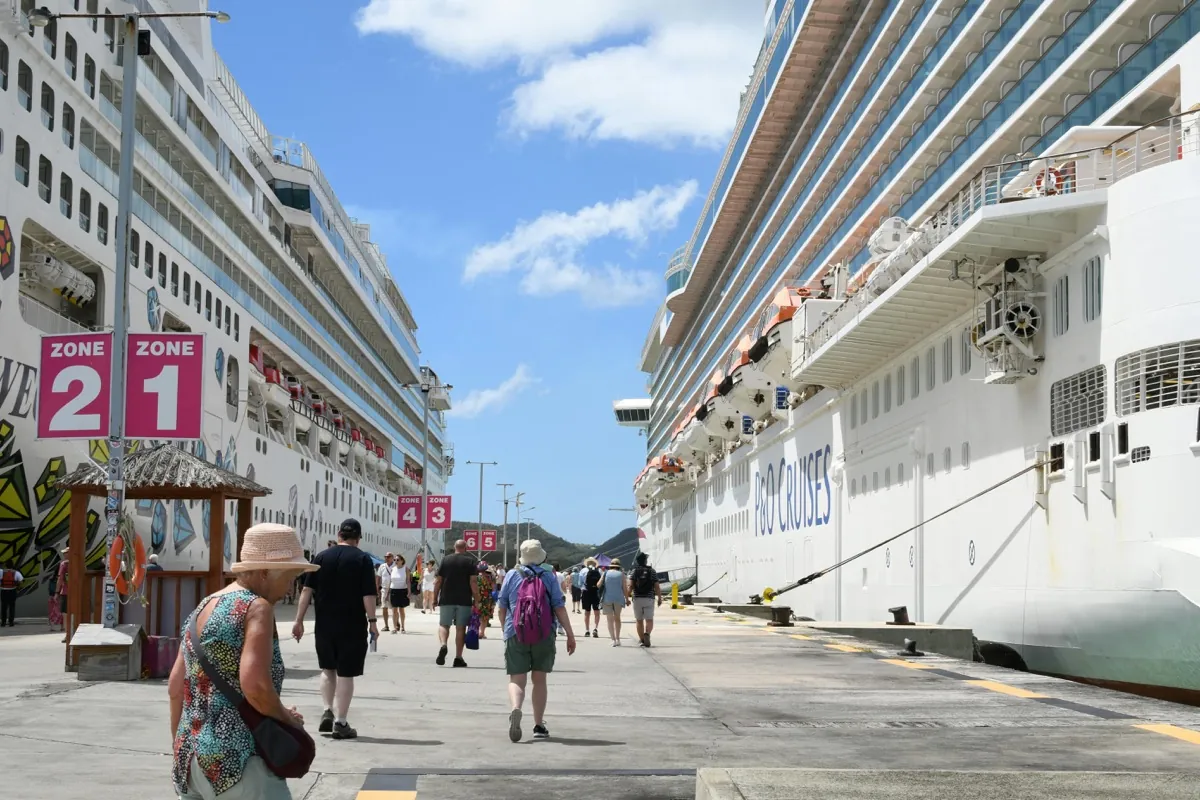
5,000 passengers. 4 hours. One terminal.
Nobody's talking about what happens between the dock and the door.
Here's what a turnaround day looks like at a major cruise homeport in 2026: a ship carrying 5,000 passengers docks at 6 AM. By 10 AM, most are gone. By 11 AM, a fresh wave of 5,000 arrives to board the same ship. That's 10,000 passenger movements through a single terminal in under six hours.
Some ports handle two or three ships on the same day. PortMiami — the busiest cruise port in the world — processes millions of passengers annually across multiple terminals. Port Canaveral handled 8.4 million passengers last year. Galveston is projecting 3.9 million passenger movements in 2026 and just approved a $2.4 billion, 20-year master plan because current capacity can't keep up.
The industry has invested heavily in making the inside of this process faster. Biometric facial recognition. Mobile check-in. Automated baggage screening. Self-service kiosks. The world's newest cruise terminal — MSC's facility at PortMiami — features end-to-end biometric embarkation, 42 luggage screening machines, and 22 automated e-gates.
But between the parking garage and the terminal door? Between the terminal door and the gangway? Between the remote shuttle drop-off and the check-in hall? That's still a walk. A long one. Often in the heat. Often with luggage. Often for passengers who aren't built for it.
The gap that turnaround day exposes
Cruise terminal design has become extraordinarily sophisticated. Multi-story facilities separate embarkation and disembarkation by floor level — arriving passengers flow through ground-level customs and baggage claim while departing passengers check in and wait on the upper level. The model borrows directly from airport terminal design, and the best new facilities rival airports in processing speed and passenger experience.
But airports have something cruise terminals mostly don't: a comprehensive onsite transportation layer between the parking structure and the gate.
It's the same missing layer we've documented in warehouses and distribution centers and at data center construction campuses — the outdoor transit between where people park and where they need to be. At a cruise terminal, the consequences just happen to fall on passengers pulling luggage instead of workers on a shift.
At an airport, you park in a remote garage and ride a shuttle, tram, or people mover to the terminal. The system runs continuously. The route is fixed. The frequency is posted. You don't think about it because it just works.
At most cruise terminals, you park — sometimes in a structure integrated with the terminal, sometimes in a remote lot across the port campus — and then you walk. You walk with your carry-on bags, your family, your elderly parents. You walk in the Florida sun or the Galveston humidity or the Seattle rain. You walk past construction zones at ports that are mid-expansion, through temporary detours, across surfaces that weren't designed for pedestrians pulling roller bags.
And if you're one of the passengers who can't walk that distance? You wait. You hope a wheelchair attendant or a courtesy cart is available. During peak embarkation, when hundreds of passengers are arriving simultaneously, there may be a wait for assistance. Royal Caribbean's own accessibility page notes that wheelchair assistance is available from terminal check-in to the ship — but adds that "during peak times there may be a wait."
"May be a wait" is the quiet admission that the system doesn't scale.
The demographic reality
Here's what makes cruise terminals fundamentally different from every other environment FlexTram serves: the passenger demographic.
The average cruise passenger is older than the average festival attendee, stadium fan, or theme park visitor. A significant and growing percentage of cruise passengers have some form of mobility limitation — whether that's a wheelchair, a walker, a cane, or simply the reduced stamina that comes with age. Many are traveling with multi-generational family groups that include both elderly grandparents and young children.
The cruise industry knows this. It's why ships have accessible cabins, elevators to every deck, and mobility assistance programs. It's why the Department of Transportation issued a Final Rule in 2010 specifically addressing ADA compliance on cruise vessels — and why Carnival's 2015 ADA settlement established detailed accessibility standards across its fleet.
But that compliance focus has been overwhelmingly concentrated on the ship and the terminal building. The space in between — the walk from the car to the door, the transit from the remote lot to the check-in hall, the movement from the drop-off curb to the gangway — sits in an operational gray zone where accessibility is handled ad hoc rather than by design.
An accessibility guide for cruise travelers puts it directly: if mobility is limited, pre-planning is essential to avoid long-distance walking on embarkation day. That's advice given to passengers — plan around the problem — rather than a solution implemented by the port. The burden is on the traveler to manage a gap that the infrastructure doesn't address.
A scheduled, ADA-accessible tram on a fixed loop eliminates that burden entirely. The route is posted. The vehicle is accessible as standard — not as a special request that may or may not be available during peak times. Every passenger, regardless of mobility, knows where to board and when the next ride arrives. For a demographic that skews older and travels with more luggage than any other segment, that's not a convenience. It's the difference between an embarkation experience that feels premium and one that feels like an obstacle course.
The port construction boom creates the opportunity
The cruise port expansion underway right now is staggering in scale.
PortMiami broke ground on Cruise Terminal G in January 2026, adding to an already massive campus. Port Canaveral is investing $500 million in upgrades over five years, including a 65% expansion of Terminal 5 and increased capacity at Terminal 10 to handle ships carrying 5,600 passengers. Galveston — already the fourth-largest cruise homeport in the U.S. — just approved a $2.4 billion master plan that calls for three new cruise terminals, multiple parking garages, and an eventual capacity of 10 million annual passengers by 2045. Port Tampa Bay is building a fourth terminal after a record 1.6 million passengers in 2025.
During these construction phases, the passenger experience gets worse before it gets better. Temporary detours. Relocated parking. Longer walks between structures. Changed drop-off points. Reduced curb space. All while passenger volumes continue to climb — Galveston alone is expecting 445 sailings this year.
This is the exact environment FlexTram was built for. A pop-up transportation system that deploys in hours, runs on temporary surfaces, adapts as the construction footprint changes, and stores compactly when the ships are at sea. During the construction phase, it bridges the gaps that expansion creates. Once the new terminals are operational, it becomes the permanent transit layer connecting parking structures, terminal buildings, and remote facilities across a port campus that keeps getting bigger.
What the Brooklyn model tells us
One of the most illuminating documents in cruise terminal operations is the Brooklyn Cruise Terminal Community Traffic Mitigation Plan, published by NYC EDC in 2025. It's a detailed, unflinching look at what happens when a major cruise operation outgrows its infrastructure.
The plan describes high passenger traffic volumes on cruise days causing spillover negative impacts into the surrounding neighborhood. It documents congestion from simultaneous embarkation and disembarkation, the challenge of coordinating thousands of arriving vehicles with limited curb space, and the need for strategies including promotion of shuttles, park-and-ride options, and ferry systems to encourage passengers to use mass transit modes.
In other words: the port authority itself is acknowledging that the current model — everyone drives to the terminal, parks (or doesn't), walks to the building, and hopes for the best — doesn't work at scale. The mitigation strategies they're exploring are exactly the kind of problems a fixed-route tram system solves by design.
The Brooklyn example isn't unique. It's just the one that got documented publicly. Every growing cruise homeport in America is dealing with some version of the same problem: more passengers, bigger ships, limited real estate, and a ground transportation plan that was designed for a fraction of current volume.
The sponsorship angle ports haven't considered
Cruise terminals have one characteristic that makes them uniquely attractive for sponsored transportation: the passenger is in a spending state of mind.
A person boarding a cruise has already committed thousands of dollars to the experience. They're on vacation. They're receptive to premium services, brand messaging, and anything that enhances the feeling that the experience has begun. A branded tram ride from the parking garage to the terminal — perhaps sponsored by the cruise line itself, or by a port retail partner, or by a destination tourism board — isn't an interruption. It's the first touchpoint of the vacation.
Cruise lines already understand this. MSC's new Galveston terminal features a digital welcome screen at the entryway and a dedicated lounge for their premium guests. The embarkation process is designed to build anticipation. But right now, that experience design starts at the terminal door. Everything before it — the drive, the parking, the walk — is a dead zone.
A branded Dock-and-Ride service extends the experience back to the parking structure. It wraps the passenger in the vacation from the moment they leave their car. And for the port authority, it creates a sponsorable asset and a potential revenue line from infrastructure that's currently a pure cost center — exactly the model we've proven at festivals and stadiums.
Running a homeport turnaround? Let's map the flow.
We're working with cruise operators and port terminals on dock-to-door systems that handle the surge without adding staff.
The ships keep getting bigger
The cruise industry's growth trajectory makes this problem worse with every new ship class.
Royal Caribbean's Icon of the Seas — the world's largest cruise ship — carries nearly 10,000 passengers and crew. MSC's World Class vessels carry over 6,000 guests. Every new generation of ships is larger than the last, which means more passengers per turnaround day, more vehicles arriving at the port, more luggage, and more people making the walk from the parking lot to the gangway.
The terminal buildings are being designed to handle this volume inside. The biometrics, the baggage systems, the check-in flow — all of that scales with investment. But the ground-level transit between the car and the building scales with nothing. It's the same walk it was when the ships carried 2,000 passengers. Now it just has three times the people doing it simultaneously.
Port directors and terminal operators have spent the last decade optimizing everything that happens after a passenger walks through the terminal door. The next decade will be defined by what happens before they reach it.
Beyond the homeport: the destination revenue problem
Everything above describes the homeport — the embarkation terminal in Miami or Galveston or Tampa where the voyage begins and ends. But the people-moving problem doesn't stay dockside in Florida. It follows the ship to every port of call — and at the commercial Caribbean stops, the same pier-to-town gap drives a measurable drop in disembark rates and per-passenger spending.
Here's the part most people outside the cruise industry don't realize: cruise lines don't just visit Caribbean destinations. Increasingly, they own them.
Royal Caribbean owns Perfect Day at CocoCay and Labadee in Haiti, and recently opened the Royal Beach Club in Nassau. Carnival operates Half Moon Cay and built Celebration Key as a private destination in the Bahamas. MSC developed Ocean Cay Marine Reserve as an exclusive island experience. These aren't sponsorship deals or day-pass partnerships. They're owned assets — beaches, restaurants, bars, retail shops, cabanas, water parks — all generating revenue directly for the cruise line. (The FlexTram cruise-destinations atlas catalogs all 16 owned destinations across Royal Caribbean, Carnival, Disney, MSC, NCL, and Princess — with acreage, daily capacity, berth count, and current transit status per entry, updated August 2026.)
And at every one of these destinations, the same transit gap exists. Passengers disembark via tender boat or gangway, arrive at a dock, and then need to get to the venues where the money is spent. The beach club is a quarter mile down a path. The shopping village is a 10-minute walk in the opposite direction. The waterpark is past the dining pavilion on the far end of the island. At a private destination with 3,000–5,000 passengers arriving over a 2–3 hour window, that walk isn't just an inconvenience. It's a drag on per-passenger revenue.
Every minute a passenger spends walking from the tender dock to the beach bar is a minute they're not spending at the beach bar. Every family that turns around halfway to the waterpark because the grandparents can't make the walk is a set of cabana rentals and food purchases that never happen. At a destination the cruise line owns, the revenue impact of that friction isn't theoretical — it hits the P&L directly.
This is where FlexTram's compact form factor becomes a genuine differentiator. Most Caribbean ports of call are small. Roads are narrow. Infrastructure is minimal. There's no room for buses, and the terrain often can't support heavy vehicles. Golf carts are the default — and the limitations are the same ones we see at festivals and stadiums: low capacity, no fixed routes, no schedule, and utilization rates that waste more capacity than they use.
A FlexTram carries up to 27 passengers on a vehicle designed for tight, unpredictable spaces. It operates on pavement, gravel, sand-packed paths, and unfinished surfaces. It deploys without permanent infrastructure. And at a private island or port-of-call destination, it does something no golf cart fleet can do: it creates a reliable, high-capacity transit loop that gets passengers from the dock to the revenue centers faster, more comfortably, and in greater numbers.
For the cruise line, this isn't a cost center. It's a revenue accelerator. The tram doesn't just improve the guest experience — it compresses the time between arrival and first purchase. On a port call where passengers have 6–8 hours on the island, recovering even 15–20 minutes of walking time per passenger translates directly into additional spend across dining, retail, excursions, and premium rentals.
And the sponsorship model works here too — perhaps even better than at a homeport. A branded tram loop at a private island destination, sponsored by a beverage partner or a retail brand, turns the ride itself into the first activation of the port call experience. The passenger steps off the tender and onto a branded tram that delivers them to the heart of the destination. The vacation doesn't pause between the ship and the shore. It continues seamlessly.
The cruise industry has spent billions engineering the onboard experience — every deck, every restaurant, every entertainment venue designed to maximize guest satisfaction and per-passenger revenue. The owned destinations are an extension of that same strategy. But the transit between the dock and the destination? That's still a walk. And for a company that owns both ends of the journey, that walk is the most expensive gap in the guest experience.
The opportunity is end to end
The cruise industry's future is being built right now — at homeports expanding to handle bigger ships and record passenger volumes, and at private destinations being developed as extensions of the onboard experience. In both environments, the people-moving problem is real, growing, and unsolved.
FlexTram operates at both ends. Homeport terminal shuttles during turnaround day. Destination tram loops at ports of call. Construction-phase transit during terminal expansions. Permanent campus mobility once the new infrastructure is operational. One vehicle platform, one operational model, deployed wherever the cruise line moves people — which, as it turns out, is everywhere.
— The FlexTram Team
Frequently asked questions
How many passengers move through a major cruise homeport on turnaround day?
A single ship carrying 5,000 passengers creates 10,000 passenger movements through one terminal in under six hours — disembarkation in the morning, embarkation in the afternoon. Some ports handle two or three ships on the same day. Port Canaveral handled 8.4 million passengers last year, and Galveston is projecting 3.9 million passenger movements in 2026.
Why are cruise terminals particularly sensitive to pedestrian transit gaps?
The average cruise passenger is older than the average festival, stadium, or theme park visitor. A significant percentage have mobility limitations. Many travel with multi-generational family groups. A long walk from parking to terminal in Florida heat or Galveston humidity isn't an inconvenience for this demographic — it's a barrier.
How does FlexTram handle cruise terminal construction and expansion phases?
FlexTram deploys as a pop-up transportation system that runs on temporary surfaces and adapts as construction footprints change. During port expansions — like PortMiami's Terminal G, Port Canaveral's $500M upgrade, or Galveston's $2.4B master plan — it bridges the passenger experience gaps that construction creates. Once new terminals open, it transitions to a permanent transit layer.
Can FlexTram operate at private island cruise destinations?
Yes. Private destinations like Perfect Day at CocoCay, Celebration Key, and Ocean Cay need the same kind of high-capacity transit between the tender dock and revenue venues. FlexTram's compact form factor and ability to operate on pavement, gravel, and sand-packed paths make it ideal for these tight, unpaved island environments.
What's the revenue impact at cruise line owned destinations?
Every minute a passenger spends walking from the tender dock to the beach bar is a minute they're not spending at the beach bar. Recovering 15–20 minutes of walking time per passenger translates directly into additional spend across dining, retail, excursions, and premium rentals.
Explore solutions
Ready to bridge the dock-to-door gap?
FlexTram offers rentals, long-term leases, and turnkey transportation plans for cruise terminals, port operations, private island destinations, and maritime facilities of any size.