Port of call.
The 4-hour window nobody optimizes.
In 2024, cruise passengers made 29.4 million shore visits across 33 Caribbean and Latin American destinations. They spent an average of $104.36 per visit — $3.07 billion in direct passenger spending. That $104 is one of the most studied numbers in the cruise industry. The number that doesn't get nearly enough attention: how much of it is lost to friction between the pier and the first place a passenger can actually spend money.
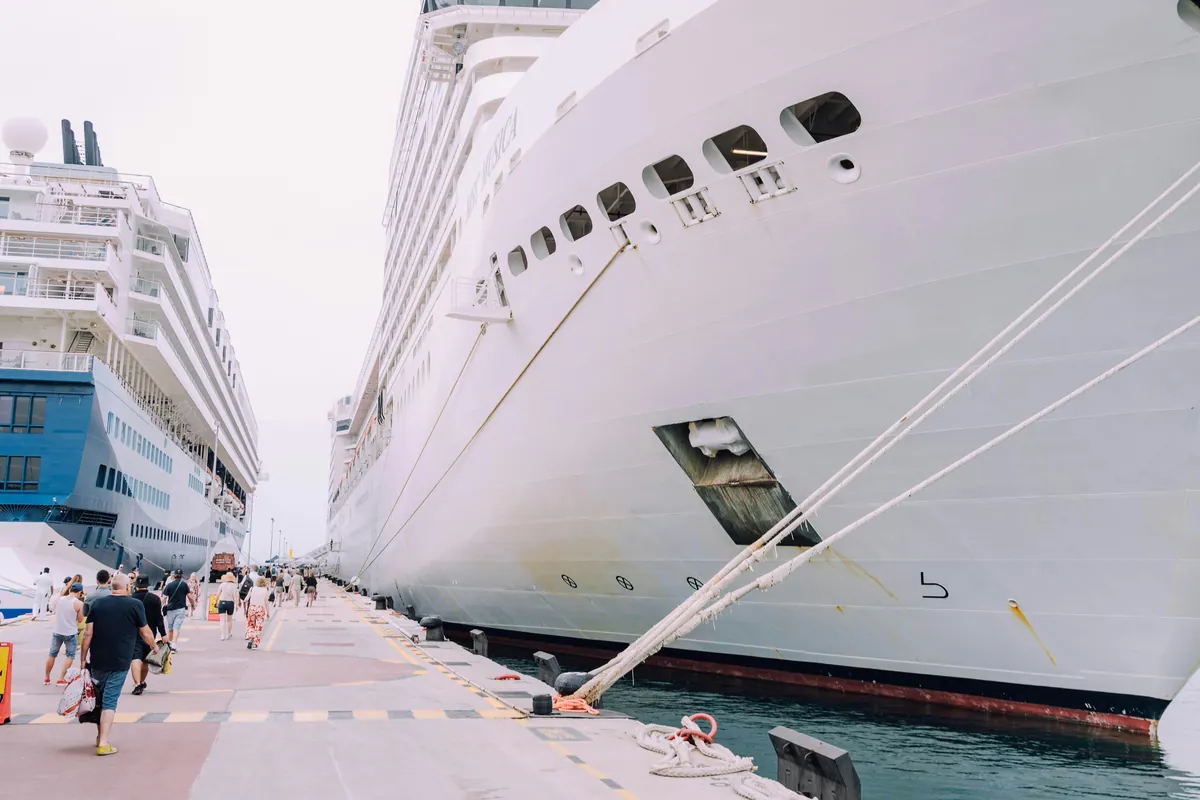
At most ports of call, that gap is significant. The ship docks. Passengers disembark down a gangway. They walk down a pier. They exit into a port area. And then they need to get to town — to the shops, the restaurants, the excursion staging area, the beach, the commercial district.
At some ports, town is right there. Cozumel's Punta Langosta pier opens directly into downtown San Miguel. You step off the ship and you're shopping.
At others, it's not. Civitavecchia docks inside a large commercial harbor — passengers take a shuttle from the pier to the edge of the port, then walk to town or the train station. Juneau's cruise ships dock at piers that can be a 15-to-20-minute walk from the downtown district. Nassau's Prince George Wharf is close to Bay Street, but the walk through the port area, across the road, and into the commercial zone can feel longer than the map suggests — especially in the Bahamian heat, for a demographic that skews older.
The gap between the pier and the first commercial touchpoint isn't just an inconvenience. It's a revenue filter. And every minute a passenger spends crossing it is a minute they're not spending money in the destination economy.
The disembark rate is already falling
Here's a trend that should concern every port authority: the percentage of cruise passengers who actually get off the ship is declining.
The BREA study found that transit passenger disembark rates dropped from 85% in 2018 to 83% in the most recent study period. Crew disembark rates fell even more sharply — from 39% to 30%. (BREA / FCCA)
A 2-point drop in passenger disembark rates across 29.4 million shore visits represents hundreds of thousands of passengers who stayed on the ship instead of going ashore. Each one of those passengers represents $104 in average spending that the destination didn't capture.
The reasons are multiple — some passengers prefer the ship, some have been to the port before, some don't find the shore excursion options compelling. But one factor that the industry consistently underestimates is the physical experience of getting from the ship to the destination. For a 75-year-old passenger with a mobility limitation, a quarter-mile walk from the gangway through a port area to a taxi stand in 90-degree heat isn't a "short walk." It's a barrier. And the rational decision is to stay on the ship, where the pool, the buffet, and the air conditioning are right there.
Meanwhile, the ships themselves are getting better at capturing onboard spending. Onboard revenue now represents 30-35% of total cruise revenue — casinos, bars, specialty dining, spa services, retail. (Royal Caribbean Group / Carnival Corporation annual reports via Michigan Journal of Economics) Every dollar a passenger spends on the ship is a dollar not spent in the port. The ship is competing with the destination for the same wallet — and the ship has a structural advantage because it's easier to reach.
The port's counter-strategy has to be reducing friction. Making it easier to get off the ship and into the destination than it is to stay onboard. And the single largest friction point is the physical transit between the pier and the commercial district.
The 4-hour clock
At a typical port of call, the ship docks between 7 and 9 AM. Passengers begin disembarking around 8 or 9 AM. The "all aboard" time is usually 4 or 5 PM, with most lines requiring passengers back 60 minutes before departure. That gives the average passenger roughly 6-8 hours ashore.
But that's the theoretical window. The actual usable time is considerably less.
Subtract the disembarkation queue — 20 to 40 minutes on a large ship, depending on priority status and tendering requirements. Subtract the walk from the gangway through the port area to the commercial zone — 10 to 20 minutes, depending on the port layout. Subtract the return walk and the re-boarding queue — another 20 to 30 minutes, because most passengers budget extra time to avoid missing the ship.
The usable window for actual destination engagement — shopping, eating, sightseeing, excursions — is often closer to 4 hours than 6. And the first and last 30 minutes of that window are consumed by transit, not by the destination experience.
For a passenger who booked a shore excursion through the cruise line, the transit is handled — a bus or van picks them up at the pier. For the 40-60% of passengers who go independent, the transit gap is theirs to solve. And solving it usually means walking, finding a taxi, or figuring out a local shuttle system they've never used before, in a place they may have never visited.
That's not an arrival experience. That's a logistics exercise. And the passenger who finds it daunting — because of age, mobility, unfamiliarity, heat, or simply the inertia of being on vacation — is the passenger who turns around, walks back up the gangway, and doesn't spend a dollar ashore.
Closing the pier-to-town gap is a 1-day deployment.
FlexTram offers permanent port installations, equipment storage deployments, and turnkey transportation plans for port authorities, destination management companies, and cruise terminal operators.
Who actually loses
The passenger who stays on the ship doesn't lose much. The ship has restaurants, pools, entertainment, and activities. The onboard experience is designed to be self-contained.
The destination loses.
The shop owner on Bay Street in Nassau loses. The restaurant in downtown Juneau loses. The excursion operator in Cozumel loses. The taxi driver in St. Thomas loses. The artisan market in Bridgetown loses.
And the port authority loses — because port revenues are tied to passenger volumes and economic impact metrics that justify the infrastructure investment, the tax incentives, and the political support that keep the cruise ships coming.
The BREA study found that 14 of the 33 destinations studied recorded average per-passenger spending above $100. That means 19 destinations are below $100. For ports that are investing hundreds of millions in pier expansion and terminal upgrades — Nassau's $300 million port development, St. Maarten's $120 million pier expansion, Jamaica's $65 million Falmouth enhancement — the return on that investment depends directly on how much each passenger spends ashore. (Hope Research Group / Caribbean Cruise Industry Analysis)
A tram system running a continuous loop from the pier to the commercial district doesn't just improve the passenger experience. It directly impacts the economic model that justifies the port's existence as a cruise destination.
The transit solution most ports don't have
At owned destinations like CocoCay and Celebration Key, the cruise lines have already solved this — complimentary tram services with multiple loops and stops, running continuously from the pier into the destination. The cruise line controls both the ship and the island, so designing the transit is part of designing the destination.
At commercial ports of call, nobody owns the gap.
The cruise line's responsibility ends at the gangway. The port authority manages the pier and the port area. The city or the tourism board manages the commercial district. The transit between them falls into a no-man's-land — technically the port's jurisdiction, but rarely the port's priority.
Some ports have shuttle buses. Some have taxi queues. Some have nothing — the passenger walks, and the distance determines how many of them make it to town.
A tram system running a fixed loop from the pier to the commercial district addresses the gap directly:
For the port authority: Higher disembark rates. More passengers reaching the commercial zone. Better economic impact metrics. A visible, quantifiable improvement in the guest experience that can be included in cruise line solicitation materials.
For the destination economy: More foot traffic in the shops, restaurants, and markets. More time for passengers to browse and buy because they didn't spend the first 20 minutes walking. More accessibility for the passengers who would have stayed on the ship because the walk was too far.
For the cruise line: A better port experience for their passengers, which factors into itinerary planning decisions. Cruise lines evaluate ports based on passenger satisfaction scores, and a port that moves passengers efficiently from pier to destination scores higher than one that dumps them on a pier and wishes them luck.
For the passenger: A clear, visible, easy way to get from the ship to the destination and back. No guessing. No navigating. No wondering if the walk is worth it. Step off the ship, step onto a tram, arrive at the commercial district. That's an experience that invites the passenger ashore instead of making them calculate whether it's worth the effort.
Equipment that lives at the port
The deployment model for a port-of-call tram system mirrors what we described in our owned-destination piece: the equipment lives onsite.
A port that receives cruise ships on a regular weekly or bi-weekly schedule doesn't need to rent or ship tram equipment for each call. The vehicles are stored at the port — in a maintenance compound, a covered storage area, or a dedicated equipment facility near the pier. When a ship arrives, the vehicles are staged. When the ship departs, the vehicles return to storage.
Local port staff operate the system. The drivers are trained on the specific route between the pier and the commercial district. They know the port layout. They know the passenger flow. They know the heat, the terrain, and the timing. The tram system is a port amenity — part of the port's infrastructure, staffed by the port's people, serving the port's economic interests.
The operating cost is offset by the economic impact. If a tram system increases the disembark rate by even 2 percentage points — returning to the 2018 baseline — and increases the average time-in-destination by 15 minutes per passenger, the incremental spending captured by the local economy dwarfs the cost of the tram operation.
The math isn't speculative. It's the same math the port authority already uses to justify pier expansion, terminal upgrades, and tourism marketing. The tram is just the last piece of infrastructure between the investment and the return. The same operational logic applies on the homeport side too — turnaround day at PortMiami, Galveston, or Port Canaveral has the same pier-to-terminal walk problem in a different form.
The port that makes it easy wins
Cruise lines are building their own destinations for a reason. Owned islands let them control the entire guest experience — including the transit from pier to venue. The economics of CocoCay and Celebration Key prove that when you remove friction, guests engage more deeply and spend more time doing what the destination was designed for.
Commercial ports can't build private islands. But they can apply the same principle: make it easy to get from the ship to the destination, and more passengers will make the trip.
The ports that are investing hundreds of millions in terminal upgrades and pier expansion are making a bet — that more ships and more passengers will translate into more economic impact. That bet only pays off if the passengers get off the ship and reach the places where they spend money.
Right now, 17% of passengers don't disembark at all. Of the 83% who do, an unknown percentage limits their time ashore because the transit friction discourages deeper exploration. Every one of those passengers is a lost opportunity — not for the cruise line, which captures them onboard, but for the destination economy that depends on their arrival.
The port that makes it easiest to get from the pier to the town is the port that captures the most value from every ship that docks.
Frequently asked questions
Why does the pier-to-town transit gap matter for cruise ports of call?
Every minute a cruise passenger spends crossing the gap between the pier and the first commercial touchpoint is a minute they're not spending money in the destination economy. With 29.4 million Caribbean shore visits in 2024 generating $3.07 billion in direct passenger spending at $104 per visit, the friction between the gangway and the commercial district is a measurable revenue filter — especially for older passengers and those with mobility limitations who may turn around rather than cross it.
How much do cruise passengers actually spend ashore?
The 2024 BREA / Florida-Caribbean Cruise Association study found cruise passengers averaged $104.36 per shore visit across 33 Caribbean and Latin American destinations. Fourteen of the 33 destinations recorded average per-passenger spending above $100; 19 were below. For ports investing hundreds of millions in pier and terminal infrastructure — Nassau's $300 million expansion, St. Maarten's $120 million pier, Jamaica's $65 million Falmouth enhancement — the return on those investments depends directly on how much each passenger actually spends ashore.
What's a typical deployment model for a port-of-call tram system?
The equipment lives at the port. Vehicles are stored in a maintenance compound or dedicated equipment facility near the pier; they're staged when ships arrive and returned to storage when ships depart. Local port staff operate the system — drivers trained on the specific route, the port layout, and the passenger flow. This mirrors the deployment model used at owned cruise destinations like CocoCay and Celebration Key, where the equipment is part of the destination's infrastructure rather than a contracted-service arrival.
How does the disembark rate trend affect port economics?
BREA found transit passenger disembark rates dropped from 85% in 2018 to 83% in the most recent study period. Crew disembark rates fell from 39% to 30%. A 2-point drop across 29.4 million shore visits is hundreds of thousands of passengers staying on the ship — at $104 average spend, that's tens of millions of dollars the destinations don't capture. Onboard cruise revenue has grown to 30-35% of total cruise revenue at the same time, meaning the ship is structurally winning the wallet competition with the port. Reducing pier-to-town friction is the port's most direct counter-strategy.
How does this differ from owned cruise destinations like CocoCay?
At owned destinations, the cruise line controls both the ship and the island, so designing the transit is part of designing the destination — and complimentary tram services are already standard. At commercial ports of call, nobody owns the gap. The cruise line's responsibility ends at the gangway. The port authority manages the pier. The city manages the commercial district. The transit between them falls into a no-man's-land that's technically the port's jurisdiction but rarely the port's priority. A port-installed tram system closes that gap deliberately rather than leaving it to chance.
Related reading
Close the pier-to-town gap. Capture the spending that's already on the ship.
FlexTram offers permanent port installations, equipment storage deployments, and turnkey transportation plans for port authorities, destination management companies, and cruise terminal operators.