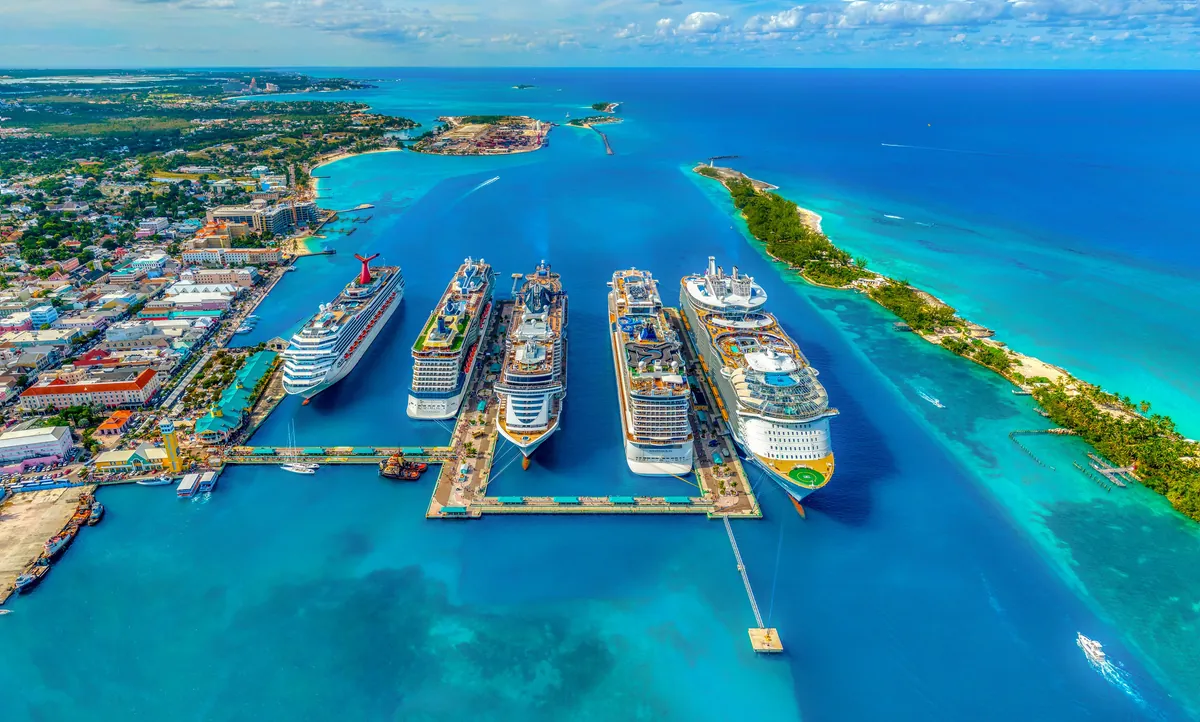
Cruise-line-owned
private destinations.
A practitioner reference. Sixteen cruise-line-owned destinations across Royal Caribbean, Carnival, Disney, MSC, Norwegian, and Princess — with the operational facts (acreage, berths, daily capacity, current onsite transit) and the kind of context that doesn't appear in vendor brochures.
In 1977, Norwegian Cruise Line stopped at a 268-acre cay in the Berry Islands of the Bahamas and called it a private destination. It was the first time a cruise line had built one. (NCL) Forty-nine years later, every major cruise line operates at least one — many operate two or three — and the category has crossed thresholds that would have been hard to imagine in the founding era: a single-investment scale of $600 million (Carnival's Celebration Key, opened July 2025), a daily guest capacity of 13,000 (Royal Caribbean's Perfect Day at CocoCay, expanded 2023), and active capex expansion across nearly every major brand.
This atlas catalogs the sixteen cruise-line-owned private destinations that matter most for fleet planning, partnership development, and destination operations as of August 2026. Each entry covers the operational facts a destination-ops practitioner actually needs — parent ownership, acreage, daily guest capacity, ship-berth count, and the current state of onsite transit — followed by the kind of context that doesn't appear in vendor brochures.
FlexTram operates onsite transit at large venues and properties: events, stadiums, industrial campuses, and most relevantly here, cruise destinations where the asset lives onsite, runs continuous loops between arrival and amenity zones, and is operated by local destination crew. Royal Caribbean's CocoCay runs a four-stop tram on continuous rotation. Carnival's Celebration Key runs hop-on/hop-off service across four lagoons. The pattern is increasingly standard at the largest destinations and increasingly absent from the smaller ones — and the operational consequence shows up in guest-flow metrics, accessible-service request volume, and the rate at which a destination's developed footprint outgrows the walking-distance assumption underneath it.
What follows is the catalog. Entries are grouped by parent cruise line. Sources cited inline. Last updated September 14, 2026.
Royal Caribbean International
Perfect Day at CocoCay
Royal Caribbean International (Royal Caribbean Group) · Little Stirrup Cay, Berry Islands, Bahamas
- ~140 acres. Opened 1990 as CocoCay; $250M "Perfect Day" redevelopment opened May 2019; Hideaway Beach adult expansion opened January 2024.
- ~13,000 guests at peak daily capacity (expanded 2023 from original 6,000 design).
- 2-ship pier, Oasis-class capable since June 2018.
- Active continuous tram service. Island Tram runs four stops (Arrivals Plaza, South Beach, Oasis Lagoon, Chill Island/Breezy Bay) on ~10–15 minute headway. Dedicated Hideaway Beach tram serves seven stops within the adult-only expansion. Accessible trams are in standard rotation; guests request via Guest Services rather than a separate accessible-only fleet.
CocoCay is the category benchmark on operational tram throughput. The platform is leased from the Bahamian government rather than owned outright — a structural detail that matters less for daily operations and more for any conversation about long-term capital improvements. The post-2019 Perfect Day branding now functions as a marketed destination on its own; many Royal Caribbean itineraries sell "CocoCay-included" as the headline value proposition rather than a side stop on the way somewhere else.
Source: royalcaribbean.com — Perfect Day at CocoCay transportation
Labadee
Royal Caribbean International · Northern coast peninsula, Haiti
- ~260 acres. Coastal peninsula leased from the Haitian government through 2050. Opened 1986; $55M improvements 2009.
- One ship per day · 720,000+ passengers + crew in 2019 (160 ship-days).
- 1-ship pier, 400m long, Oasis-class capable (since 2009).
- Complimentary tram service between Columbus Cove, Adrenaline Beach, Nellie's Beach, and Town Square. Plus the Dragon's Tail Coaster as a paid excursion within the destination.
- Currently offline (updated Aug 2026). Royal Caribbean suspended all Labadee calls in 2024 amid Haiti's security crisis and, as of late July 2026, extended the pause through June 2027 under a U.S. Level 4 travel advisory. The destination is fully non-operational, with Labadee-based staff reassigned across the fleet.
Labadee runs on a community-employment model — Haitian destination staff, a local artisan market, and the longest single-tenant lease in the category. What began in 2024 as episodic, itinerary-by-itinerary substitution has since hardened into a full multi-year suspension: Royal Caribbean has kept its published cadence intact by swapping other ports in, but the destination itself has now been offline long enough (through at least June 2027) that it functions as a stranded asset rather than a rotating one. It is the sharpest cautionary data point in this atlas on exposure concentration — a fully built, tram-equipped owned destination can still be zeroed out by factors entirely outside the operator's control, which is a live consideration for any line weighing how much of its guest-experience strategy to anchor to a single geography.
Sources: Labadee (Wikipedia); Travel Weekly — RCL extends Haiti pause through June 2027 (July 2026)
Royal Beach Club Paradise Island
Royal Caribbean International · Paradise Island, Nassau, Bahamas
- ~17 acres beachfront — smaller than most entries on this list; positioned as a beach club, not a full private destination.
- Soft-opened October 2025; grand opening December 23, 2025.
- ~4,000 guests at peak.
- No private pier. Guests tender or ferry from the Nassau cruise port (Prince George Wharf), where Royal Caribbean ships already dock — approximately a 10-minute ferry to the club.
- Walkable footprint. No tram service published.
This is the first property in Royal Caribbean's "Royal Beach Club" sub-brand — separate from "Perfect Day" and operating on a different model. It's a day-pass amenity built on top of an existing port call rather than a destination unto itself. The strategic read is that Royal Caribbean is building a tiered owned-destination portfolio: Perfect Day at the high end (CocoCay), Royal Beach Club as a value-add within existing high-volume ports (Nassau here, with more planned), and Labadee as the original community-model destination.
Source: royalcaribbean.com — Royal Beach Club Paradise Island
Royal Beach Club Cozumel
Royal Caribbean International (Royal Caribbean Group) · Cozumel, Quintana Roo, Mexico
- ~42 acres on the former Playa Mia site — roughly 2.5× the Paradise Island club and the largest property in the Royal Beach Club sub-brand to date.
- Opening December 31, 2026.
- No private pier. Sited about 20 minutes south of the Cozumel cruise port; guests transfer overland from an existing berth rather than arriving directly.
- Zoned in Royal Caribbean's standard chill / family / party configuration, with North Beach and South Beach areas and a large pool with swim-up bar. Day-pass access; open to Cozumel residents on limited days each year.
- No tram service published. The 20-minute port-to-club transfer is the defining movement problem, not internal circulation.
Cozumel is the clearest evidence that the Royal Beach Club tier is a deliberate portfolio strategy rather than a one-off. It also inverts the usual transit question. At CocoCay or Celebration Key the operational problem is internal — moving guests between arrival plaza and amenity zones once they are already on the property. Here the property sits 20 minutes from the berth, so the movement problem is the transfer itself: throughput between an existing public cruise port and a private club, at day-pass volume, on a fixed schedule, with an announced opening date that lands mid-holiday-week. Worth watching as the template for how lines add owned amenity capacity in ports they do not control — particularly with Perfect Day Mexico stalled, which leaves Cozumel carrying Royal Caribbean's western-Caribbean ambitions on its own for now.
Source: royalcaribbeanpresscenter.com — Royal Beach Club Cozumel
Carnival Corporation
Celebration Key
Carnival Cruise Line (Carnival Corporation) · East Grand Bahama, Bahamas
- 68 acres developed at opening; 154 acres of planned expansion; 110 acres wetlands preserve — ~332 acres total footprint.
- Opened July 19, 2025.
- Projected 2.2M annual guests in 2025; 4M projected by 2028.
- 4 berths as of 2026. The ~$100M Phase 2 pier extension completed ahead of schedule — doubling from 2 berths to 4, all Excel-class capable, with peak daily capacity now above 13,000 guests. First three-ship call ran in late spring 2026; three- and four-ship days become routine from September 2026. The expansion adds roughly 200 ship calls and 700,000 guest visits annually.
- Opening to sister brands. Princess Cruises begins calling November 1, 2026 (Star Princess inaugural); AIDA Cruises joins across the 2026–2027 season — making Celebration Key a multi-brand Carnival Corporation asset rather than a Carnival Cruise Line–only destination. (Sources differ on AIDA's exact first call — some list November 2026, others 2027.)
- Continuous hop-on/hop-off tram service across four portals/lagoons (Paradise Plaza, Calypso Lagoon, Lokono Cove, Pearl Cove).
Celebration Key is the largest single investment in Carnival Corporation's history (~$600M total project), built specifically to absorb Excel-class throughput at scale. The Sensory Inclusive Certification at opening (via KultureCity) is the operational headline that doesn't get enough attention: the destination is positioned as an integrated-ADA model from day one rather than a parallel accessible-service overlay. For comparison: most older destinations on this list still operate request-based accessible-transport models. Celebration Key sets a new floor.
Half Moon Cay (RelaxAway)
Holland America Line / Carnival Cruise Line (Carnival Corporation) · Little San Salvador Island, Bahamas
- 2,400 acres total; ~50 developed; ~90% of the island is preserved as a Bahamian nature reserve and bird sanctuary.
- Opened 1997 (Holland America purchased Little San Salvador for $6M in December 1996).
- Deep-water pier opened June 1, 2026 — ending nearly three decades of tender-only access. Excel-class capable. Carnival Sunrise was the first ship to dock (08:00, June 1).
- $50M transformation completed June 1, 2026 — ribbon-cutting attended by Carnival Cruise Line President Christine Duffy. Expanded beachfront, reservable cabanas and daybeds, and five new/upgraded F&B venues (Orchid Beach Grill, Hibiscus Beach Grill, Luna Tide Beach Bar, Stay Awhile Beach Shack, Lil' Tiki Bar).
- New island-wide tram service introduced with the June 2026 expansion, connecting all areas of the destination — replacing the previous tractor-drawn beach trams that only served remote beach areas.
Updated July 2026: the pier opened June 1 and the transformation is complete, converting Half Moon Cay from a tender-bottlenecked single-ship boutique destination into a Carnival Excel-class platform — exactly the inflection this atlas flagged in May. The detail worth underlining for operators: Carnival introduced island-wide tram service as part of the same expansion, not as a later retrofit. That is the pattern the category keeps repeating — once pier capacity rises, walking stops working, and transit becomes infrastructure rather than an amenity. The "RelaxAway, Half Moon Cay" rebrand of 2024 was the marketing signal that this repositioning was coming. The equestrian beach excursion is an unusual operational asset for a cruise destination — not the kind of thing most fleets can run without a long lead time on facilities and animal care — and worth noting for anyone benchmarking premium-tier amenity operations.
Source: carnival-news.com — Carnival celebrates expansion of RelaxAway, Half Moon Cay (June 2026)
Mahogany Bay / Isla Tropicale
Carnival Corporation · Isla Roatán, Honduras
- ~20 acres + adjacent 10-acre Mahogany Beach. $62M Carnival investment.
- Opened 2009; rebranded "Isla Tropicale" in 2026.
- 2-ship pier · 8,000+ simultaneous passenger capacity.
- "Magical Flyer" chairlift connecting the port arrival area to Mahogany Beach — a category-unique vertical transit asset (not a tram).
Mahogany Bay is the rare cruise-line-owned destination with named vertical transit infrastructure — the Magical Flyer chairlift is not just a guest amenity, it's an operational solution to a terrain problem (steep approach from pier-level to the beach plateau) that most destinations would solve with a shuttle road. Worth bookmarking as a case study in cruise-destination-specific transit design that goes beyond the standard tram-on-a-loop pattern. The 2026 rebrand to "Isla Tropicale" is part of a broader Carnival Corp portfolio renaming exercise.
Source: mahoganybayport.com
Amber Cove
Carnival Corporation · Puerto Plata, Dominican Republic
- ~25–30 acres. $85M Carnival investment.
- Opened October 2015.
- 2-ship pier · ~8,000 passengers.
- Exclusive to Carnival Corp brands (Carnival, Princess, Holland America, Seabourn, Costa, and AIDA).
- Walkable developed footprint.
Amber Cove is Carnival's gateway to the Dominican Republic and the operational template for a "private destination as a port-area redevelopment" — not a private island but a self-contained owned port within an active commercial area. It's worth comparing to Mahogany Bay structurally: similar acreage, similar investment scale, similar dual-berth design, but very different geography (mainland coast vs. island). Both function as the "Carnival Corp brand-portfolio destinations" in their regions — spreading the investment cost across multiple brand calls.
Source: carnival.com — Amber Cove
Princess Cays
Princess Cruises (Carnival Corporation) · Southern Eleuthera, Bahamas
- ~40 acres · ~1/2 mile of shoreline. Leased peninsula, not an island.
- Opened 1992.
- One ship/day, tender-only (no pier, ~100-passenger tenders).
- Walkable footprint. No tram service.
- Shared with Carnival Cruise Line since 2017.
Princess Cays is the smallest "real" private destination in the Carnival Corp portfolio — and increasingly looks dated against the same parent company's $600M Celebration Key build a few hundred miles north. The leased-peninsula structure (vs. island ownership) and tender-only model are both structurally constraining. The open strategic question is whether Carnival Corp invests further here or lets Princess Cays drift while Celebration Key absorbs the brand-portfolio traffic. Worth watching over the 2026–2028 horizon.
Disney Cruise Line
Castaway Cay
Disney Cruise Line (The Walt Disney Company) · Gorda Cay, Abaco Islands, Bahamas
- 1,000 acres total (3 mi × 2 mi); ~55 developed.
- Acquired 1996 (99-year lease); opened 1998. First private cruise destination with a direct walk-off pier (no tender) at opening.
- One ship/day.
- 1-ship pier · tram service from arrivals plaza to Family Beach, Serenity Bay (adults-only), and Pelican Plaza.
- ~140 Disney permanent residents live onsite to operate the destination.
Castaway Cay's two operationally distinctive features don't appear at any other destination on this list. First, the residential staffing model: Disney maintains a permanent onsite population of ~140 employees, which dramatically simplifies the day-of operational ramp but adds a fixed-overhead structure no competitor carries. Second, character meet-and-greets running outdoors creates intellectual-property protection considerations (costume integrity, performer rotation, weather management) that no other cruise destination has to design around. Both are precedents for what the next generation of branded private destinations will look like as cruise lines push more first-party IP onto the islands.
Disney Lookout Cay at Lighthouse Point
Disney Cruise Line · Southern tip of Eleuthera, Bahamas
- ~700 acres acquired; 152 acres designated developable; less than 16% built at opening; explicit cap of 20% ever.
- Opened June 6, 2024. Disney Magic was the first ship.
- One ship/day.
- 1-ship pier (direct walk-off).
- Walkable by design. Disney has not deployed a tram system per public materials — the small developed footprint and intentional preservation of green space are the brand differentiator.
Lookout Cay is the deliberate counter-positioning to the rest of the category: smaller, walkable-by-design, with ~80% of the acquired land left permanently undeveloped (Disney donated ~190 acres to the Bahamian government as a nature park on Harbour Island). The Bahamian artist collaboration and dual-naming with Junkanoo cultural elements are the marketing differentiator from Castaway Cay's more generic tropical-Disney aesthetic. Worth bookmarking as the case study in "smaller is the strategy" — this destination is structurally designed not to grow into the multi-berth, multi-tram operational profile of Celebration Key or CocoCay.
MSC Cruises
Ocean Cay MSC Marine Reserve
MSC Cruises (MSC Group) · Berry Islands, Bahamas
- ~95 acres (38.5 ha) · surrounded by 64 sq mi of protected marine reserve.
- Opened December 2019. Former industrial sand-mining island, now restored.
- Typically one ship/day; overnight stays on select sailings — the category-distinctive operational fact.
- 1-ship pier (direct walk-off).
- Walkable footprint. No published tram service.
Ocean Cay is the only cruise destination on this list with overnight stays as a standard product feature — MSC ships routinely dock through 11pm–midnight on most calls, with the restored lighthouse light shows replacing daytime amenity. That operational pattern requires onsite lighting infrastructure, evening F&B staffing, and entertainment design that no other destination in the category currently runs. The environmental restoration story (1.5 mi of reclaimed beach from an industrial sand-mining site) is the ESG marketing asset, and increasingly relevant in the Mexican regulatory pushback context that just hit Royal Caribbean's Perfect Day Mexico project.
Sir Bani Yas Island
MSC Cruises (long-term exclusive operating agreement; island owned by Abu Dhabi government) · Persian Gulf, UAE
- 2.5 km MSC beach footprint within the larger Sir Bani Yas Island (governmental wildlife reserve, ~87 sq km total).
- First MSC call: December 5, 2016.
- 2-ship 600m jetty opened 2021; overnight-capable.
- Operationally functions like an MSC private destination in the Caribbean model.
Sir Bani Yas is the only non-Caribbean entry in this atlas and the only one that operates on a long-term operating agreement rather than property ownership. The structural analog within this list is Royal Beach Club Paradise Island (operating rights without real estate) — both are examples of the category expanding beyond "buy or lease an island" into "lock down exclusive day-use operating rights on assets owned by others." Worth tracking as a model the other cruise lines are likely to apply to other governmental wildlife reserves, especially in regions where outright island acquisition isn't politically viable.
Norwegian Cruise Line Holdings
Great Stirrup Cay
Norwegian Cruise Line (Norwegian Cruise Line Holdings) · Berry Islands, Bahamas (immediately adjacent to Royal Caribbean's CocoCay)
- 268 acres (108 ha).
- Opened 1977 — the original cruise-line private destination, predating Castaway Cay by 21 years.
- Pier opened December 28, 2025 (Norwegian Getaway was the first ship) as part of a $150M expansion, then re-closed April 1, 2026 to build the final second-berth phase. Guests tendered ashore through the spring and early summer; the finished two-berth pier is now open — ships dock directly rather than tendering, and the island can take two at once for the first time in its 49-year history (confirmed in trade coverage by early Aug 2026).
- Great Tides Waterpark opened September 4, 2026 (inaugural call by Norwegian Luna) — nearly six acres across five headline attractions: The Wandering River (billed as the industry's first immersive river tunnel), The Great Slide, the Splash Cay family zone, Tidal Tower with its Breakwater Blasters dueling slides, and Cliffside Cove, whose cliff jumps are billed as the Caribbean's tallest.
- ~1 million guests projected across 15 ships in 2026.
- Island-wide tram service introduced with the waterpark (September 2026). A two-leg system: guests board at the Welcome Center, cross to the main island, and transfer to a dedicated waterpark tram that runs to the Great Tides entrance. Tram transportation is included with waterpark admission. The atlas had this entry as "walkable today; tram likely to follow as the developed footprint expands" — it followed within a month of the second berth opening.
- Now visited by Oceania and Regent (NCLH's other brands), not just Norwegian.
Great Stirrup Cay's recent inflection — the December 2025 pier opening — is the most significant operational change in the destination's 49-year history. The fact that the original cruise-line private destination spent decades as a tender-only single-ship operation while CocoCay (literally on the same Berry Islands chain) became a multi-billion-dollar tram-equipped Perfect Day platform is the cleanest possible example of how dramatically the category-leading operating model has pulled away from the founders. The 2026–2028 horizon will determine whether NCL closes the operational gap or accepts a permanent tier-two position.
Source: ncl.com — Great Stirrup Cay
Harvest Caye
Norwegian Cruise Line · Southern Belize coast
- 75 acres.
- Opened November 2016.
- One ship/day · 400 hard-capped ferry tickets/day for mainland excursions.
- 1-ship pier — only deep-water cruise pier in Belize.
- Walkable footprint.
Harvest Caye's strategic value is geographic monopoly: it's the only direct-access cruise pier in Belize, so any cruise line whose itinerary calls in the country either uses Harvest Caye or tenders. The 400-tickets/day cap on mainland excursions is the binding operational constraint — the destination can absorb a full ship's worth of beach-only guests but only a small fraction of guests who want to see the actual country. That tension between "private destination as self-contained" and "private destination as gateway to the host country" is a useful framing for any cruise line evaluating destination strategy in countries where it owns the only direct access.
Source: ncl.com — Harvest Caye
Royal Caribbean Group — in regulatory limbo
Costa Maya / Puerto Costa Maya (Perfect Day Mexico, planned)
Royal Caribbean Group (Royal Caribbean acquired Puerto Costa Maya + 34 surrounding properties for ~$292M, closed September 2024; took possession July 11, 2025) · Mahahual, Quintana Roo, Mexico
- Existing public port + ~230-acre planned buildout ("Perfect Day Mexico" — 20,000 guests/day, 30+ waterslides).
- Project status: regulatory limbo — relocation-pending as of Aug 2026. Mexico's SEMARNAT rejected the ~$600M project on May 19, 2026 — citing mangroves, coral reef, and groundwater/hydrological risk to the Mesoamerican Reef System. Royal Caribbean withdrew the proposal on May 27, 2026 (the day this atlas first published). Since then, Mexico's government (President Sheinbaum, late May 2026) confirmed Royal Caribbean may explore a different location in Mexico subject to fresh environmental review, and CEO Michael Bayley reaffirmed on the Q1 call that Perfect Day Mexico is still targeted to open in late 2027 — so this reads as relocation-pending, not cancelled. No revised site or timeline has been published.
- Existing port currently operating as a multi-line public port (calls from Carnival, MSC, Norwegian, Virgin Voyages, alongside Royal Caribbean).
Costa Maya is the only entry in this atlas in active regulatory limbo — and the freshest data point for anyone trying to project the future of the private-destination category. The SEMARNAT rejection is significant because it's the first major governmental block on a private-destination buildout in the category's history; previous expansions (CocoCay, Celebration Key, Lighthouse Point) all moved through their approvals without comparable resistance. Watch closely — the next year's regulatory developments here will set the precedent that informs every future cruise-line destination acquisition in Mexico, the Caribbean, and beyond. The existing port operations continue unaffected; only the Perfect Day Mexico buildout is on hold.
Source: seatrade-cruise.com — SEMARNAT rejects Perfect Day Mexico
Patterns across the category
Tram service is becoming category standard at the largest destinations. Perfect Day at CocoCay and Celebration Key both operate continuous tram circulation as a designed-in operational feature, not an accessibility afterthought. Castaway Cay and Labadee run tram service across multiple zones. Half Moon Cay's 2026 pier opening will almost certainly drive a tram deployment as the developed footprint expands beyond walking distance. The deliberate counterexamples — Lookout Cay's walkable-by-design philosophy, Ocean Cay's compact single-loop layout — are themselves strategic positioning rather than the absence of a system. The under-served operational tier today is the mid-size 75–140-acre destinations (Harvest Caye, Amber Cove, Mahogany Bay, Great Stirrup Cay before December 2025) where walking distances are at the edge of what a typical cruise guest population can absorb and where the next operational investment is likely to be a structured transit system rather than further amenity expansion.
Pier capacity is the binding operational constraint. Single-berth = single-ship/day = limited itinerary flexibility. The active capex direction across the industry is dual- and quad-berth conversion: CocoCay (2-ship since 2018), Celebration Key (2 berths growing to 4 by 2026), Great Stirrup Cay (single-berth pier opened December 2025, re-closed April 2026 for second-berth construction, reopened as a two-berth pier by August 2026), Half Moon Cay (deep-water pier live since June 2026). Pier capacity, more than acreage, is the metric that defines whether a destination is a strategic asset or an inflexible asset.
The category is in unprecedented capex expansion. Within an 18-month window we have Celebration Key ($600M, July 2025), Royal Beach Club Paradise Island (December 2025), Great Stirrup Cay's pier (single-berth December 2025, two-berth August 2026), Half Moon Cay's pier (June 2026), Lighthouse Point (June 2024), and the now-blocked Perfect Day Mexico (May 2026). Six major openings or buildouts in 18 months in a category that historically averaged one or two per decade is a clear signal of strategic shift: destinations are no longer itinerary fillers but profit centers, and the major cruise lines are racing to capture exclusive owned-destination footprint before the remaining viable sites are taken.
Owned destinations are becoming first-party revenue centers, not just port calls. Carnival's $600M Celebration Key investment is impossible to justify on per-port economics alone; the financial model requires the destination to drive itinerary premiums, in-destination spend, brand differentiation, and increasingly, marketing currency on its own. The Perfect Day branding at CocoCay is the cleanest example: "CocoCay-included" sells the itinerary at a premium. Celebration Key is being marketed the same way. The category is shifting from "destinations exist to make itineraries work" to "destinations exist to make cruise lines worth choosing." That has implications for how onsite operations are designed, branded, and resourced.
ADA integration vs. parallel service is the next operational standard. Celebration Key's Sensory Inclusive Certification at opening (KultureCity) signals where the category is going: integrated accessible service as part of the standard guest experience, not a request-based parallel system. Most older destinations on this list still operate request-based accessible-transport models — a model that increasingly fails to scale as the 65+ population grows and as the ADA-demand surge documented in recent demographic analysis moves from a 5–10% guest base to a 15–20% guest base over the next decade.
What's coming
✓ Shipped since the last update. Three items forecast in the May 2026 edition have now landed: the Half Moon Cay pier opened June 1, 2026 (with island-wide tram service introduced alongside it); the Celebration Key Phase 2 pier extension completed ahead of schedule, taking the destination from 2 berths to 4; and Great Stirrup Cay's Great Tides Waterpark opened September 4, 2026, with a two-leg island tram introduced alongside it. In all three cases the pattern held: pier capacity rose first, and circulation infrastructure followed.
Great Stirrup Cay second berth (Norwegian) — complete and open. The December 2025 pier was re-closed April 1, 2026 for the final second-berth phase, guests tendered ashore through the spring and early summer, and the finished two-berth pier is now open. That converts NCL's founding destination into a genuine multi-ship platform for the first time in 49 years — and is the point at which its walkable footprint stops being walkable. That point has now arrived: the Great Tides Waterpark opened September 4, 2026 with a two-leg tram system from the Welcome Center to the park entrance, included with admission. Great Stirrup Cay is the third destination in this atlas where a berth expansion was followed within months by fixed-route circulation, after CocoCay and Half Moon Cay.
Royal Beach Club Cozumel (Royal Caribbean) — December 31, 2026. 42 acres on the former Playa Mia site, 20 minutes from the Cozumel berth. The transfer between port and club, not internal circulation, is the movement problem to watch.
Celebration Key multi-brand ramp — November 2026 onward. With the Phase 2 pier extension now complete (June 2026), Princess Cruises begins calling November 1, 2026 and AIDA Cruises joins across the 2026–2027 season, alongside routine three- and four-ship days from September 2026. Peak-day guest volume above 13,000 puts Celebration Key into the same operational tier as CocoCay.
Perfect Day Mexico (Royal Caribbean) — regulatory limbo, relocation-pending. SEMARNAT rejected the ~$600M project May 19, 2026 over mangrove, reef, and groundwater risk; Royal Caribbean withdrew May 27, 2026. As of August 2026 Mexico's government has signaled the line may pursue a different Mexican site under fresh environmental review, and RCL still targets a late-2027 opening — but no revised site or timeline is public. The next 6–12 months will determine whether the category's expansion model continues in Mexico or hits a structural ceiling.
Perfect Day Lelepa (Royal Caribbean, Vanuatu) — announced for early 2030s. The first cruise-line-owned destination in the South Pacific — a category expansion outside the Caribbean and Bahamas footprint where every other entry lives. Worth tracking for any cruise line evaluating multi-region private-destination strategy.
Royal Beach Club expansion (Royal Caribbean). Paradise Island opened December 2025 and Cozumel follows December 2026, confirming the sub-brand is a portfolio strategy rather than a one-off. Expect further locations in existing high-volume Royal Caribbean ports through 2027.
The exclusive-operating-agreement model. Sir Bani Yas demonstrates that the category isn't limited to property ownership — long-term exclusive operating rights on assets owned by host governments is a viable structural alternative. Expect more cruise lines to pursue this model in jurisdictions where outright land acquisition is politically infeasible.
About this atlas. Last updated September 14, 2026. The cruise-line-owned private destinations category is in active capex expansion — major openings, pier extensions, and regulatory developments are happening every few months. This page is maintained as the category evolves; if you spot an error or a meaningful update, email Joseph directly.
Building or scaling transit at an owned destination?
Different operational model than event deployments. Permanent platforms, onsite equipment storage, local destination crew, pier-capacity scaling, two-ship-day saturation planning, integrated ADA service from day one. If you're evaluating transit for a buildout, an expansion, or a new property in the planning phase, the right path is a direct conversation — tell us about the project and we’ll take it from there.
Sources
Each entry above cites its primary source inline. The atlas synthesizes data from cruise line operational pages, trade press (Cruise Industry News, Seatrade Cruise, Travel Weekly), Wikipedia cross-references, and FlexTram's own operational analysis of the category. For corrections or updates, email Joseph directly.
Related reading on FlexTram
Talk through an onsite transit platform for an owned destination.
This atlas is a fraction of what we track in the cruise-destination category. If you're evaluating transit for a new build, a pier-capacity expansion, a destination acquisition under negotiation, or a portfolio of properties at multiple stages of buildout — start a conversation. Tell us about the project and we’ll route it to the right person — no generic vendor pitch.