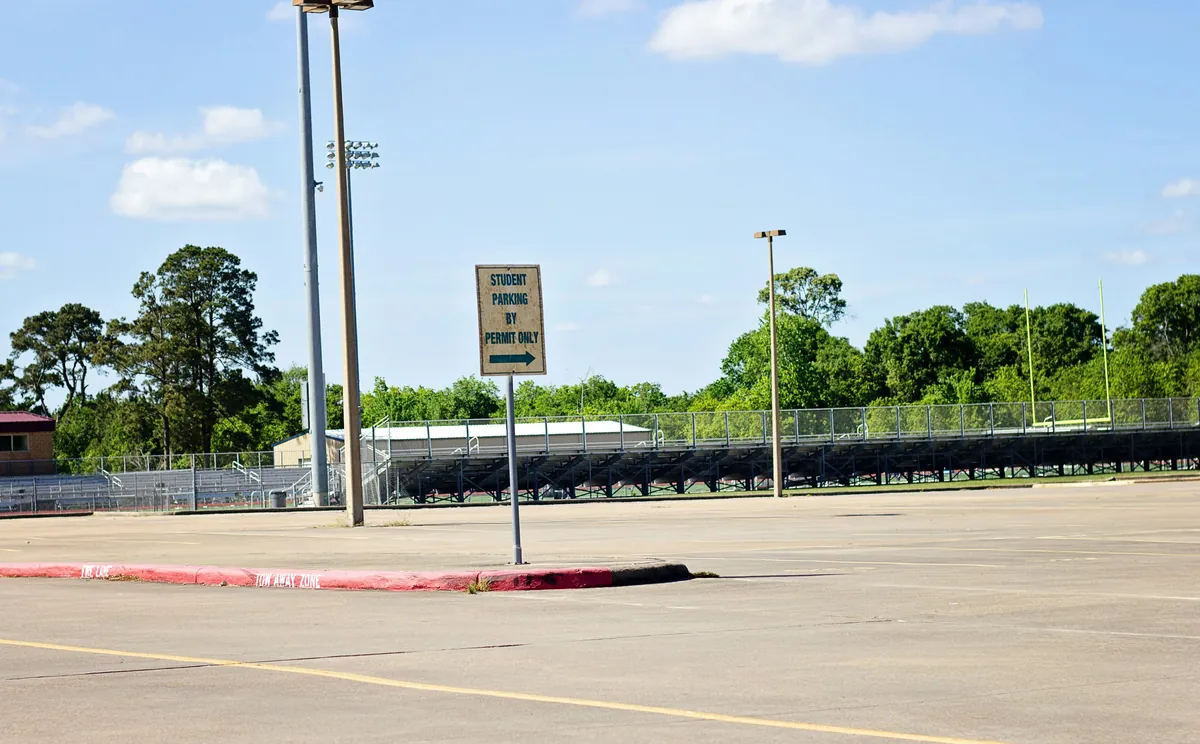
You spent $2 billion on the stadium.
The parking lot is still 1987.
Levi's Stadium just spent $200M on a tech upgrade. Penn State spent $700M. The Titans are spending $2.1B. Every category of the fan experience has been innovated, funded, and celebrated — except the parking-to-gate walk.
Levi's Stadium in Santa Clara just completed a $200 million renovation. The upgrades: the largest outdoor 4K video boards in the NFL — 70% larger than the previous ones, with 300% more pixels. Over 55,000 square feet of new LED ribbon boards. LED field lights with programmable color capabilities. A reimagined production room. Wi-Fi 6 and 5G connectivity via a distributed antenna system dense enough to support 70,000 fans simultaneously streaming, posting, and paying. Cashierless concession stands on the main concourse. (Construction Dive / Discover Santa Clara)
"Anyone that shows up to an event like a Super Bowl is taking pictures and wanting everyone to know that they're there," said Anish Patel, director of stadium and wireless engineering for the NFL. "It requires a very flexible and scalable wireless infrastructure." (Construction Dive)
The technology inside the stadium is 2026. The fan walks through facial recognition gates, buys a beer with their face, watches replays on a screen the size of a house, and shares it all on a 5G network that handles 70,000 simultaneous connections.
Then the game ends. The fan walks out the gate and into a dark parking lot with no transit system, no lighting plan, no posted routes, and no evidence that anyone designed what happens after the final whistle.
The parking lot is still 1987.
The innovation timeline inside the building
The pace of technological investment in stadiums over the last two decades has been staggering. Every few years, a new wave of innovation transforms the fan experience inside the venue:
2000s: Premium seating revolution. Club levels, luxury suites, and premium hospitality areas transformed stadiums from single-product venues (a seat) into tiered hospitality experiences. The club seat became a separate product with its own entrance, its own concessions, and its own pricing. Revenue per seat multiplied.
2010s: Mobile ticketing and digital entry. Paper tickets disappeared. Mobile apps became the primary entry method. QR codes replaced turnstiles. The fan's phone became their ticket, their concessions menu, their seat finder, and their replay screen.
2015–2020: Cashless concessions. Cash registers gave way to card-only transactions, then to mobile ordering, then to self-service kiosks. By 2025, 70% of major venues had adopted some form of cashierless concessions technology. (Biometric Update / Verizon & Stadium Tech Report White Paper)
2020–2024: Biometric entry. The Cleveland Browns pioneered facial recognition for ticket authentication. The Atlanta Falcons followed. The Tennessee Titans deployed 5G Edge Express Entry at Nissan Stadium in Nashville. By 2024, the NFL implemented league-wide facial authentication for media and staff access, with Wicket's technology deployed across multiple stadiums. Fans can now enter a stadium, access premium areas, and buy concessions with their face — no phone, no wallet, no ticket. (Athletic Business / Stadium Tech Report / Biometric Update)
2024–2026: AI and immersive experience. 4K video boards. Programmable LED field lighting. AI-generated highlight packages personalized to each fan's seat location. Augmented reality wayfinding inside the concourse. Generative AI chatbots for fan service. Smart stadium platforms that track crowd density, concession wait times, and restroom queues in real time.
Each of these innovations was developed, tested, funded, installed, and marketed. Each one had a budget, a project team, a vendor, and a measurable ROI. Each one transformed some dimension of the fan experience inside the building.
Now look at the parking-to-gate corridor — the space between the fan's car and the venue entrance. The space where the fan spends the first 20–30 minutes and the last 20–30 minutes of every visit.
What changed there?
The timeline outside the building
2000s: The fan parks in a surface lot or a parking structure. They walk to the gate. There is no transit system.
2010s: The fan parks in a surface lot or a parking structure. They walk to the gate. There is no transit system. Some venues add a shuttle bus from a remote lot.
2020s: The fan parks in a surface lot or a parking structure. They walk to the gate. There is no transit system. The shuttle bus is still a charter bus designed for the highway, running every 20 minutes.
2026: The fan parks in a surface lot or a parking structure. They walk to the gate. There is no transit system.
Four decades of stadium technology innovation. Zero decades of parking-to-gate innovation. The most visible expression of the gap arrives this summer at MetLife, where $100 million in transit infrastructure gets 2026 World Cup fans to the Meadowlands but nobody planned the last half mile from the transit node to the gate.
The fan who enters the stadium through facial recognition and buys a beer with a biometric scan walked a quarter mile through a dark parking lot to get there. The fan who watches the game on a 4K video board with 300% more pixels will walk back through that same dark parking lot to leave. The fan who experienced a $200 million technology upgrade inside the building experienced a 1987-vintage walking path outside of it.
The contrast isn't just notable. It's absurd.
Operating a stadium, arena, or major sports venue?
FlexTram offers parking-to-gate transit systems for game-day deployments, season-long programs, and multi-event venues. Fixed routes, posted schedules, ADA accessible standard, sponsor integration built in. Equipment rentals and full-service deployments available.
Where the money went
The investment numbers make the disparity even more striking.
Levi's Stadium renovation: $200 million. (Construction Dive)
Penn State Beaver Stadium renovation: $700 million. (Road to CFB)
South Carolina Williams-Brice Stadium renovation: $350 million. (Road to CFB)
New Buffalo Bills stadium: $1.4 billion. (CONEXPO)
Nashville Titans new stadium: $2.1 billion. (Perkins Eastman)
Chicago Bears Arlington Heights development: $5 billion for the full entertainment district. (CONEXPO)
Kansas City Royals new ballpark: $2 billion. (CONEXPO)
Billions of dollars in stadium construction and renovation. Video boards. Suites. Clubs. Concourses. Connectivity. Concessions technology. Biometric entry. AI-powered fan experience platforms.
The allocation for how fans move between the parking lot and the gate: effectively zero.
Not because the venues don't care. Not because the fans don't notice. But because the parking-to-gate corridor has never been treated as a technology category, a budget category, or a design category. It's been treated as a gap — a space between the car and the building that the fan is expected to cross on their own.
The fan notices
The fan may not articulate it as a technology gap. But they feel it.
They feel it when they park in a remote lot and face a 20-minute walk to the gate — past the lots that filled two hours ago, across unmarked pedestrian paths, through a landscape that looks exactly the same as it did when the stadium opened.
They feel it when they leave the game and walk into a dark parking lot with no wayfinding, no lighting plan, and no system for moving 70,000 people toward their cars.
They feel it when they compare the experience to the inside of the building — where every touchpoint was designed, every interaction was optimized, and every technology investment was made with the fan's experience in mind.
Research consistently shows that fans are making this comparison consciously. With 59% reporting interest in watching games at home — attracted by better camera angles, multimedia experiences, and lower cost — the in-venue experience is competing against the living room on every dimension. (Drive Research / Stadium Experience Surveys)
The $200 million video board doesn't help if the fan's last memory is a 30-minute walk through a dark parking lot. The biometric entry doesn't matter if the fan dreads the exit so much that they leave in the fourth quarter to beat the crowd. As we documented in "You Can't Solve Egress. But You Can Stop Ignoring It," the last impression is the lasting impression. And the last impression at most stadiums hasn't been updated since Reagan was in office.
Every other category evolved. This one didn't.
The parking-to-gate corridor isn't the only part of the venue operation that could have been innovated. But it's the only part that wasn't.
Concessions evolved. From cash registers to credit cards to mobile ordering to cashierless kiosks to biometric payment. Each step reduced friction and increased per-cap revenue.
Ticketing evolved. From paper to digital to mobile to NFC to facial recognition. Each step reduced entry time and eliminated fraud.
Seating evolved. From general admission to reserved to premium to club to suite to field-level hospitality. Each step created new revenue tiers and new fan experiences.
Connectivity evolved. From no wifi to basic wifi to high-density wifi to 5G DAS to edge computing. Each step enabled new fan engagement and new data collection.
Security evolved. From manual bag checks to clear bags to metal detectors to walk-through screening to biometric credentialing. Each step improved safety and reduced wait times.
Parking-to-gate transit: still the same walk it was in 1987. The same dark lot. The same unmarked path. The same absence of a system.
As we wrote in "The Properties Got Bigger. The Plan Didn't," there is a size threshold beyond which a property cannot function without a transit system. Most major stadiums crossed that threshold years ago. They just never applied the same innovation mindset to the parking lot that they applied to everything inside the building.
The fix costs a fraction of the video board
Here's the irony: the parking-to-gate transit gap is the cheapest part of the stadium to fix relative to its impact on the fan experience.
A 4K video board installation: $20–50 million. A biometric entry system: $5–15 million. A 5G DAS network: $10–30 million. A cashierless concessions platform: $2–5 million.
A FlexTram system running a continuous loop from the remote lots to the gates — with fixed routes, posted schedules, ADA accessibility, and sponsor branding: a fraction of any of these investments.
The video board improves the experience for 3 hours during the game. The tram improves the experience for the 30 minutes before and the 30 minutes after — the bookends that frame the entire visit. The fan's first physical experience at the venue and the fan's last physical experience at the venue. The arrival and the departure. The moments that determine whether the fan says "that was amazing" or "I'm not doing that again."
As we wrote in "The Demand Is Already There. The Friction Is Eating It," the fan already bought the ticket. They're already at the venue. The friction of the parking-to-gate walk is suppressing how fully they engage with the experience the venue spent $2 billion to create.
It's 2026. The parking lot should be too.
Every other category of the fan experience has been innovated, funded, and celebrated. Venues announce their video boards in press releases. They market their biometric entry as competitive advantages. They win architecture awards for their premium clubs. They publish white papers on their connectivity infrastructure.
Nobody publishes a press release about their parking lot.
But the parking lot is where the fan experience starts and ends. It's the first thing the fan sees and the last thing they remember. It's the space where the investment gap between the inside of the building and the outside of the building is most visible — and most consequential.
The stadium is 2026. The video boards are 4K. The entry is biometric. The concessions are cashless. The connectivity is 5G.
The parking lot is still 1987. It doesn't have to be.
Frequently asked questions
How much have stadiums invested in fan experience technology recently?
Billions. Levi's Stadium completed a $200 million renovation (4K video boards, 55,000 sq ft of LED ribbon, programmable LED field lighting, Wi-Fi 6 / 5G distributed antenna system for 70,000 concurrent users, cashierless concessions). Penn State Beaver Stadium: $700M. South Carolina Williams-Brice: $350M. New Buffalo Bills stadium: $1.4B. Nashville Titans new stadium: $2.1B. Chicago Bears Arlington Heights district: $5B. Kansas City Royals new ballpark: $2B. The cumulative figure across major stadium construction and renovation is well into the tens of billions over the last decade.
Why has the parking-to-gate corridor stayed unchanged while everything else evolved?
Because it has never been treated as a technology category, a budget category, or a design category. Concessions, ticketing, seating, connectivity, and security all have dedicated departments, vendors, ROI models, and white papers. The parking-to-gate corridor has none of those. It's been treated as a gap between the car and the building that the fan is expected to cross on their own — not as a discipline with budget, vendors, and innovation pipelines.
Does the parking-to-gate walk actually affect fan satisfaction?
Yes, and the comparison is getting harder for venues to win. 59% of fans report interest in watching games at home — attracted by better camera angles, multimedia experiences, and lower cost. The in-venue experience is competing against the living room on every dimension. A $200 million video board doesn't help if the fan's last memory is a 30-minute walk through a dark parking lot. The biometric entry doesn't matter if the fan dreads the exit so much that they leave in the fourth quarter to beat the crowd. The bookends frame the entire visit.
What does fixing the parking-to-gate corridor actually cost relative to other investments?
A fraction. A 4K video board installation runs $20–50 million. A biometric entry system runs $5–15 million. A 5G distributed antenna system runs $10–30 million. A cashierless concessions platform runs $2–5 million. A FlexTram system running a continuous loop from remote lots to the gates — with fixed routes, posted schedules, ADA accessibility, and sponsor branding — costs a fraction of any of these. And it improves the experience during the 30 minutes before and the 30 minutes after the game, which is when the fan's first impression and last impression are formed.
What would a parking-to-gate transit system look like in practice?
A FlexTram deployment running a fixed loop from each remote parking area to the gate cluster nearest it, on a posted 5–10 minute headway during arrival and departure windows. Every vehicle ADA-accessible standard — no separate dispatch, no parallel service. Routes use existing roads and pathways with minimal infrastructure. Sponsor branding integrated as a revenue stream. ADA program runs on the same system, not a parallel one. Operates on game days only, or expands to all stadium events depending on the venue's usage profile.
Related reading
The stadium is 2026. The parking lot can be too.
FlexTram offers stadium transit systems — from game-day deployments to season-long programs — with fixed routes, posted schedules, ADA accessibility, and sponsor integration. Equipment rentals and full-service deployments available.