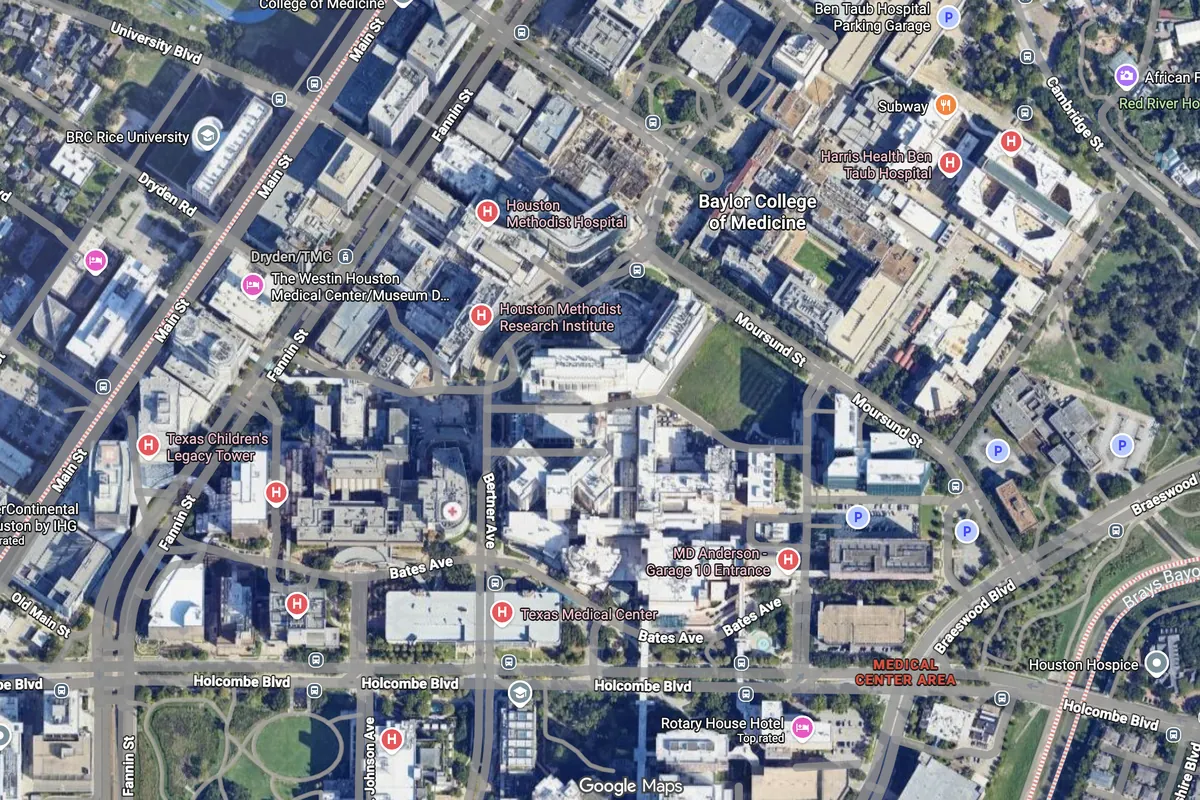
Your hospital campus has 14 buildings.
Your patients have one set of knees.
The patient arrives at 8:15 AM for a 9:00 cardiology appointment. By 11:00 she's covered close to a mile inside the campus, her knees are done, and she's calling her daughter to pick her up. The third appointment — the one that completes the care plan — gets rescheduled for next week.
She parks in the garage — the closest available space is on level 4, a five-minute walk from the elevator. She takes the elevator down, crosses the skybridge to the main building, follows the signs to the east wing, takes another elevator to the third floor, and arrives at the cardiology reception desk at 8:38. Twenty-three minutes from parking space to waiting room.
Her second appointment — imaging — is in a separate building across the campus. The receptionist gives her a map. She walks back to the elevator, crosses the skybridge in the other direction, exits through the main lobby, walks along a covered walkway to the outpatient pavilion, and takes the elevator to the imaging floor. Twelve minutes if she walks briskly. She doesn't walk briskly — she's 72, she has a knee replacement, and she's already tired.
Her third appointment — blood work at the lab — is in the medical office building adjacent to the parking garage. She's been on her feet for two hours. She's covered close to a mile inside the campus. She looks at the map, looks at her knees, and calls her daughter to pick her up. She'll reschedule the lab work for next week.
That rescheduled lab draw will generate its own appointment, its own parking search, its own walk. The care plan that was designed to be completed in a single morning visit has fragmented into two visits across two weeks — because the campus was designed for clinical efficiency, not patient mobility.
The campus grew. The patient didn't.
Hospital campuses are among the largest and most complex properties in any community. Academic medical centers routinely span 50 to 200+ acres. Multi-building systems with cancer centers, cardiac institutes, women's hospitals, outpatient pavilions, surgery centers, rehabilitation facilities, medical office buildings, and research labs are the norm, not the exception.
These campuses were built over decades — building by building, wing by wing, addition by addition. Each new building solved a clinical need. A new cancer center meant better oncology care. A new surgery pavilion meant more operating room capacity. A new parking garage meant more spaces. Each addition was justified by the clinical or operational improvement it provided.
But each addition also increased the distances patients, visitors, and staff need to cover. The campus that was walkable in 1990 — when it was three buildings and a parking lot — is no longer walkable in 2026, when it's fourteen buildings spanning a quarter mile in every direction.
The clinical infrastructure evolved. The patient's mobility didn't.
This isn't a convenience problem. It's a clinical problem.
Hospital facilities directors sometimes categorize campus transit as a "patient convenience" issue — a nice-to-have that improves the experience but doesn't affect outcomes. That categorization is wrong.
When a patient skips the third appointment because the walk is too far, that's a clinical outcome. The lab work that should have been completed today gets deferred. The results that the cardiologist needed before adjusting the medication don't arrive on time. The care pathway fragments. The patient returns in two weeks for a standalone lab visit — consuming another appointment slot, another parking space, and another hour of clinical staff time.
For patients in oncology, the stakes are even higher. A cancer patient on a multi-step treatment protocol — imaging, infusion, lab work, oncology consult — may have four appointments in a single day across three different buildings. These patients are often immunocompromised, fatigued, and managing pain. The walk between the infusion center and the imaging center isn't uncomfortable. It's clinically contraindicated — the patient shouldn't be exerting themselves between treatments.
For patients in orthopedics and rehabilitation — the population with the highest concentration of mobility limitations — the campus distance is the barrier to the very care designed to restore their mobility. The patient recovering from a hip replacement who needs to visit the orthopedic clinic, the physical therapy center, and the imaging department in a single morning is being asked to walk the distance that their treatment is supposed to eventually make possible.
For elderly patients — who represent the majority of hospital visits — the compounding effect of campus distance on care adherence is well-documented. As we explored in our analysis of friction and demand, the U.S. News/USAging survey found that physical disability or lack of mobility is the number one cause of isolation and disengagement in older adults. The same dynamic applies at the hospital campus: when the distance exceeds the patient's physical capacity, they disengage from their own care plan.
HCAHPS: the financial case for patient experience
For hospital administrators who need a financial argument alongside the clinical one, it already exists. It's called HCAHPS.
The Hospital Consumer Assessment of Healthcare Providers and Systems survey is the national standardized measure of patient experience. Every acute care hospital that accepts Medicare must administer it. The results are publicly reported on Hospital Compare. And since 2012, HCAHPS scores have directly affected hospital reimbursement through the Value-Based Purchasing program. (CMS)
Patient satisfaction scores account for 25% of a hospital's total VBP performance score — which determines how much of a 2% Medicare payment adjustment the hospital receives. For a large hospital system processing hundreds of millions in Medicare revenue, a single percentage point improvement in HCAHPS scores can translate to hundreds of thousands of dollars in additional reimbursement. (Anzolo Medical / CMS)
The HCAHPS survey measures dimensions including communication, responsiveness, care coordination, cleanliness, and the overall hospital experience. While no question specifically asks "how was the parking and campus transit?" the patient's experience of navigating the campus — the frustration of the walk, the confusion of wayfinding, the exhaustion of covering a mile between appointments — bleeds into every dimension the survey measures. A patient who arrives at their appointment tired and frustrated rates every subsequent interaction lower than a patient who arrives calm and rested.
As one healthcare data company noted: businesses that partner with hospitals, like patient transport services, are indirectly impacted by HCAHPS scores — and companies with solutions that demonstrably improve patient experience have an edge when hospitals evaluate vendors. (Definitive Healthcare)
The patient experience doesn't start at the exam room door. It starts at the parking garage. And every step between the garage and the exam room either supports or undermines the HCAHPS score that determines millions of dollars in annual reimbursement.
Designing transit for a hospital campus?
FlexTram partners with parking operators and healthcare systems to deploy campus transit — from single-building connector routes to multi-campus systems. ADA accessible standard. Up to 27 passengers per vehicle. One driver.
The parking operator is already there
Here's what makes the hospital campus transit problem different from stadiums, festivals, or cruise terminals: the operational partner who should be running the transit system is already on the property.
At most large hospital campuses, a parking management company — LAZ Parking, Towne Park, SP+ (now Metropolis), or a regional operator — already manages the parking infrastructure. They operate the garages, run the surface lots, staff the valet lanes, and in many cases, manage the existing shuttle service between remote lots and building entrances.
LAZ Parking — the largest privately owned parking operator in the United States, operating over 1.3 million spaces across 3,550 locations — has built an entire Healthcare Services division around this exact model. LAZ Healthcare Services already provides valet, parking management, shuttle services, ambassadors and greeters, wheelchair transport, and patient ride services at major academic medical centers including Duke University Health System, Beth Israel Deaconess Medical Center, Hartford Healthcare, MedStar Washington Hospital Center, Kaiser Permanente, UC San Diego Health System, and University Hospitals Cleveland. (LAZ Parking / PR Newswire)
FlexTram works with LAZ in various capacities across our venue and event deployments. The partnership model is natural: LAZ already has the staff on the ground, the operational expertise in healthcare environments, and the contractual relationship with the hospital system. What they need is a vehicle platform designed for campus-scale patient transit — not a shuttle bus built for the highway, and not a golf cart that carries four passengers with no weather protection and no ADA compliance.
A FlexTram vehicle carrying up to 27 passengers on a fixed loop between the parking garage, the main entrance, the outpatient pavilion, the cancer center, and the medical office building — operated by LAZ's existing healthcare-trained staff, on routes designed around the campus footprint — is the logical extension of a parking and transportation operation that's already in place.
The hospital doesn't need to hire a new vendor. It doesn't need to build new infrastructure. It doesn't need to create a new operational team. The operator is already there. The staff is already trained in healthcare environments. The vehicle and the route plan are what complete the system. As we wrote in "The parking lot is becoming a mobility origin," the parking operator is positioned to absorb the next layer of onsite mobility — and healthcare campuses are the highest-impact place to do it.
What the staff problem looks like
The patient transit challenge gets the most attention, but hospital staff face their own version of the campus distance problem — and it has direct operational consequences.
Parking is one of the most persistent operational headaches for large medical campuses. Facilities built over decades often have parking infrastructure that hasn't kept pace with staff growth. The practical result: many hospitals rely on remote parking facilities, leased lots, or park-and-ride arrangements that put staff anywhere from a short walk to several blocks away from their building. (North American Charter Bus / Healthcare Campus Analysis)
A nurse who parks in a remote lot and walks 15 minutes to the building entrance before a 12-hour shift starts the day already fatigued. Multiply that by the return walk at the end of the shift — often after dark, often alone — and the daily campus transit adds 30 minutes of unpaid physical exertion to an already demanding job.
For hospitals competing to recruit and retain nursing staff — in a market where the national nursing shortage shows no sign of easing — the campus commute isn't trivial. It's a factor in job satisfaction, shift preference, and retention. The hospital where the nurse can park and ride directly to the building entrance is a more attractive employer than the hospital where the nurse walks a quarter mile in the rain before clocking in.
The same applies to physicians, technicians, and support staff who move between buildings throughout the day. The physician who splits time between the main hospital and the cancer center makes that walk multiple times per day. The phlebotomist who draws blood across four buildings covers miles of campus hallway before lunch. The facilities team that responds to maintenance calls across 14 buildings drives golf carts through pedestrian corridors — creating the same conflict points we see at every other large property.
The system that already exists — just not yet complete
Most large hospital campuses already have some version of patient and staff transit. It usually looks like this:
A shuttle bus running between the remote parking lot and the main entrance. The shuttle runs every 15-20 minutes, follows a fixed route designed around the perimeter road, and uses a vehicle built for the highway — a 40-foot transit bus or a 25-passenger cutaway that requires wide turning radii and can't navigate the interior campus pathways between buildings.
A valet service at the main entrance and sometimes at the cancer center or women's hospital. The valet handles the parking — but the patient still needs to get from the valet drop-off to their specific department, which may be a 10-minute walk inside the building.
A wheelchair escort service dispatched on request for patients with acute mobility needs. This service is reactive — the patient calls ahead or requests it at arrival — and it handles one patient at a time. It doesn't serve the much larger population of patients who can walk but shouldn't have to walk a quarter mile between appointments.
Golf carts operated by facilities staff for maintenance and internal logistics. These are utility vehicles, not patient transport — but they're often pressed into service for ad hoc patient rides, creating the same uncontrolled, unscheduled, unaccountable vehicle situation we see at every other large property.
What's missing is the layer between the shuttle bus and the wheelchair escort: a scheduled, fixed-route, high-capacity transit system that runs continuously between the parking garage, the building entrances, and the key clinical destinations on the campus. A system that any patient, visitor, or staff member can use — not by calling ahead, not by requesting assistance, but by walking to the nearest boarding point and waiting two minutes for the next vehicle.
That's the layer FlexTram provides. And it's the layer that a parking operator like LAZ — already on the ground, already managing the parking and valet and shuttle — can integrate into their existing healthcare services contract with minimal additional complexity.
The campus that cares about the walk
Every hospital system in the country has a mission statement about patient-centered care. The clinical teams live that mission in every exam room, every operating suite, every treatment bay. The question is whether the campus itself lives it in the spaces between.
The parking garage isn't patient-centered. The quarter-mile walk between cardiology and imaging isn't patient-centered. The 20-minute shuttle wait after a chemotherapy session isn't patient-centered. The golf cart pressed into service because a patient can't make the walk to the lab isn't patient-centered.
A transit system designed around the patient journey — connecting the parking garage to the building entrances to the key clinical destinations, running on a posted schedule with ADA accessibility as standard, operated by staff trained in healthcare environments — is what patient-centered looks like outside the exam room.
The hospital invested in the buildings. It invested in the physicians. It invested in the technology. The walk between them is the last part of the patient experience that hasn't been designed.
Frequently asked questions
Why is hospital campus transit a clinical problem and not just a convenience issue?
When a patient skips an appointment because the walk between buildings is too far, that's a clinical outcome. Lab work gets deferred. Imaging follow-ups get pushed. Care plans designed around same-day multi-appointment visits fragment into multiple separate visits over weeks. For oncology patients, the walk between infusion and imaging is clinically contraindicated. For orthopedic and rehabilitation patients, the campus distance is the very barrier that the treatment is designed to address. Campus transit isn't about comfort — it's about whether patients complete the care plan that was designed for them.
How does campus transit affect HCAHPS scores and hospital reimbursement?
Patient satisfaction (HCAHPS) accounts for 25% of a hospital's total Value-Based Purchasing performance score, which determines how much of a 2% Medicare payment adjustment the hospital receives. For a large system processing hundreds of millions in Medicare revenue, even a single percentage point improvement in HCAHPS scores can translate to hundreds of thousands of dollars in additional reimbursement. The patient's experience of navigating the campus — wayfinding, walking distances, exhaustion between appointments — bleeds into every dimension HCAHPS measures. The patient experience starts at the parking garage, not the exam room door.
Why is the parking operator the natural partner for hospital campus transit?
At most large hospital campuses, a parking management company — LAZ Parking, Towne Park, Metropolis (formerly SP+) — already operates the garages, surface lots, valet lanes, and existing shuttle service. LAZ in particular has a dedicated Healthcare Services division active at Duke Health, Beth Israel Deaconess, Hartford Healthcare, MedStar, Kaiser Permanente, UC San Diego Health, and University Hospitals Cleveland. The operational relationship, the contractual framework, and the healthcare-trained staff are already in place. What's missing is a vehicle platform designed for campus-scale patient transit instead of highway-built shuttle buses or four-passenger golf carts.
How does FlexTram fit into a hospital's existing transportation operation?
FlexTram operates as the layer between the perimeter shuttle bus and the wheelchair escort service — a scheduled, fixed-route, high-capacity transit system running continuously between the parking garage, building entrances, and key clinical destinations. Up to 27 passengers per trip, ADA accessible as standard, one driver, posted schedules. Any patient, visitor, or staff member can use it without calling ahead or requesting assistance. Operated by the parking vendor's existing healthcare-trained staff (LAZ, Towne Park, etc.) on routes designed around the campus footprint.
Does this also help with hospital staff parking and recruitment?
Yes. Many hospital campuses rely on remote employee parking lots, leased lots, or park-and-ride arrangements that put staff a 10–15 minute walk from the building before a 12-hour shift starts. In a tight nursing labor market, the campus commute is a real factor in job satisfaction and retention. A campus transit system that runs reliably between staff lots and building entrances reduces unpaid daily walking time, eliminates the after-dark-walk-alone safety concern, and makes the hospital a more attractive employer compared to systems where staff walk a quarter mile in the rain before clocking in.
Related reading
Design the walk between the buildings.
FlexTram partners with parking operators and healthcare systems to deploy campus transit — from single-building connector routes to multi-campus systems. Equipment rentals, full-service deployments, and long-term leases available.