You're planning the groundbreaking.
You have three options — and all of them are bad.
Sprinter vans, a caravan of golf carts, or a walk across a construction site in dress shoes. The corporate event planner's real problem isn't moving forty VIPs — it's keeping forty people inside one story.
This one's for you — the person who actually has to solve this. Not a transportation professional. A corporate events manager, a chief of staff, a communications director, an executive assistant who inherited this because you're the one who gets things done.
The groundbreaking is in six weeks. The guest list has settled at about forty: the board, two state officials, the mayor, four major customers, the architecture firm, three trade reporters, and a photographer. The site is 60 acres of graded dirt with a tent at one end and the ceremonial shovel pile at the other, and somewhere in between is the spot where the CEO wants everyone standing when he says the line about eleven months.
Now: what do they ride in?
You have three options, and all three of them are bad. That's not a planning failure. That's the actual state of the market.
Option one: the Sprinter vans
A factory-standard Mercedes-Benz Sprinter passenger van holds either 12 or 15 people — and that count includes the driver. (Sprinter Van Seating Capacity Guide)
Here's why. The Federal Motor Carrier Safety Administration defines a commercial motor vehicle, in part, as any vehicle designed to transport 16 or more passengers including the driver. (49 CFR 383.5, via LegalClarity) A 15-passenger van seats fourteen guests plus a driver. Fifteen total. Exactly one seat under the line.
The van isn't sized for your group. It's sized for a regulation.
And you can't fix it by taking seats out of a bigger one — FMCSA has addressed that directly. "Designed to transport" means the original manufacturer's design, and pulling seats doesn't change the vehicle's design capacity. (LegalClarity) Go above the line and you're typically into CDL-with-passenger-endorsement territory, depending on your state and how the vehicle is being used — which means a hired driver, which means a vendor, which means a contract.
So forty guests is three vans. Three vans is three drivers, three caravans, and three separate groups who arrive at the ceremonial pile at three different times.
But the seating isn't even the real problem. The real problem is the windows.
You brought these people here to see something. A van is an enclosed metal box that drives them past it. Nobody can hear the guide. Nobody can ask a question. The two people in the third row are looking at the back of someone's head. You have converted a tour into a commute, and you did it on the one day of the year when the governor is on site.
Option two: the golf carts
So you go open-air. Reasonable instinct — at least people can see, and you probably already own some.
Forty guests at four to six seats a cart is eight to eleven carts.
Eight to eleven carts is eight to eleven drivers.
Where do those come from? They come off the floor. They're your maintenance lead, two people from shipping, somebody's admin, and a supervisor who is now driving the mayor around instead of doing the job you actually pay him for. None of them have been trained for this, because nobody trains for this. They got the keys and a hand-wave twenty minutes ago.
That's the arrangement on the highest-stakes day your facility will have all year. As we documented in The Labor Problem Nobody Talks About, the staffing math on cart fleets is punishing even when you're hiring for it. When you're improvising it out of the people who happened to be on shift, the risk isn't theoretical — it's eleven untrained operators moving VIPs through an active site with forklift traffic, and it's every one of them on your general liability policy. We walked through that exposure in detail in You Don't Know Who's Driving on Your Property Right Now.
And the caravan fragments. It always fragments. Cart one is at the ceremonial pile while cart nine is still at the tent. The CEO delivers the eleven-months line to the six people in his cart. Everybody else gets it secondhand, or reads it in the press release.
Planning a groundbreaking or facility tour?
FlexTram plans the route around your program — where the stops are, how long each one runs, and where the group needs to be standing — and runs it with trained drivers on open-air, ADA-accessible trams. Equipment rentals and full-service deployments available.
Option three: they walk
They won't say anything. That's the thing about this audience — they're too polite to complain and too important to be walked across a construction site.
But you know exactly who's in that group. The 71-year-old board member. The customer who had a knee replaced in March. The reporter in heels because nobody told her it was 60 acres of dirt. The state official whose aide quietly asked you last week whether there'd be seating.
The plant tour industry's own guidance assumes this away. SafetyCulture's plant visit guide instructs hosts to "develop a detailed walk path that covers high-impact zones and critical control points." (SafetyCulture) A walk path. It's not a transportation question in the standard playbook. It's a routing question — and the vehicle is assumed to be feet.
That works fine for a 40,000-square-foot shop. It does not work for a 60-acre greenfield, or a million-square-foot distribution center, or a campus where the line you want them to see is at the far end of Building 4.
What you're actually trying to do
Here's the thing nobody names, and it's why all three options fail.
You are not moving forty people. You are keeping a story together.
A plant tour is a narrative. It has a sequence, a build, and a payoff. The whole mechanism is the CEO turning around at the right moment and saying this is the line we brought up in eleven months — and that only works if forty people hear it simultaneously. The tour isn't logistics with content attached. The content is the tour, and the vehicle either preserves it or destroys it.
Every option above destroys it. The vans isolate the group from the thing they came to see. The carts shatter the group into eleven audiences of four. Walking works right up until the moment your least mobile guest becomes the pace of the entire tour — at which point the tour is about her knees, and everyone knows it, and nobody says it.
You can measure how badly this is understood by what the market has built around it. There is an entire product category — plant tour communication systems — that exists purely to get the guide's voice to people who have drifted too far away to hear it. Vendors sell one-way and two-way radio and headset programs designed for "small and large group tours in loud environments," including "ADA-compliant and interpreter-ready systems that make every tour inclusive." (Implecho)
Read that again. Companies are buying hardware to solve the fact that their group won't stay together. The headset isn't fixing the plant's noise. It's fixing the spread.
The tour is losing to a 360° video
And here's the part that should genuinely concern anyone who plans these.
An entire competing industry has grown up in this gap, and its pitch is explicitly that physical tours are too hard. Virtual tour vendors market against "flights, accommodation, escort staff, and production slowdowns," arguing that a digital walkthrough "eliminates the routine inspection visit entirely." (Panoee) Another notes that facility visits from clients and investors "are logistically challenging." (The Future 3D) A third puts it plainly: "Hosting VIP visits can be time-consuming, and not every stakeholder can safely enter production areas." (Actsugi)
They're not wrong about the logistics. That's what makes it dangerous.
The in-person plant tour is one of the most effective business development tools a manufacturer has. Plant visits build trust with investors, customers, and regulators by showing the operation openly, and they create the setting where questions get asked and deals move. (SafetyCulture; PlantTours) You cannot replicate a customer standing on your floor watching your people work. A 360° video is a brochure. The tour is a decision.
Some industries have already turned the tour into a business of its own. Kentucky's distilleries welcomed 2.7 million Bourbon Trail visitors in 2025 to working production campuses, and they're running into the same movement problem.
And the tour is losing ground — partly because nobody solved the vehicle.
One vehicle. One group. One story.
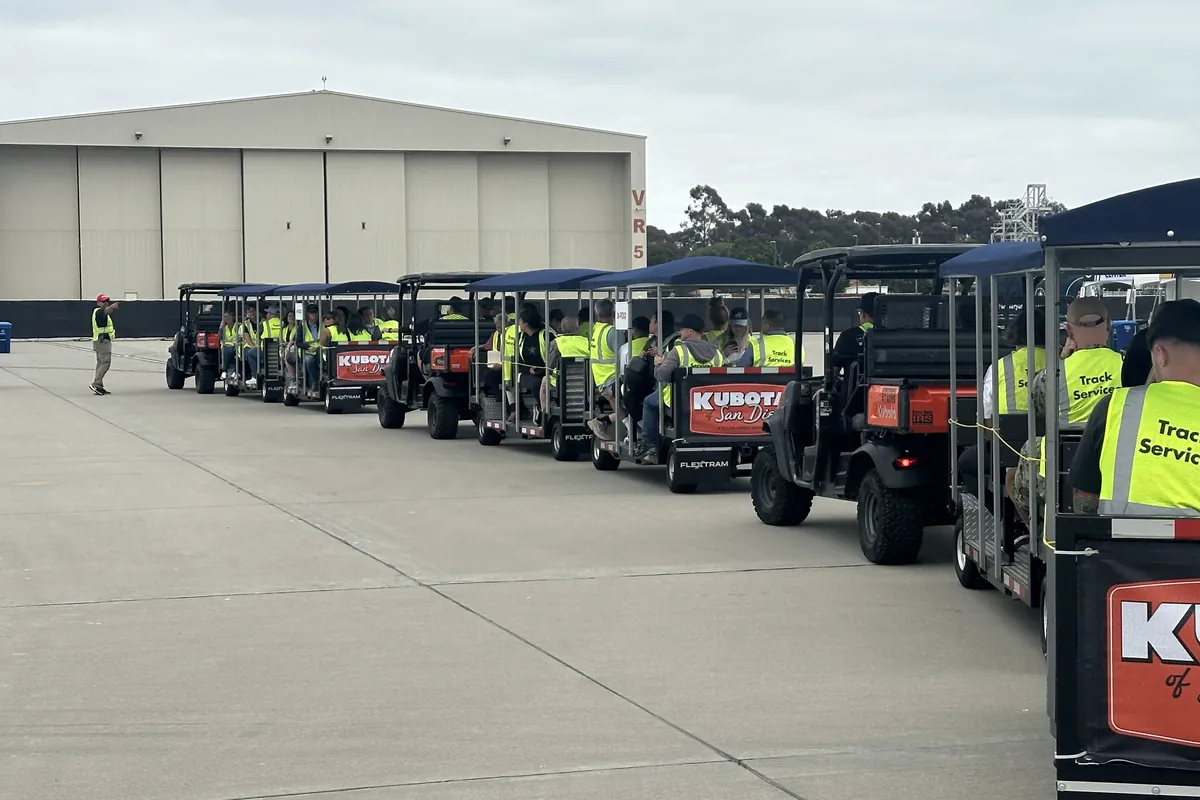
Forty guests. Twenty-seven seats a tram, one driver. Two vehicles, two operators — not eleven. Nobody comes off the floor. The maintenance lead does maintenance.
Open-air, so the guide narrates to the whole group at once and people can actually see the thing they flew in to see. No headsets required, because nobody drifted.
ADA-accessible as standard — not a separate cart quietly dispatched for the board member with the bad knee, which is its own small humiliation. She boards the same vehicle as the CEO, at the same time, in the same conversation. As we argued in You Can't Buy Availability One Cart at a Time, accessibility that requires you to ask for it isn't access. It's a favor.
Independently turning axles, so it navigates the actual site — graded dirt, gravel staging, the tight turn behind Building 2 that a Sprinter can't make. Pavement, gravel, grass. The route follows the story instead of the story bending around the vehicle's turning radius.
And the route itself gets planned before anyone arrives: where the tent is, where the shovel pile is, where the money shot is, where the photographers need to be standing, how long the CEO talks at stop three. Same operations planning we bring to a 60,000-person festival, applied to forty people who matter more than 60,000 people.
We wrote about the arrival side of this in You Spent $50 Million on the Facility. Spend Two Weeks on How Guests Move Through It. This is the other half — what happens after they're out of the car.
The day you can't do over
Most of what you plan has a second chance. A bad quarterly meeting gets fixed next quarter. A weak email gets a follow-up.
The groundbreaking happens once. The board tours the plant once a year — and so does the class of students you'd host on MFG Day, if you can move enough of them through the building. The customer who flew in from Osaka is on site for four hours and will decide something about your company based on those four hours. The governor's photo either exists or it doesn't.
You have exactly one shot to make forty important people feel like your operation is the most competent thing they've seen all year — and right now the market hands you a choice between a metal box, an eleven-cart caravan driven by whoever was free, and a walk across a construction site in dress shoes.
You're not moving forty people from one place to another. You're keeping forty people inside one story. Pick the vehicle that does that.
— The FlexTram Team
Frequently asked questions
How many passengers can you carry on a plant tour without a CDL?
A factory-standard Mercedes-Benz Sprinter passenger van seats 12 or 15 people including the driver. The ceiling exists because the Federal Motor Carrier Safety Administration defines a commercial motor vehicle in part as any vehicle designed to transport 16 or more passengers including the driver, which typically triggers a CDL with passenger endorsement depending on state and use. A 15-passenger van carries 14 guests plus a driver — one seat under the line. You can't get around it by removing seats: FMCSA counts the original manufacturer's design capacity, not the current seat count. So moving forty guests means three vans, three drivers, and three groups arriving at three different times.
Why are golf carts a poor choice for a VIP plant tour or groundbreaking?
Forty guests at four to six seats per cart is eight to eleven carts, which means eight to eleven drivers. On a groundbreaking day those drivers come off the floor — the maintenance lead, shipping staff, an admin, a supervisor — none of them trained for it, all of them on the company's general liability policy while moving VIPs through an active site with forklift traffic. And the caravan fragments: the CEO delivers the key line to the six people in his cart while the rest of the group is still back at the tent. The tour shatters into a dozen audiences of four.
Why isn't a walking tour enough for a large facility?
The plant tour playbook assumes walking — SafetyCulture's plant visit guidance tells hosts to develop a detailed walk path, treating movement as a routing question with feet as the default vehicle. That works for a 40,000-square-foot shop. It does not work for a 60-acre greenfield, a million-square-foot distribution center, or a campus where the point of interest is at the far end of Building 4. On a large site the walk fails on the least mobile guest: the moment a 71-year-old board member or a guest recovering from surgery sets the pace, the tour becomes about their mobility, and everyone knows it even though no one says it.
What is the real goal of transportation on a plant tour?
Keeping the group together. A plant tour is a narrative with a sequence, a build, and a payoff — the CEO turning around at the right moment to deliver the line only works if the whole group hears it at once. The content is the tour, and the vehicle either preserves it or destroys it. An entire product category (plant-tour communication headset systems) exists purely to get the guide's voice to people who have drifted too far to hear it — hardware sold to solve the fact that the group won't stay together. The vehicle should solve the spread, not a headset.
What does FlexTram provide for groundbreakings and plant tours?
Forty guests fit on two trams with two drivers — 27 seats and one driver per vehicle — so no one comes off the floor. The trams are open-air, so the guide narrates to the whole group at once and guests see the facility they came to see; no headsets, because nobody drifts. ADA accessibility is standard, so the board member with a bad knee boards the same vehicle as the CEO rather than a separate cart. Independently turning axles handle graded dirt, gravel staging, and tight turns a Sprinter can't make. And the route is planned before anyone arrives — stops, timing, and where the group needs to be standing for each moment of the program. Equipment rentals and full-service deployments with trained drivers are available.
Related reading
You're not moving forty people. You're keeping forty people inside one story.
FlexTram supports plant tours, groundbreaking ceremonies, facility openings, and corporate events with route planning built around your program — where the stops are, how long each one runs, and where the group needs to be standing. Equipment rentals and full-service deployments with trained drivers available.