Large-footprint
destination resorts.
A practitioner reference. Eighteen large-footprint U.S. destination resorts, grouped by ownership platform — with the operational facts (acreage, lodging scale, amenity dispersion, current onsite transit) and the kind of context that doesn't appear in vendor brochures.
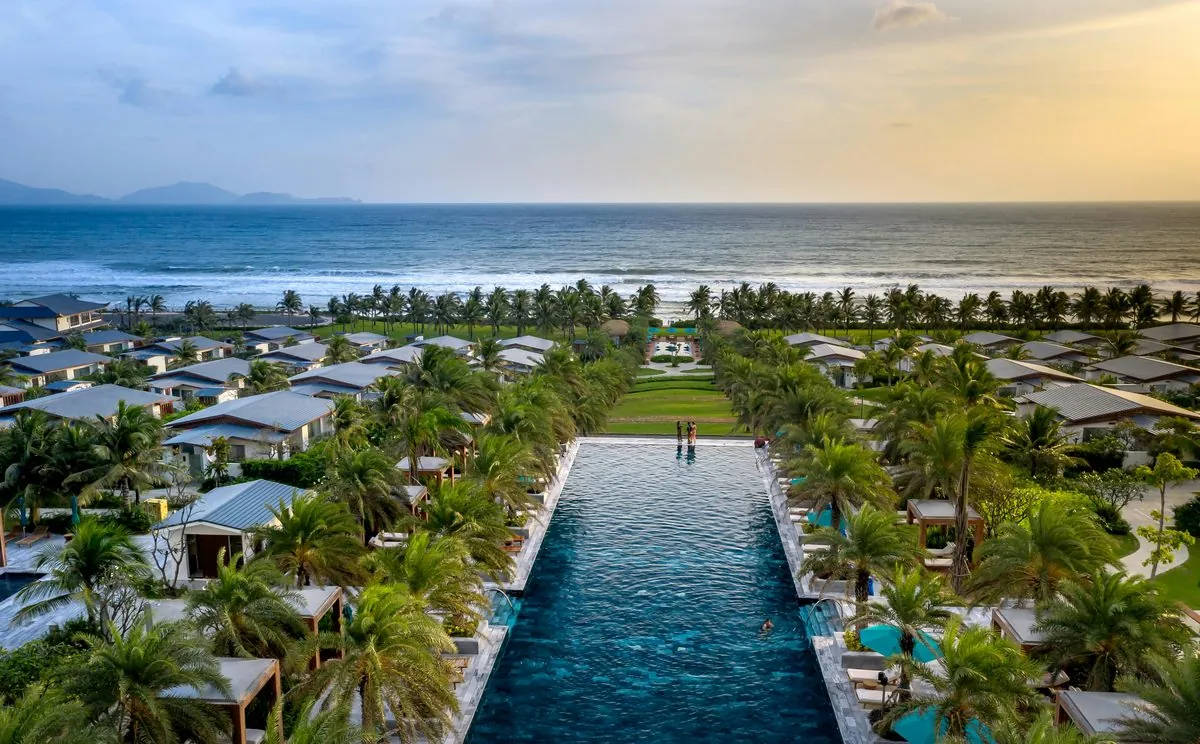
In 1957, Charles Fraser began developing the southern tip of Hilton Head Island. What he built — Sea Pines — is widely regarded as one of the first environmentally sensitive master-planned resort communities in America, a template that spread across the country over the next half century. (The Sea Pines Resort) Fraser's core idea was to spread a resort out: to scatter lodging, golf, dining, and marina across thousands of acres of preserved landscape rather than stack them into a single building. It worked, and it became the model.
It also created a problem that compounds with every acre. A resort designed to be spread out is, by definition, a resort where guests must move between non-adjacent zones — the lodge to the golf clubhouse, the clubhouse to the beach club, the beach club to dinner. Call it the inside mile: the distances a guest crosses after they've arrived and before they leave. At the largest properties on this list, that mile is a daily operational reality. Palmetto Bluff spans roughly 20,000 acres; The Greenbrier and Kiawah Island each run to five figures; Big Cedar Lodge moves more than 1.5 million guests a year across 4,600 acres; and at the extreme end, Michigan's Mackinac Island bans automobiles entirely, leaving horse, bicycle, and foot as the only ways across.
FlexTram operates onsite transit at large venues and properties: events, stadiums, industrial campuses, and dispersed-amenity resorts, where the vehicle lives onsite, runs continuous loops between lodging and amenity zones, and is operated by local staff. The pattern this atlas documents is that structured circulation — a named tram or trolley on a fixed route — is already standard at the top of the category and largely absent in the middle. Sandestin runs a three-line color-coded tram. French Lick runs road trolleys every 15 minutes around the clock. Sea Pines and Omni Amelia Island run their own systems. Below that tier, the default answer is a fleet of on-demand vans and golf carts — no fixed route, no posted schedule, no integrated accessible service — on properties whose footprints long ago outgrew the walking-distance assumption they were designed around.
What follows is the catalog. Entries are grouped by ownership platform, because in this category the transit decision increasingly happens at the portfolio level, not the property level. Sources cited inline. Last updated September 14, 2026.
Anschutz Corporation
Philip Anschutz's Denver-based Anschutz Corporation owns two of the grand American resorts through a single subsidiary, the Broadmoor–Sea Island Company — making it the closest thing this category has to a two-flagship owner. The two properties could not be more different in terrain (Colorado mountains vs. Georgia coast), but they share an operating philosophy: a walkable historic core surrounded by far-flung outlying attractions reached by shuttle.
Sea Island
Anschutz Corporation (Broadmoor–Sea Island Company) · Sea Island & St. Simons Island, Georgia
- The Cloister sits on ~50 acres fronting five miles of private beach. No single resort-wide acreage figure is published; the property spans Sea Island and St. Simons Island. The Anschutz family took sole ownership in 2016, buying out the post-2011 investor group.
- Roughly 393 rooms across three hotels — The Cloister, The Lodge, and The Inn at Sea Island — plus cottages and three golf courses.
- Dispersed across two islands. The Lodge and golf sit on St. Simons, physically separated from the Cloister and Beach Club core; the beach is across the road from the Cloister grounds.
- Complimentary on-demand shuttle — "Sea Island Transportation offers a complimentary shuttle between The Lodge and the resort… on demand and by request," per the resort's own guest pages — supplemented by a complimentary BMW loaner program.
Sea Island's transit is concierge-style: request a ride, wait for a car. It works at Forbes-five-star service ratios where the staff-to-guest count supports on-demand dispatch, but it is a fundamentally different model from a fixed-route system — availability is a function of fleet size and staffing rather than a posted schedule. The cross-island separation (Cloister core on Sea Island, Lodge and golf on St. Simons) is the structural fact that makes movement a daily consideration rather than an occasional one.
Source: seaisland.com — transportation
The Broadmoor
Anschutz Corporation (Broadmoor–Sea Island Company) · Colorado Springs, Colorado
- ~3,000 acres (main resort); ~5,000 acres including the outlying Wilderness Experience properties. Anschutz has owned it since 2011. Opened 1918.
- 784 guest rooms including 100+ suites (per the resort's own FAQ), with two 18-hole championship golf courses.
- Walkable lakeside core, far-flung attractions. The central hotel wraps Cheyenne Lake with a two-thirds-mile pedestrian walkway; the outlying draws (Seven Falls, Cheyenne Mountain Zoo, the World Arena, and the Cloud Camp / Emerald Valley wilderness camps) are miles — and thousands of feet of elevation — away.
- Bell-stand-summoned shuttle to the outlying attractions (per the resort's FAQ), plus scheduled shuttles to the Wilderness camps (Cloud Camp departures at fixed morning and afternoon times).
The Broadmoor is the cleanest illustration of the hybrid model this category runs on: the guest-dense core is designed to be walked (the lakeside promenade is a deliberate amenity), while everything beyond it is reached by a summoned shuttle rather than a scheduled one. The scheduled Cloud Camp runs are the exception that proves the rule — where the destination is remote and demand is predictable (guests checking in and out of a mountaintop camp), the resort already runs a fixed timetable. That is precisely the pattern that generalizes to a larger property.
Source: broadmoor.com — resort FAQs
South Street Partners
South Street Partners (Charlotte and Charleston) is one of the largest owners and operators of private club and resort communities in the country, and it owns two of the largest-footprint properties in the Southeast: Kiawah Island (acquired via Kiawah Partners in 2013) and Palmetto Bluff (with Henderson Park, 2021). The firm has continued to expand aggressively — the Sawgrass Marriott (November 2025 joint venture), Solé Miami (May 2026), and Crystal Springs Resort in New Jersey (June 2026), atop a portfolio that already includes The Cliffs, Barnsley Resort, PGA National, and the Arizona Biltmore (~$3.8B in assets) — a reminder that transit and amenity decisions across these properties increasingly sit with a single institutional owner.
Kiawah Island Golf Resort
South Street Partners (Kiawah Partners) · Kiawah Island, South Carolina
- ~10,000-acre barrier island with more than 10 miles of beach, roughly 25 miles southwest of Charleston.
- The Sanctuary hotel: 255 rooms and suites (Forbes Five-Star), plus 500+ private villas and homes in the resort rental program.
- Five golf courses and 14 dining venues spread point-to-point along the 10-mile-long island (Ocean Course, Turtle Point, Osprey Point, Oak Point, Cougar Point).
- Complimentary on-demand shuttle: "Simply call extension 82900 to request a complimentary ride to any location on Kiawah" — guest-exclusive, roughly 10–15 minute wait, per the resort's own FAQ. No fixed route or schedule.
Kiawah is the archetype of the call-and-wait resort shuttle: a concierge ride to any point on a 10-mile island. The operational tell is the published wait time — 10 to 15 minutes is the honest number for on-demand dispatch across a footprint this size, and it is the number that a fixed-route loop is designed to beat at predictable peaks (morning tee times, dinner seatings, beach-club turnover). Kiawah has the demand density and the point-to-point geography where a scheduled corridor would complement the on-demand service rather than replace it.
Source: kiawahresort.com — FAQ
Palmetto Bluff
South Street Partners & Henderson Park · Bluffton, South Carolina
- ~20,000 acres along 32 miles of river shoreline (the May, Cooper, and New rivers), with roughly 7,500 acres in permanent conservation — the largest single property in this atlas. Acquired 2021 in what was reported as the largest real-estate transaction in South Carolina history.
- Montage Palmetto Bluff is the on-property hotel (widely cited at ~200 rooms and cottages; not confirmed from a first-party page). The community is organized into separate villages — Wilson, Moreland, and the newer Anson.
- Village-scale dispersion. Longfield Stables and Wilson Landing Marina sit at opposite ends; the resort publishes "more than 20 miles of biking and walking trails" connecting the villages.
- On-demand shuttle, golf carts, and bikes. The official site documents the trail network; guest-services shuttle and cart circulation is widely reported but the detailed guest-transportation pages sit behind Montage's access controls, so treat route specifics as reported rather than first-party-confirmed.
Palmetto Bluff is the scale outlier — a 20,000-acre property organized as a set of villages rather than a single core, which is functionally a small master-planned town. That structure is the strongest argument in this atlas for corridor-based transit: with named villages at fixed locations and a spine road connecting them, the geography already resembles a transit map. The active buildout (see What's coming) keeps adding villages and courses, which stretches the distances further with every phase.
Omni Hotels & Resorts
Omni Hotels & Resorts — owned by TRT Holdings (the Rowling family) — operates a cluster of sprawling resort properties, of which The Homestead and Amelia Island are the two largest-footprint entries; Omni also runs the ~4,000-acre Barton Creek (Austin) and the 1913 Grove Park Inn (Asheville). Note the cross-reference below: TRT Holdings, Omni's parent, spent most of 2026 pursuing control of The Greenbrier through a receivership action, but stood down in August 2026 when the Justice family closed a competing joint venture and the TRT affiliate moved to dismiss its suit with prejudice — so this ownership group holds two properties in this atlas, not the three it was on track for.
The Omni Homestead Resort
Omni Hotels & Resorts (TRT Holdings) · Hot Springs, Virginia
- ~2,300 acres in the Allegheny Mountains. A 250-year-old spa resort; Omni acquired and rebranded it in 2013.
- 483 guest rooms across five wings, recently through a $150M property-wide renovation completed in 2023.
- Mountain-distributed amenities: two championship golf courses (the Old Course dates to 1892), a ski area, the Allegheny Springs waterpark, spa, ice rink, and the historic Warm Springs pools set apart from the hotel core.
- Resort shuttle plus a seasonal ski shuttle (included in the resort fee). Route and frequency detail is from secondary sources rather than a first-party page — treat specifics as reported.
The Homestead's transit story is seasonal and terrain-driven: the ski shuttle is the piece that already runs on something like a schedule, because winter guest movement to a fixed lift base is predictable. The rest of the sprawling grounds — golf, springs, waterpark — is the classic dispersed-amenity layout where a walkable core gives way to drive-or-shuttle distances. The recently completed nine-figure renovation signals an owner investing to keep the property competitive; guest circulation is the layer that renovation programs of this kind typically address last.
Omni Amelia Island Resort & Spa
Omni Hotels & Resorts (TRT Holdings) · Amelia Island, Florida
- ~1,350 acres with nearly four miles of private beach, about 35 miles northeast of Jacksonville. Formerly the Amelia Island Plantation.
- 401 guest rooms and suites, plus the separately programmed Villas of Amelia Island. A $40M+ resort-wide transformation completed July 14, 2026.
- Oceanfront hotel, multiple golf courses, spa, and the Villas spread across the property — wide enough that walking between zones is impractical.
- Complimentary resort tram/shuttle circulating the grounds (widely reported at roughly 15-minute intervals; covered by the resort fee, gated to the property). Corroborated across multiple secondary sources; exact headway is reported rather than first-party-confirmed.
Amelia Island is one of the clearer "the category already does this" entries: a complimentary tram circulating a 1,350-acre resort is exactly the operating model the largest properties are converging on. That the resort just closed a $40M transformation and kept the tram in service is the useful signal — onsite circulation is treated here as standing infrastructure, not a discretionary amenity. The open operational question at properties like this is always headway consistency at peak: a tram that comes "roughly every 15 minutes" is a schedule guests can plan around only if the peak-hour interval holds.
KemperSports
KemperSports manages more than 140 golf properties, and at two of the most acclaimed destination-golf resorts in the country it is more than the operator — it runs Bandon Dunes for the Keiser family and, since 2023, owns Streamsong outright. Both are shuttle-dependent by design: the courses are deliberately spread apart, and guests are not expected to walk between them.
Bandon Dunes Golf Resort
Owned by the Keiser family; managed by KemperSports · Bandon, Oregon
- A links-golf resort on the southern Oregon coast with five championship courses (Bandon Dunes, Pacific Dunes, Bandon Trails, Old Macdonald, Sheep Ranch) plus short courses. Resort-published total acreage is not stated.
- Walking-only golf — caddies and push carts on every course — which makes inter-venue transport a resort responsibility rather than a guest one.
- Courses, lodging, dining, and the practice center are not co-located; the practice center in particular sits apart, "requiring guests to drive or take the shuttle and allow extra time."
- 24-hour on-site shuttle that, per the resort, "makes getting between the courses, lodging, restaurants, and practice areas easy and stress-free," summoned by phone or app (app service ~5am–9:30pm), typical waits under five minutes.
Bandon is the destination-golf archetype: a resort built on the premise that you walk the course and ride between them. The five-minute typical wait is a genuinely strong on-demand number, achieved with a large fleet running 24 hours — which is the cost structure on-demand requires to feel instant. The interesting comparison is with Streamsong below, its sister KemperSports property: same design philosophy, same shuttle dependence, different ownership relationship.
Streamsong Resort
KemperSports (owner & operator, via Lone Windmill LLC) · Bowling Green, Florida
- Built on a ~16,000-acre former phosphate-mining tract in central Florida, about an hour from Tampa. KemperSports bought the resort from The Mosaic Company for $160M, closing January 2023 — so it now owns as well as operates.
- The Lodge: ~216 guest rooms. Courses: Red (Coore & Crenshaw), Blue (Doak), Black (Hanse), and The Chain short course, with a fifth — Bone Valley (David McLay Kidd, 7,300+ yds) — in preview play from Oct 30, 2026 and officially opening Jan 26, 2027.
- Three separated hubs — the main Lodge, the Red/Blue clubhouse, and the Black clubhouse — divided by dunes and wetland.
- Complimentary shuttle throughout the resort, per the resort's own FAQ: "All resort amenities… are located on property. We also offer complimentary shuttle service throughout the resort," running both directions between the Lodge and clubhouses through the day.
Streamsong is the same operating model as Bandon under the same manager — but here KemperSports owns the real estate outright, which changes the calculus on any capital investment in circulation. The three-hub layout (Lodge, two clubhouses) across a vast reclaimed-mine landscape is essentially a three-stop transit problem, and the planned fifth course will add a fourth node. Ownership and operation sitting in the same hands is the condition under which a resort is most able to move from on-demand shuttling to a scheduled system.
Source: streamsongresort.com — FAQ
Salamander Collection
Sheila Johnson's Salamander Collection owns and operates a set of resorts including the Middleburg flagship below and Innisbrook near Tampa, home of the PGA TOUR's Valspar Championship. The collection recently rebranded from "Salamander Hotels & Resorts."
Salamander Middleburg
Salamander Collection (Sheila Johnson) · Middleburg, Virginia
- 340 acres in Virginia's horse-and-wine country — verified on the resort's own site — opened 2013 at a reported ~$170M build cost.
- 168 guest rooms and suites.
- A 23,000-sq-ft spa and a full equestrian center on its own 25 dedicated acres (a 14,000-sq-ft stable) set apart from the lodge core.
- No published internal shuttle or tram. The resort documents valet parking; the lodge core is walkable and the equestrian center is reached by car or valet. Included here as the smaller-footprint, walkable-core counterpoint.
Salamander Middleburg is deliberately in this atlas as a boundary case: at 340 acres with a compact core, it is a property where walking genuinely works for most of the guest experience, and the absence of a shuttle is a reasonable design choice rather than a gap. It earns its place because the equestrian center — on its own 25 acres — is exactly the kind of high-value, separated amenity that defines the category's inside-mile problem at larger scale. It is the property where the problem is smallest, which makes it a useful floor for the pattern.
Source: salamanderresort.com — about
Herschend
Herschend — the family-owned attractions company that co-owns Dollywood and operates Silver Dollar City — bought the revenue-producing resort assets of Callaway in April 2022, while the Ida Cason Callaway Foundation continues to own the gardens and non-profit attractions that Herschend leases and manages. It is an unusual ownership structure, and a rare case of a themed-attractions operator entering the destination-resort category.
Callaway Resort & Gardens
Herschend (resort assets) / Ida Cason Callaway Foundation (gardens) · Pine Mountain, Georgia
- ~2,500 acres (reduced from a historical ~13,000 during a 2012 restructuring). Herschend acquired the resort assets in April 2022 and committed $20M+ in improvements over five years.
- The Lodge & Spa: 149 guest rooms.
- Garden-scale dispersion: the gardens, Robin Lake Beach (one of the world's largest man-made white-sand beaches), the butterfly center, a chapel, and golf are spread across the 2,500-acre estate.
- No onsite transit system confirmed from first-party materials. Callaway's guest-transportation policy could not be verified from its own published pages; stated here as unconfirmed rather than assumed.
Callaway is the category's ownership-diversification signal: an attractions operator (Herschend) applying theme-park-adjacent thinking to a garden resort. That lineage matters, because attractions companies are unusually fluent in moving large volumes of guests across dispersed footprints — it is the core competency of the Silver Dollar City / Dollywood side of the house. Whether that competency migrates into Callaway's guest circulation is an open question worth watching as the five-year investment program plays out.
Source: Herschend — Callaway acquisition
Single-property giants
The properties below are singular — not part of a multi-resort platform — but each is large enough, storied enough, or operationally distinctive enough to define the category on its own. Three of them (Big Cedar, Sandestin, French Lick) already run named circulation systems, and are the clearest proof that structured transit belongs at this scale.
The Greenbrier
Kennedy Lewis Investment Management (51%) with the Justice family (minority), since Aug 2026 · White Sulphur Springs, West Virginia
- ~11,000 acres in the Allegheny Mountains. Guests have "taken the waters" of the sulphur springs since 1778; the white-columned spring house is the resort's enduring symbol.
- 710 guest rooms, 20+ dining and lounge venues, 55+ activities. Also home to the once-secret Cold War Congressional bunker.
- Compact historic core — a daily property shuttle loops the main entrances, shops, pool, and golf shop, though the resort notes each is "less than a 10-minute walk." Golf, carriage rides, and riding are on the grounds.
- Ownership resolved — control changed hands Aug 14, 2026. After a receivership fight that ran most of 2026, the Justice family closed a $500M joint venture with Kennedy Lewis Investment Management, the New York private-credit firm. Kennedy Lewis took 51% control; the Justice family (owner since 2009) is now a minority holder. Governance sits with a five-member board of managers chaired by Kennedy Lewis' Lloyd Nathan, with James C. Justice III (Jay) holding a seat and one Justice seat vacant at closing. Proceeds pay down the ~$289M of first-lien debt Carter Bank sold earlier in 2026 to White Sulphur Springs Holdings LLC, the TRT Holdings affiliate that had been pressing for a receiver — and that affiliate moved to dismiss its federal suit with prejudice, permanently ending the action. The last gate closed on Aug 26, 2026, when the West Virginia Lottery Commission voted unanimously to approve the casino license under the new ownership and board. The transaction is now fully closed: Kennedy Lewis 51%, the Justice family 49% with two of five board seats.
The Greenbrier spent most of 2026 as the timeliest entry in this atlas; it has now resolved, and in a way worth noting. The outcome was not the one the consolidation pattern predicted: TRT Holdings, which already owns two properties on this list through Omni, was positioned to take control via receivership and did not — the resort instead moved to majority control by a private-credit firm with no other resort on this list. That is a different kind of portfolio owner. A strategic operator inherits a playbook and standardizes across properties; a credit investor holding 51% and three of five board seats underwrites returns. Operationally The Greenbrier remains a walkable-core historic resort where the shuttle loop is a convenience rather than a necessity, so the near-term circulation question is less about a portfolio rollout than about how a return-focused board treats guest-experience capex on an ~11,000-acre property.
Sources: greenbrier.com; WV MetroNews — $500M deal "on track" with hurdles remaining (Aug 5, 2026).
Pinehurst Resort
Dedman family (Pinehurst LLC) · Village of Pinehurst, North Carolina
- ~2,200-acre core plus a new ~900-acre "Pinehurst Sandmines" parcel on former sand-mining land. Owned by Bob Dedman Jr.
- Ten golf courses — No. 2 is the USGA's anchor U.S. Open site — across three hotels, a spa, and the walkable Village of Pinehurst.
- Courses, lodging, and the Village are point-to-point apart; No. 10 sits about three miles south of the main clubhouse near Aberdeen.
- Complimentary on-call shuttle "to all Resort owned facilities and to Pinehurst Village proper," ~15-minute average pickup (per the resort's getting-around page), plus a scheduled Lake Pinehurst shuttle "top of the hour" and a complimentary Lexus guest-drive program.
Pinehurst already runs a mixed model that is instructive: an on-call shuttle for general movement, but a scheduled hourly shuttle on the Lake Pinehurst corridor where the route and demand are fixed. That is the same split The Broadmoor runs, and it is the tell for where fixed-route service fits — the moment a resort can name the corridor and predict the demand, it posts a schedule. With the Sandmines expansion adding courses three miles from the core (see What's coming), the number of nameable corridors is only growing.
Source: pinehurst.com — getting around
Big Cedar Lodge
Johnny Morris (Bass Pro Shops) · Ridgedale, Missouri
- ~4,600 acres on Table Rock Lake in the Ozarks — the flagship resort of Bass Pro Shops founder Johnny Morris.
- More than 1.5 million guests annually across six golf courses, two marinas, a 50,000-sq-ft activity center, and a spa.
- Attractions spread miles apart: the lodge, marinas, the golf courses (Payne's Valley, Ozarks National), and the off-site Top of the Rock complex.
- App-summoned shuttle fleet — the "JM Nature Resort Shuttle App" provides "general shuttle transportation around Big Cedar Property and to select off-site locations," 6am to midnight, with live vehicle tracking and ride requests; a separate loop connects the Top of the Rock venues.
Big Cedar is the volume proof point: 1.5 million guests a year across 4,600 acres is a genuine people-moving operation, and the resort has built an app-based, live-tracked shuttle system to run it — closer to a transit network than a bell-stand car service. It validates the category thesis at scale. The distinction worth noting is on-demand-with-tracking versus fixed-route: the app tells you where the shuttle is, which is the modern answer to the on-demand wait problem, but it is still dispatch rather than a posted headway.
Sandestin Golf and Beach Resort
Becnel family (Sandestin Investments, LLC) · Miramar Beach, Florida
- ~2,400 acres running from the Gulf beach to Choctawhatchee Bay. Owned by the Becnel family since 2018.
- Golf, tennis, a marina, the Baytowne Wharf village, and multiple lodging neighborhoods — "from the beach to the bay and everywhere in between."
- Beach (Gulf) → Baytowne Wharf / marina → bayside golf and lodging across the full width of the property.
- Complimentary fixed-route tram — three color-coded lines (Blue/Lakeside, Red/Beachside, Yellow/Golf), departing each stop roughly every 30 minutes, with transfers at shared stops. Seasonal hours run as late as 2:00am on summer weekends. Board by presenting a resort card — no reservations.
Sandestin is the single best in-category example of what this atlas argues for: a named, color-coded, fixed-route tram with published lines and a rough headway, run as standing resort infrastructure. It is a transit map, not a phone number. The ~30-minute headway is the honest current interval, and it is the lever a resort tunes as demand grows — the system already exists, so scaling it is an operating decision, not a capital one. Sandestin is the property other 2,000–3,000-acre resorts should be benchmarked against.
Source: sandestin.com — tram service
French Lick Resort
Cook Group (the Cook family) · French Lick, Indiana
- 3,200 acres (per the resort's own site) in southern Indiana. Owned by the Cook family of Bloomington; Bill Cook bought the French Lick Springs Hotel in 2005.
- Two historic hotels about one mile apart — French Lick Springs Hotel and the domed West Baden Springs Hotel — plus a casino and multiple golf courses including the Pete Dye Course.
- The mile between the two hotels is the defining corridor.
- Two fixed systems. ADA-accessible road trolleys run "between our hotels every 15 minutes, 24 hours a day, 7 days a week, 365 days a year," and a historic rail trolley runs the mile daily (noon–8pm) on what the resort calls "the shortest trolley line in the world."
French Lick runs the most committed fixed-route operation in this atlas: a 15-minute headway, around the clock, every day of the year, on ADA-accessible vehicles — plus a heritage rail trolley as an amenity on the same corridor. It is proof that a two-node resort with a clearly named corridor (hotel to hotel) treats scheduled transit as core infrastructure, not a nicety. The 24/7/365 commitment is the number to hold other resorts against: this is what "the resort runs a real system" looks like.
The Sea Pines Resort
Riverstone Properties (the Goodwin family) · Hilton Head Island, South Carolina
- 5,200 acres at the southern tip of Hilton Head — the property Charles Fraser began developing in 1957 as one of the first master-planned resort communities. Owned by Riverstone Properties (William H. Goodwin Jr.) since 2005.
- Five miles of beach, four golf courses, and two village hubs (Harbour Town, South Beach Marina Village).
- Village-to-village and beach-to-golf distances across 5,200 acres.
- Complimentary fixed-route trolley — three routes (Blue/Green/Red), "an easy, convenient way to get around Sea Pines." Note the operator nuance: the trolley is run by Sea Pines Community Services Associates, the community-services entity, rather than the resort company itself.
It is fitting that the property that arguably invented the dispersed-amenity resort also runs one of its cleanest fixed-route trolley systems — Fraser's spread-out design and a scheduled circulator are two halves of the same idea, 68 years apart. The operator nuance matters for anyone studying the model: at Sea Pines the transit is provided by the community-services association rather than the resort P&L, which is one structural answer to the perennial question of who funds and runs circulation across a large mixed-use property.
Nemacolin
Maggie Hardy (84 Lumber) · Farmington, Pennsylvania
- More than 2,200 acres in Pennsylvania's Laurel Highlands. Owned by Maggie Hardy, owner and CEO of 84 Lumber; family-owned since a 1987 auction purchase.
- ~320 rooms across five distinct lodging properties (The Chateau, Grand Lodge, Falling Rock, The Homes, The Estates).
- Two golf courses, a casino, spa, and a wildlife academy spread across the property — the resort's own line is "once you're on property, you'll never need to touch your car."
- 24-hour on-demand complimentary shuttle fleet so guests "can conveniently explore the many experiences." (The resort's own wording, retrieved via its site; the guest-transportation page is JavaScript-rendered, so treat route detail as reported.)
Nemacolin is notable for how explicitly it sells the onsite-transport promise — "never touch your car" is a marketing commitment to move guests, and the resort backs it with a 24-hour shuttle fleet. With five separate lodging properties as fixed origin points, it has the node structure of a scheduled system while running it on demand. Nemacolin's aggressive, well-funded guest-experience program (it reinvests heavily) makes it a property where a shift from on-demand to fixed-route would be a natural next refinement rather than a stretch.
Source: nemacolin.com
The extreme case
Grand Hotel, Mackinac Island
KSL Capital Partners · Mackinac Island, Michigan
- Mackinac Island bans automobiles entirely — a rule dating to 1898. Transport on the island is horse-and-carriage, bicycle, or foot, full stop. This is the most extreme inside-mile case in the United States.
- 388 rooms; billed as "the world's largest summer hotel," with a landmark 660-foot front porch. Owned by KSL Capital Partners since 2019 (from the Musser family, owners 1933–2019); managed by Davidson.
- The hotel is a 15–20 minute walk from the ferry docks; there is no car option to shorten it.
- Horse-drawn transport as the system. Dock porters meet every ferry; Grand Hotel carriages run between docks and hotel (taxi-carriage service ~$9/person); luggage checked with the ferry is tagged and delivered to the room.
Mackinac is in this atlas as the category's reductio ad absurdum — a resort island where the "inside mile" is the only mile, because motor vehicles are illegal. It is not a FlexTram market (the automobile ban is the whole point, and it applies to everyone). But it is the clarifying edge case: strip away cars entirely and the resort's core operational problem becomes nakedly visible — guests, and their luggage, still have to get from the arrival point to the room and across the grounds, and the resort has built an entire horse-powered logistics operation to solve exactly that. Every property in this atlas is running some version of the same problem; Mackinac just can't hide it behind a parking lot.
Source: grandhotel.com — getting here
Patterns across the category
Structured circulation is standard at the top of the category and absent in the middle. Sandestin runs a three-line fixed-route tram; French Lick runs 24/7/365 road trolleys; Sea Pines and Omni Amelia Island run their own circulators; Big Cedar runs an app-tracked shuttle network at 1.5-million-guest scale. Below that tier, the 1,000–3,000-acre properties mostly run on-demand vans and golf carts summoned by phone — Kiawah (call ext. 82900), Pinehurst, Bandon, Nemacolin — with published wait times of 10–15 minutes that a scheduled corridor is designed to beat at peak. The under-served operational tier is the middle: large enough that walking fails, not yet running the fixed-route system the largest properties already treat as standard.
Amenity sprawl is the growth model, and every addition stretches the inside mile. Resorts in this category grow by adding non-adjacent amenity zones. Pinehurst's No. 10 and forthcoming No. 11 sit on a new 900-acre parcel three miles from the core; Palmetto Bluff keeps adding villages and courses across its 20,000 acres (Anson Point opened 2026); Streamsong's fifth course, Bone Valley, opens January 2027; Big Cedar added the Cliffhangers course; Reynolds Lake Oconee's eighth, Fenmoor, opens Fall 2026. Each new zone is designed around the walking-distance assumption of the original property, and each one moves the real edge of that assumption further out.
Ownership consolidation is moving transit decisions to the portfolio level. Anschutz owns two flagships; South Street owns two; Omni (TRT Holdings) owns two, and its bid for a third (The Greenbrier) failed in August 2026; KemperSports owns or operates two; Salamander owns two. Add the institutional owners — MetLife, KSL Capital, Riverstone, the Cook Group, Herschend — and the through-line is clear: trophy resorts are increasingly held by platforms and institutions that make amenity and infrastructure decisions across multiple properties at once. Circulation is exactly the kind of standard a portfolio owner rolls out fleet-wide.
The resort industry has a fixed-route heritage the mid-tier abandoned. French Lick's rail trolley, Sea Pines' trolley routes, Sandestin's color-coded tram — the named, scheduled resort circulator is not a novelty; it is an old idea the top of the category never stopped running. Somewhere in the category's expansion, the default answer for new and mid-size properties drifted to the golf cart and the on-call van — individual vehicles, no route, no schedule. The pattern worth noticing is that the properties running real systems today are disproportionately the oldest and the largest: the ones that had the problem longest, and solved it structurally.
The demographics are moving against on-demand. Destination-resort guests skew older and multigenerational, and an on-demand model that requires a guest to call, identify a need, and wait is precisely the model that scales worst as the accessible-service base grows. As the ADA-demand surge moves the share of guests who need accessible transport from a 5–10% base toward 15–20% over the next decade, the resorts running integrated fixed-route service — where the accessible vehicle is the standard vehicle, on a posted schedule — will absorb that shift far more gracefully than the ones dispatching a separate cart on request.
What's coming
Pinehurst No. 11 (Coore & Crenshaw) — opening Fall 2027. Construction on the resort's eleventh course began in late 2025 on the 900-acre Sandmines parcel, alongside a new pro shop, restaurant, and planned guest lodging. It extends the resort's developed footprint three-plus miles from the historic core — and adds another nameable corridor to a property that already runs a scheduled shuttle on its Lake Pinehurst route.
Palmetto Bluff's Anson buildout (South Street Partners) — ongoing. The Coore & Crenshaw Anson Point course opened to members in early 2026, anchoring the new Anson Village with a planned marina and village center; a new club fitness center opens in 2026. Each phase adds a fixed destination across the 20,000-acre property — the geography that most resembles a transit map in this atlas.
Cabot Citrus Farms (Cabot Collection) — opened January 2025. The Cabot Cape Breton team's first American property, a 1,200-acre golf resort on Florida's Nature Coast redeveloped from the former World Woods, with four courses and an active real-estate buildout (cottages, fairway homes, lots). A new large-footprint destination-golf resort under a portfolio operator — the category's newest node, worth watching as its guest-circulation model takes shape.
The St. Joe Company (NYSE: JOE) — continuous panhandle development. St. Joe owned roughly 165,000 acres in Northwest Florida as of the end of 2025 and develops resort and residential communities across it continuously (Watersound, Camp Creek, WaterColor, Latitude Margaritaville). It is less a single resort than an ownership platform building an entire coast — a $400M teaching hospital is under construction on one Panama City Beach campus — and the clearest example of resort development happening at land-holding scale rather than property scale.
The Greenbrier under new control — resolved Aug 2026, consequences still ahead. The receivership fight ended on Aug 14, 2026 with Kennedy Lewis Investment Management taking 51% and three of five board seats, and TRT Holdings' affiliate dismissing its suit with prejudice. The open question is now what a private-credit majority owner does with a storied ~11,000-acre resort: the consolidation pattern above assumes portfolio operators standardizing amenities across properties, and this is the counter-case — a financial owner with no sister property to standardize against. With the Lottery Commission's unanimous approval on Aug 26 the deal is fully closed and there are no remaining gates; the thing to watch now is the first capital-plan signals under the new board.
About this atlas. Last updated September 14, 2026. The destination-resort category is in active expansion and consolidation — new courses, new villages, ownership changes, and renovation programs are announced every few months. Transit-status details are drawn from each resort's own published guest materials where available, and flagged where they are not. This page is maintained as the category evolves; if you spot an error or a meaningful update, email Joseph directly.
Building or scaling transit at a destination resort?
A permanent onsite platform, not an event deployment — equipment that lives on property, continuous loops between lodging and amenity zones run by local staff, seasonal peak-scaling for golf and beach days, and integrated ADA service on the standard vehicle rather than a separate cart on request. If you're evaluating circulation for a buildout, an expansion, or a portfolio of properties, the right path is a direct conversation — tell us about the project and we’ll take it from there.
Sources
Each entry above cites its primary source inline. The atlas synthesizes data from resorts' own guest-services and getting-around pages, ownership and trade press (Travel Weekly, Forbes, Golf.com, PR Newswire, SEC filings), Wikipedia cross-references, and FlexTram's own operational analysis of the category. Transit-status claims are drawn from each resort's published materials where available and flagged where they rest on secondary sources. For corrections or updates, email Joseph directly.
Related reading on FlexTram
Talk through an onsite transit platform for a destination resort.
This atlas is a fraction of what we track in the destination-resort category. If you're evaluating circulation for a new build, an amenity expansion, a renovation program, or a portfolio of properties at multiple stages of buildout — start a conversation. Tell us about the project and we’ll route it to the right person — no generic vendor pitch.