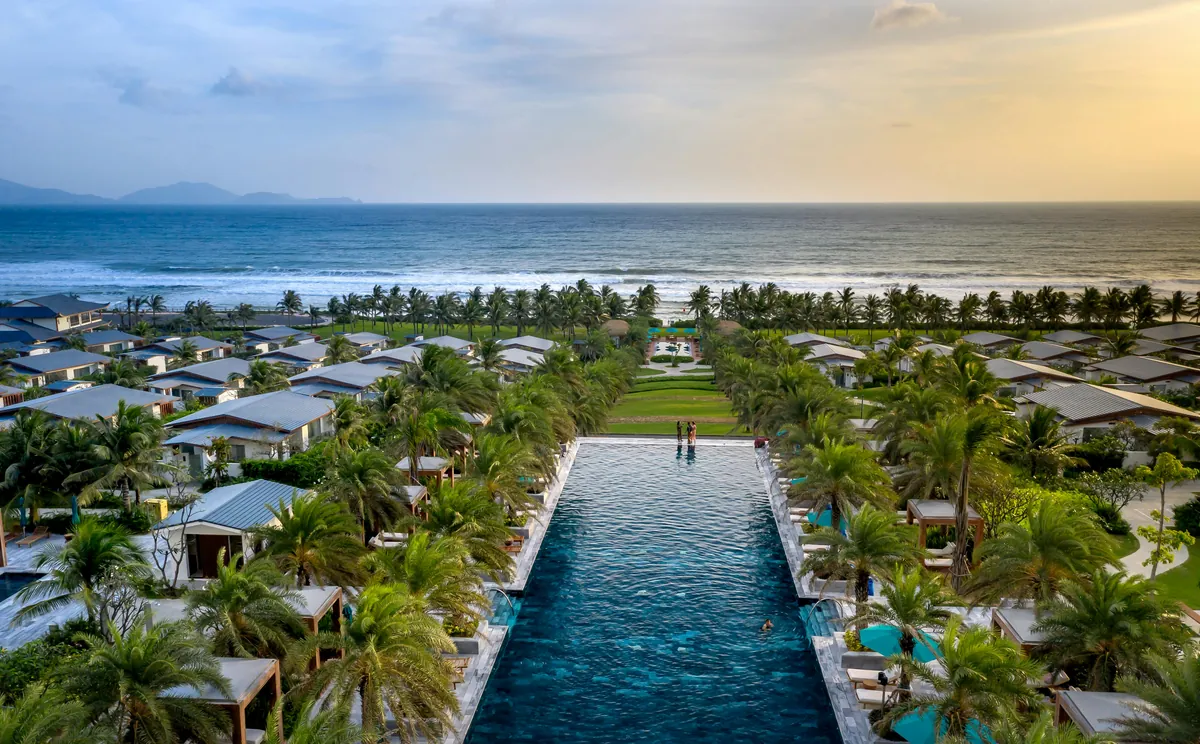
Your resort has 2,888 rooms,
15 restaurants, and a waterpark.
Nobody planned how guests move between them.
Gaylord Opryland rents wheelchairs and scooters because the resort is too large to walk. Atlantis spans 154 acres. Dorado Beach uses golf carts across 1,400. Every mega-resort has acknowledged the walking problem reactively. None has solved it as a system.
A travel blogger's tip for first-time guests at Gaylord Opryland Resort & Convention Center in Nashville: "That hike from the lobby to your room can be a bit daunting, especially if you're hauling around a ton of luggage. Spare yourself the struggle, especially if your room seems to be miles away. Your feet and back will thank you!" (PullOverAndLetMeOut)
Another guest's review: "Spent 4 hours walking around the different areas."
Four hours of walking. At a resort. Not a national park. Not a theme park. A hotel.
Gaylord Opryland has 2,888 rooms across multiple wings, 9 acres of indoor gardens, 15 restaurants, 4 bars, multiple retail stores, a 4-acre indoor and outdoor waterpark, a 20,000-square-foot spa, a fitness center, Delta River flatboat rides, and 750,000 square feet of meeting and convention space. The property is so large that guests who need mobility assistance can rent wheelchairs for $20 per day or electric scooters for $50 per day from an onsite provider, Bradley Health Services. (Gaylord Opryland Accessibility Guide)
The resort rents scooters because the resort is too large for some guests to walk.
That's not a criticism — it's a design reality. And Gaylord Opryland isn't an outlier. It's the flagship of a portfolio, and it's representative of a category of properties across the country that have grown beyond the point where walking is a reasonable expectation for every guest.
The mega-resort is a category now
The hospitality industry has been building bigger for decades. What was once a hotel with a pool is now a self-contained destination with multiple buildings, multiple dining venues, multiple entertainment attractions, and distances between them that are measured in quarter miles.
The Gaylord Hotels portfolio — owned by Ryman Hospitality Properties and operated by Marriott International — includes six properties, each one a small city: Gaylord Opryland in Nashville (2,888 rooms, 750,000 sq ft of meeting space, 9 acres of indoor gardens), Gaylord Palms in Kissimmee (1,718 rooms, a 4.6-acre glass-covered atrium), Gaylord Texan in Grapevine (1,814 rooms, a 4.5-acre Texas-inspired atrium), Gaylord National in National Harbor (545,000 sq ft of meeting space and a 19-story atrium), Gaylord Rockies in Aurora (85 acres with 500,000 sq ft of event space), and the newest Gaylord Pacific in Chula Vista, which opened in May 2025 with 1,600 rooms, a 4.25-acre waterpark, and 12 restaurants. (TakeTravelInfo / Gaylord Hotels Guide 2026)
Atlantis Paradise Island in Nassau spans 154 acres with multiple hotel towers — the Royal, the Coral, the Cove, and the Reef — plus a waterpark, a marine habitat, a casino, and dozens of restaurants and shops. (Wikipedia / Atlantis Paradise Island)
Dorado Beach, a Ritz-Carlton Reserve in Puerto Rico stretches across 1,400 acres. The resort uses golf carts to transport guests between the beach, the restaurants, and Spa Botánico. (Rachel Harrison Communications / Luxury Hotel Accessibility 2026)
The Broadmoor in Colorado Springs sits on 5,000 acres with 784 rooms, multiple golf courses, and wilderness experiences spread across a footprint larger than many towns. (It's one of 18 properties catalogued in the FlexTram atlas of large-footprint destination resorts — acreage, amenity dispersion, and current onsite transit per entry.)
The Ritz-Carlton Kapalua in Maui occupies 54 acres within a 23,000-acre resort community and already runs a courtesy shuttle to nearby beaches, restaurants, and golf courses within the Kapalua resort area. (Booking.com / Ritz-Carlton Kapalua)
These properties aren't hotels. They're campuses. And the guest experience challenge they share is the same one that stadiums, convention centers, hospitals, senior living communities, and cruise destinations face: the property has outgrown the guest's ability to navigate it on foot.
The reactive solutions are already there
Here's what's telling: every mega-resort has already acknowledged the walking problem. They just haven't solved it systemically. They've solved it reactively, one guest at a time.
Wheelchair and scooter rentals. Gaylord Opryland rents them onsite through Bradley Health Services. Multiple Gaylord properties offer similar services. The message this sends to the guest: the property is too large for you to walk, so here's a device you can rent to navigate it yourself — at your expense, on your own, without a route or a guide.
Golf cart transport on request. At Dorado Beach, golf carts are dispatched to move guests across the 1,400-acre property. The service is available, but it's request-based — the guest has to know it exists, has to ask for it, and has to wait for it. There's no schedule. There's no route. There's no system.
Bell attendant escorts. At Gaylord Opryland, the travel blogger's advice is to "enlist the help of a Bell Attendant" to navigate from the lobby to the room. The bell attendant walks with the guest, helps with luggage, and serves as an informal guide through the property. It's a service — but it's a one-to-one staffing model that doesn't scale. You can't escort 2,888 rooms of guests from the lobby to their rooms one at a time during a major convention check-in.
Courtesy shuttles to external destinations. Several of these properties run shuttle buses to airports, downtown areas, shopping centers, and golf courses. Gaylord Opryland runs shuttles to the Grand Ole Opry, Opry Mills, the General Jackson Showboat, and The Inn at Opryland. But these shuttles serve external destinations. They don't serve the internal campus — the distances between the room, the restaurant, the waterpark, the spa, and the convention center within the property.
Every one of these solutions confirms that the property is too large for unassisted walking. Every one of them is reactive — available on request, not by default. And none of them is a system — a fixed route, a posted schedule, a vehicle that runs continuously between the key destinations on the campus so that any guest can use it without asking.
The convention guest has it worst
The leisure guest at a mega-resort can take their time. They're on vacation. They can wander. They can stop for coffee. They can sit on a bench and enjoy the indoor gardens. The walk is part of the experience — until it isn't, at which point they rent a scooter or hail a bell attendant.
The convention guest doesn't have that luxury.
The convention guest has a keynote in the Grand Ballroom at 8:30 AM, a breakout session in a meeting room on the opposite side of the property at 10:00 AM, a networking lunch in the atrium at noon, an exhibitor meeting in the convention center at 2:00 PM, and a reception in the restaurant at 6:00 PM. Each transition requires a walk through the property — through the atriums, up the escalators, across the skywalks, past the restaurants, through the lobby.
At a property like Gaylord Opryland — 750,000 square feet of meeting space spread across a campus with 9 acres of indoor gardens between buildings — the walk between sessions can take 15 minutes. Multiply that by four transitions per day across a three-day convention, and the attendee has spent close to three hours walking between sessions — time that was supposed to be spent networking, attending content, or meeting with exhibitors.
This is the same dynamic we documented in our convention center analysis: the convention center got bigger, the distances grew, and the attendee experience degraded. At a convention hotel, the challenge is compounded because the attendee is also navigating between their room, the dining venues, and the meeting spaces — all within a single property that can be as large as a convention center itself.
Operating a mega-resort or convention hotel?
FlexTram offers resort transit solutions — seasonal deployments, permanent campus installations, equipment rentals, and full-service operations — for hospitality properties of any size. ADA accessible standard. Up to 27 passengers per vehicle. One driver.
61 million Americans have a disability. One in seven is mobility impaired.
The accessibility dimension at mega-resorts deserves its own conversation — because the guest population at these properties includes a significant percentage of people for whom the distances aren't just inconvenient. They're barriers.
According to the CDC, approximately 25% of U.S. adults — 61 million people — have a disability that affects major life activities. Nearly 14% of those, or about 1 in 7 adults, are mobility impaired. Adults 65 and older are six times more likely to have some form of disability. (CDC / AbiliTrek via Next Avenue)
A hospitality accessibility expert framed the standard clearly: "Disabled guests should not have to choose between style and dignity." (Rachel Harrison Communications)
At a mega-resort, the choice many mobility-impaired guests face isn't between style and dignity — it's between participation and isolation. The guest who can't walk from the room to the restaurant doesn't eat at the restaurant. The guest who can't walk from the convention center to the reception doesn't attend the reception. The guest who can't walk from the lobby to the waterpark doesn't experience the waterpark.
The wheelchair rental addresses the mobility limitation. It doesn't address the experience. A guest rolling a rented wheelchair through a luxury resort — navigating thresholds, ramps, heavy doors, and long corridors alone — is not having the same experience as the guest who walks. The wheelchair is a tool. What's missing is a system — a transit service that moves all guests, including guests with disabilities, between the key destinations on the campus as a standard amenity, not a special accommodation.
As one travel advisor noted: "If you'll be staying on a big resort, it would be wise to enquire about whether the hotel offers a complimentary shuttle service or self-service buggy for guests with mobility issues." (The Rare Welsh Bit) The fact that travel advisors are coaching guests to ask proactively about onsite transit tells you everything about the current state of the experience.
The portfolio opportunity
Here's where the business case gets interesting for multi-property resort operators like Ryman Hospitality Properties (Gaylord Hotels), Marriott International, and Hilton (which operates Waldorf Astoria, Conrad, and other large-footprint brands).
A single property implementing onsite transit is a local improvement. A portfolio of six properties — like Gaylord Hotels' Nashville, Orlando, Dallas, National Harbor, Denver, and San Diego campuses — implementing a standardized transit platform is a brand initiative.
The same vehicle. The same driver training. The same operational model. The same guest experience from Gaylord Opryland in Nashville to Gaylord Pacific in Chula Vista. The convention planner who books a Gaylord property knows that onsite transit is part of the experience at every location, not a variable that changes by campus. The repeat guest recognizes the system. The meeting attendee factors it into their recommendation to their company's event planner.
Standardized onsite transit across a resort portfolio does what standardized amenities have always done for branded hospitality networks: it creates consistency, reduces guest uncertainty, and gives the sales team a differentiator that competitors haven't matched.
The Ritz-Carlton Kapalua already runs a courtesy shuttle within the Kapalua resort community. Dorado Beach already dispatches golf carts across 1,400 acres. The concept isn't foreign to luxury hospitality. What's missing is the systemization — taking the ad hoc golf cart dispatch and the courtesy shuttle and replacing them with a fixed-route, scheduled, high-capacity transit service that operates as a standard resort amenity.
What onsite transit looks like at a resort
A FlexTram deployment at a mega-resort operates the same way it operates at a stadium, a cruise destination, or a hospital campus — with routes designed around the specific property and schedules matched to the guest journey.
The morning loop connects the parking areas and room wings to the convention center, the fitness center, and the breakfast restaurants. It runs on a tight schedule during the 7:00–9:00 AM window when convention guests are moving to their first sessions and leisure guests are heading to the pool or the spa.
The midday loop shifts to connect the convention center, the restaurant atrium, and the leisure attractions — the waterpark, the spa, the golf course shuttle point. Frequency adjusts based on convention schedule breaks and meal periods.
The evening loop connects the room wings to the restaurants, the entertainment venues, and the reception spaces. It runs through the cocktail and dinner window and extends through the evening entertainment schedule.
The accessibility layer is built in, not bolted on. Every vehicle is ADA-accessible as standard. The guest with a mobility limitation doesn't request a separate service. They use the same tram as every other guest, at the same boarding points, on the same schedule. The accessible experience isn't parallel to the guest experience — it is the guest experience.
The resort doesn't need to build infrastructure. The routes are marked with signage. The boarding points are designated at key building entrances. The vehicles run on existing pathways — paved, landscaped, or covered walkways that already connect the buildings. The system deploys in days and adjusts as the property's needs change — more vehicles during a 3,000-person convention, fewer during a quiet Tuesday in January.
The experience that hasn't been designed
Every mega-resort in the country has invested in the rooms. The restaurants. The spa. The waterpark. The gardens. The convention space. The entertainment. Hundreds of millions of dollars in design, construction, and amenity programming — all aimed at creating a guest experience that justifies the rate and earns the repeat visit.
The experience of moving between all of those investments? That's still a walk. A long walk. Through atriums and across corridors and up escalators and past the same indoor garden for the fourth time that day. For some guests, it's a pleasant stroll. For others, it's the reason they don't make it to dinner.
As we wrote in "The demand is already there. The friction is eating it" — the guest already checked in. They already have the room. They already planned to eat at the restaurant, visit the waterpark, and attend the reception. The demand is there. The friction of distance is suppressing how fully they experience the property they're paying $300 a night to enjoy.
The resort designed every destination. The ride between them is the last piece of the guest experience that hasn't been designed.
Frequently asked questions
Why does a hotel or resort need onsite transit when it already has shuttles?
Most resort shuttles serve external destinations — airports, downtown areas, attractions, golf courses outside the property. Onsite transit serves the internal campus: the distances between the room wing, the convention center, the spa, the restaurant atrium, the waterpark, and the parking areas within the property. At mega-resorts like Gaylord Opryland (2,888 rooms, 9 acres of indoor gardens), Atlantis Paradise Island (154 acres), Dorado Beach (1,400 acres), or The Broadmoor (5,000 acres), the property is too large for unassisted walking — and the existing shuttle program isn't designed to address that.
Don't wheelchair rentals and bell-attendant escorts already solve this?
They confirm the problem; they don't solve it. Wheelchair and scooter rentals are reactive accommodations available on request, at the guest's expense, with no route or guide. Bell-attendant escorts are a one-to-one staffing model that doesn't scale during major convention check-in. Golf-cart-on-request services require the guest to know the service exists, ask for it, and wait for it. None of these is a system — a fixed route, a posted schedule, a vehicle that runs continuously between key destinations so any guest can use it without asking.
How is the convention guest experience at a mega-resort different from the leisure guest?
The leisure guest can take their time — walking is part of the vacation experience until it isn't. The convention guest has a 8:30 AM keynote, a 10:00 AM breakout in a meeting room on the opposite side of the property, a noon networking lunch, a 2:00 PM exhibitor meeting, and a 6:00 PM reception. Each transition can take 15 minutes of walking at a property like Gaylord Opryland with 750,000 square feet of meeting space. Across a three-day convention, that's close to three hours walking between sessions — time meant for networking, content, and meeting exhibitors.
Why is onsite transit a portfolio opportunity for hotel brands?
A single property implementing onsite transit is a local improvement. A portfolio standardizing across all of its mega-resort properties — same vehicle, same operating model, same guest experience from one location to the next — is a brand-level differentiator. The convention planner who books a Gaylord property knows onsite transit is part of the experience at every campus, not a variable. Standardized transit across a multi-property portfolio creates consistency, reduces guest uncertainty, and gives the sales team a differentiator competitors haven't matched.
What does an onsite transit deployment at a resort actually look like?
Routes designed around the specific property and schedules matched to the guest journey. A morning loop connects parking areas and room wings to the convention center, fitness center, and breakfast restaurants on tight 7–9 AM frequency. A midday loop shifts to the convention center, restaurant atrium, and leisure attractions. An evening loop connects room wings to restaurants, entertainment venues, and reception spaces. Every vehicle is ADA-accessible as standard — the guest with a mobility limitation uses the same tram on the same schedule. No infrastructure required: routes use existing pathways, deploy in days, and adjust as the property's needs change.
Related reading
The resort designed every destination. The ride between them hasn't been designed.
FlexTram offers resort transit solutions — seasonal deployments, permanent campus installations, equipment rentals, and full-service operations — for hospitality properties of any size. ADA accessible, up to 27 passengers per vehicle, one driver.