$13 billion in convention center construction.
Zero invested in how attendees move through them.
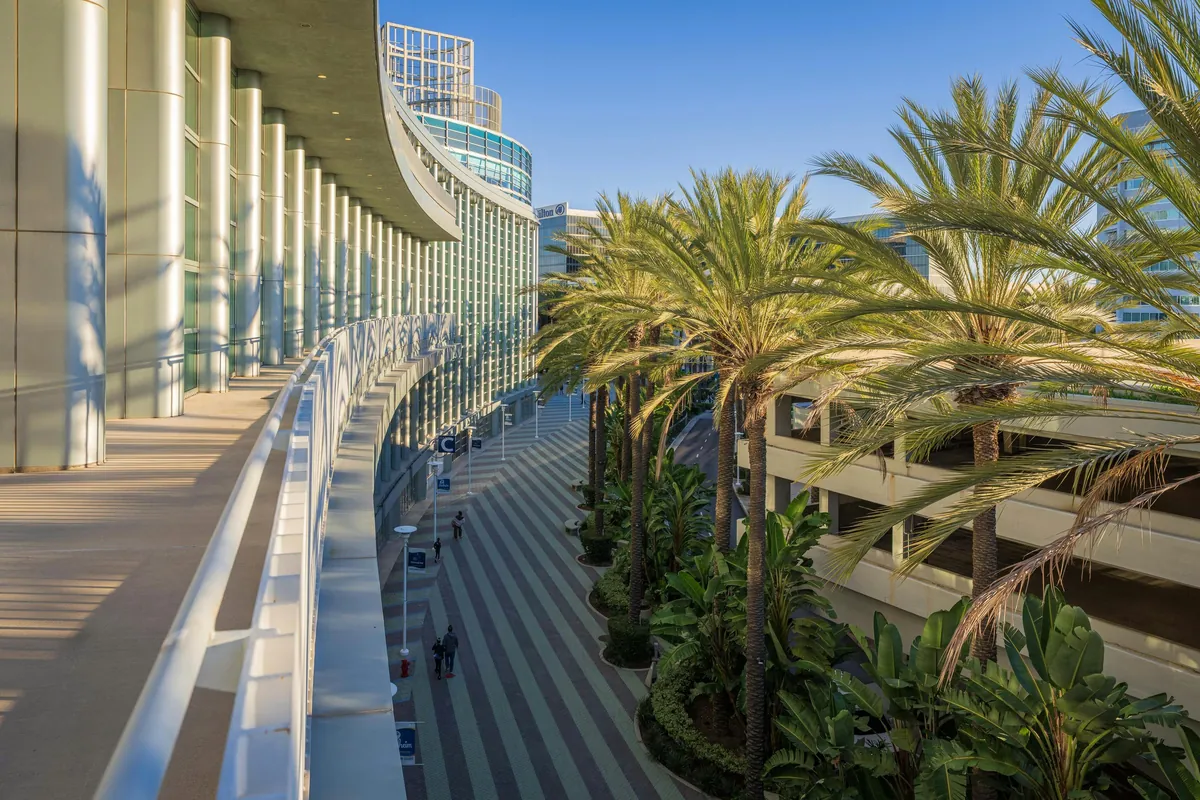
The Orange County Convention Center — the second-largest convention facility in the United States — completed its Grand Concourse expansion in 2026, connecting the North and South buildings into a facility that a luxury ground transportation company now describes as "its own city." Their advice to clients arriving for trade shows like HIMSS or MegaCon: confirm the specific hall in advance, because "navigating the interior of the Orange County Convention Center can take 20 minutes of walking." They've coined a term for it: the "convention hike."
Twenty minutes of walking. Inside the building. (Orlux Rides / OCCC Guide 2026)
That's before the attendee gets to the parking situation. During peak shows, the OCCC's on-site lots are full before the first session begins. Attendees who drive are diverted to satellite lots and "forced to wait for a cramped, slow-moving shuttle." Attendees who rideshare wait 15 minutes for their car to find the pickup loop. Attendees who walk from connected hotels navigate a skywalk system that, while convenient, adds another 10–15 minutes to the journey.
An attendee who parks in a satellite lot, shuttles to the building, walks 20 minutes through the facility to the correct hall, registers, and reaches the first booth on the expo floor has spent 45 minutes to an hour just arriving. At a trade show where the exhibit hall is open for eight hours, that's 10–15% of the day consumed by transit — before the first handshake, the first demo, or the first scan of a badge.
And the OCCC isn't an outlier. It's the template. Convention centers across the country are getting bigger, and the attendee transit problem is scaling with them.
The expansion boom nobody's talking about
The convention center industry is in the middle of its largest construction cycle in decades. The scale of investment is staggering:
Dallas: The Kay Bailey Hutchison Convention Center is undergoing a $3.7 billion rebuild — the largest convention center project in American history. When complete, it will offer 750,000 square feet of exhibit space, 181,000 square feet of meeting space, and a 105,000-square-foot ballroom. The plan includes a walkable entertainment district connecting downtown Dallas to the Cedars and the planned Rail District. (Northstar Meetings Group)
Las Vegas: The Las Vegas Convention Center completed a $600 million renovation in time for CES in January 2026. The facility now spans 4.6 million square feet. The project added a climate-controlled interior concourse connecting the North and South halls — because the facility had gotten so large that attendees needed a climate-controlled corridor just to walk between halls. (Skift Meetings)
Los Angeles: The LA Convention Center broke ground on a $2.6 billion expansion and modernization project in October 2025. The project connects the South and West exhibit halls into one contiguous hall of more than 750,000 square feet, adds a 98,000-square-foot rooftop ballroom, and will achieve "Olympic Readiness" by spring 2028. (Construction Dive / City of LA)
Houston: The George R. Brown Convention Center is undergoing a $2 billion, 700,000-square-foot expansion, including a 100,000-square-foot pedestrian plaza connecting the venue to the Toyota Center. (Skift Meetings)
Austin: The Austin Convention Center closed in April 2025 for a $1.6 billion top-to-bottom reconstruction that will nearly double rentable square footage from 365,000 to 620,000. (Northstar Meetings Group)
Fort Lauderdale: The Broward County Convention Center completed a $1 billion expansion adding 525,000 square feet of meeting space, a 65,000-square-foot waterfront ballroom, and a six-acre outdoor waterfront plaza. (Event Marketer)
Fort Worth, Cincinnati, Louisville, Atlanta, Hawai‘i — all mid-construction or recently completed on projects ranging from $125 million to $460 million.
The total: roughly $13 billion in convention center construction either underway or recently completed across the United States. Every one of these projects makes the facility bigger. Every one of them increases the distances attendees need to cover. And almost none of them include a plan for how attendees move through the expanded facility once they arrive.
The attendee's actual day
Here's what the convention center expansion boom looks like from the attendee's perspective.
7:30 AM: Depart the hotel. The headquarters hotel is connected via skywalk — a 10-minute walk through a corridor, down an escalator, across a lobby, and into the convention center's registration area. The overflow hotel is three blocks away — a 15-minute walk, or a shuttle bus that runs every 20 minutes and stops at four other hotels first.
8:00 AM: Arrive at registration. Pick up badge. Consult the floor map. Discover that the keynote is in Hall A (north end) and the first breakout session is in Meeting Room 314 (south end, third floor). The distance between them: a quarter mile through the building.
8:45 AM: Keynote ends. Walk to the breakout session. Arrive 10 minutes late because the walk took longer than expected and the signage was confusing.
10:15 AM: Breakout ends. Walk to the exhibit hall. The exhibit hall entrance is on the opposite side of the building from the meeting rooms. Another 10-minute walk.
12:00 PM: Break for lunch. The convention center's food court is in the concourse — a 5-minute walk from the exhibit hall. The off-site restaurant the attendee actually wants to visit is three blocks away, requiring a 15-minute walk each way. With a 90-minute lunch break, the attendee spends 30 minutes walking and 60 minutes eating. Or they stay in the food court.
2:00 PM: Afternoon session in a different hall. Another walk. By now the attendee's feet hurt, they've covered three miles inside the building, and the exhibitor booth they meant to revisit on the far end of the expo floor gets skipped.
5:00 PM: Event ends. Walk back to parking or the shuttle stop. The satellite lot shuttle has a 20-minute wait. The attendee has been on their feet for nine hours, covered five miles inside the facility, and missed two exhibitor meetings and one breakout session because the walks between venues consumed the buffer time they needed.
This is the convention center experience at scale. And it's getting worse with every expansion.
Planning a show at one of these expanding facilities?
FlexTram offers event-specific deployments, venue partnerships, and turnkey transportation plans for convention centers, trade shows, conferences, and corporate events of any size. ADA accessible standard. Up to 27 passengers per vehicle. One driver. Sponsorship-eligible.
The venue management industry knows the facilities are getting bigger
The companies that manage these facilities understand the scale challenge.
Legends Global (formerly ASM Global) — the world's largest venue management company — operates over 400 venues globally, including many of the convention centers undergoing expansion. When Legends acquired ASM Global in 2024, it created an entity managing over 20,000 live events annually and welcoming 164 million guests per year. (Wikipedia / Legends Global)
Kim Allison, VP of Convention Sales at the Georgia World Congress Center, described the industry trend: "Event planners today are focused on creating environments that foster connection, comfort, and inclusivity." The GWCC sits adjacent to Mercedes-Benz Stadium and State Farm Arena — a multi-venue campus where attendees move between convention facilities and entertainment venues across multiple city blocks. (ConventionSouth)
Convention feasibility studies increasingly flag the tension between walkability and parking accessibility. A 2025 feasibility study for a proposed convention center in Columbia, Missouri explicitly identified "walkability vs. parking accessibility" as a key challenge — noting that attendees need both pedestrian proximity to hotels and restaurants AND adequate parking infrastructure, and that the gap between them is where the attendee experience breaks down. (City of Columbia Feasibility Study)
The facilities are getting bigger. The management companies know it. The planners know it. The feasibility studies flag it. And yet the solution for how attendees move through these expanding campuses remains the same as it was when the facilities were half the size: they walk.
The convention center is becoming a campus
Here's what's changed structurally: the convention center is no longer a building. It's a campus.
The GWCC is adjacent to a stadium and an arena. The OCCC is next to Universal's Epic Universe. The LA Convention Center is embedded in the LA Live entertainment district and will host Olympic events. Houston's GRB expansion includes a pedestrian plaza connecting to the Toyota Center. Dallas's rebuild includes a walkable entertainment district bridging multiple neighborhoods. Fort Lauderdale's expansion includes a six-acre waterfront plaza with restaurants.
These aren't convention centers with parking lots. They're multi-venue, multi-block campuses where attendees move between exhibit halls, meeting rooms, hotels, entertainment venues, restaurants, and outdoor plazas — often across distances that exceed a quarter mile.
As we wrote in "The Properties Got Bigger. The Plan Didn't." — there is a size threshold beyond which a property cannot function without a transit system. Convention centers crossed that threshold when they expanded from single-building facilities into multi-building, multi-block campuses integrated with hotels, entertainment districts, and outdoor venues.
The Las Vegas Convention Center built a climate-controlled concourse to connect its halls because the facility got too large for attendees to walk between them comfortably. That's an architectural acknowledgment of a transit problem — solved with concrete instead of vehicles. A tram running a fixed loop between halls, between the convention center and the hotel corridor, and between the facility and the parking structures would accomplish the same thing with more flexibility, at a fraction of the construction cost, and with the ability to scale up during CES and scale down during a mid-week corporate meeting.
The event planner's hidden cost
Convention center transit isn't just an attendee comfort issue. It's a planning cost that event organizers absorb without recognizing it.
Every major trade show and conference includes a transportation line item in the event budget: shuttle buses between the convention center and official hotels. These shuttle contracts typically cost $50,000 to $200,000 for a multi-day event, depending on the number of hotels, the frequency of service, and the distance.
But the shuttle only covers the hotel-to-convention-center leg. Once the attendee is inside the facility, they're on their own. The walk from the registration area to the exhibit hall. The walk from the exhibit hall to the breakout rooms. The walk from the breakout rooms to the food court. The walk from the building to the parking structure. All of these interior and perimeter distances are unmanaged.
For event planners, this creates scheduling constraints that are rarely acknowledged. Session blocks need 15-minute buffers between them — not for content transitions, but for walking time. Lunch breaks need to be 90 minutes instead of 60 to accommodate the walk to and from food service. Exhibit hall hours need to account for the 30 minutes of "arrival friction" at the start of each day when attendees are still making their way through the facility.
These scheduling buffers reduce the productive hours available for content, networking, and exhibitor engagement. A four-day trade show with 30 minutes of daily arrival friction and 15-minute session buffers loses the equivalent of a full half-day of productive time to walking. Nobody calculates this cost — but the event planner who could eliminate it would deliver measurably more value to exhibitors and attendees alike.
What a system looks like at a convention center
A FlexTram deployment at a convention center campus operates the same way it operates at a stadium district, a cruise destination, or a data center campus — with routes designed around the specific property and schedules designed around the event timeline.
Perimeter loop: A continuous route connecting the parking structures, the ground transportation center, the hotel corridor, and the convention center entrance. This replaces or supplements the shuttle bus contract, with higher-capacity vehicles running more frequently on a fixed, visible route.
Interior/campus circulation: At multi-building facilities or campus-style convention centers — where the exhibit hall, the meeting rooms, the ballroom, and the outdoor venues are spread across multiple structures — a tram running a fixed loop between buildings reduces the interior walking distances that currently consume attendee time and energy.
Event-day scaling: During CES (roughly 150,000 attendees) the system runs at maximum frequency with the full fleet deployed. During a 2,000-person corporate meeting, two vehicles run a simplified route. The system scales to the event, not the other way around.
ADA service built in, not bolted on. Convention attendees include people with mobility limitations, attendees recovering from medical procedures, attendees using wheelchairs and scooters, and elderly attendees. The current ADA solution at most convention centers is "contact us for assistance" — reactive, inconsistent, and dependent on the attendee asking. A tram with ADA accessibility as standard means accessible service is the default experience, not the exception.
Sponsor integration. Convention sponsorship is a multi-billion-dollar industry. The tram — carrying a captive audience between venues, with dwell time and visual real estate — is a natural sponsorship activation. "This ride brought to you by [exhibitor]" delivers impressions to every attendee, every trip, all day. For the event organizer, it's a revenue line that offsets the transit cost.
The attendee experience is the product
The convention and trade show industry is in the middle of a fundamental shift. Virtual events proved that content can be delivered remotely. The value of in-person events — the reason roughly 150,000 people fly to Las Vegas for CES, the reason exhibitors pay tens of thousands for a booth — is the experience of being there. The hallway conversation. The chance encounter. The booth demo. The dinner with a prospect.
Every minute an attendee spends walking between sessions, navigating parking, waiting for shuttles, or figuring out wayfinding is a minute they're not having those experiences. It's a minute of value that the attendee paid for and didn't receive.
As we wrote in "The Demand Is Already There. The Friction Is Eating It." — the attendee already bought the badge. They already flew to the city. They already checked into the hotel. The demand is there. The friction of moving through an expanding, multi-building, multi-block convention campus is suppressing how fully they engage with the event they paid to attend.
Convention centers are investing $13 billion to expand their facilities. Event planners are investing millions to fill them with content, exhibitors, and programming. The attendee is investing thousands in airfare, hotels, and registration fees to be there.
The gap between all of that investment and the attendee's actual experience is measured in footsteps. It doesn't have to be.
Frequently asked questions
Why is convention center expansion creating an attendee transit problem?
Modern convention center projects are making facilities physically larger — Las Vegas Convention Center now spans 4.6M square feet, OCCC's Grand Concourse expansion connected the North and South buildings, and the Kay Bailey Hutchison rebuild in Dallas will be the largest convention center project (by investment) in U.S. history. As facilities grow into multi-building, multi-block campuses integrated with hotels and entertainment districts, the distances attendees walk between sessions, exhibit halls, food service, and parking grow with them. Most expansion budgets fund concrete, glass, and HVAC. Almost none fund a transit system to move attendees across the expanded footprint.
How much time do attendees actually lose to walking inside a convention center?
At the Orange County Convention Center, a luxury ground transportation service warns clients that navigating the interior can take 20 minutes of walking — they call it the "convention hike." Combined with parking, satellite shuttle waits, and corridor walks, an attendee can spend 45 minutes to an hour just arriving each morning. Across an 8-hour exhibit day that's 10–15% of the day consumed by transit before the first handshake. Compounded across a multi-day show, attendees lose the equivalent of a half-day of productive networking and exhibitor engagement to walking.
Don't shuttle bus contracts already cover this?
Hotel-to-convention-center shuttles cover the perimeter only. Once the attendee is inside the facility — between registration and the exhibit hall, between halls, between meeting rooms and food service, between the building and the parking structure — they're on their own. Modern multi-building convention campuses have interior and inter-building distances that exceed what attendees can comfortably walk during break times. Shuttle bus contracts aren't designed to circulate attendees between buildings on a campus, and most charter buses can't operate inside pedestrian plazas anyway.
What does a convention-center transit system actually look like?
Three operating modes that share one platform: a perimeter loop connecting parking structures, ground transportation centers, hotel corridors, and the convention center entrance; an interior or inter-building circulation route at multi-building facilities; and event-day scaling so the same fleet runs maximum frequency during CES and a simplified two-vehicle route during a 2,000-person corporate meeting. ADA accessibility is built in as standard rather than as a request-and-wait service. Every vehicle is sponsorship-eligible — convention sponsorship is a multi-billion-dollar category and a tram with a captive audience between venues is a natural activation surface.
Who actually owns the attendee-transit problem at a convention center?
Today, it's split: the venue owns the building, the city or convention bureau owns the destination marketing, the show organizer owns the attendee experience, and the venue management company (Legends Global, Oak View Group, Spectra) operates the day-of facility. Onsite transit usually falls between those seams. Solving it requires whoever feels the gap most acutely to claim it — typically the show organizer (whose attendees are losing productive hours) or the venue management company (whose comp set increasingly includes facilities with integrated mobility). FlexTram works with both.
Related reading
The gap between $14B in expansion and the attendee's actual experience is measured in footsteps.
FlexTram offers event-specific deployments, venue partnerships, and turnkey transportation plans for convention centers, trade shows, conferences, and corporate events of any size — ADA accessible, up to 27 passengers per vehicle, sponsorship-eligible.