Football season is 150 days out.
Your parking lot is still the weakest link.
NFL kickoff is September 9. College football starts the last week of August. Preseason camps open in July. The time to rethink your game-day parking shuttle is now — not August.
This summer, the 2026 FIFA World Cup will put stadium transportation under a global microscope. Sixteen host cities, 104 matches, 5.5 million expected fans — and every operational gap on display for the world to see. The last-mile problem between the parking lot and the gate will be visible in a way it's never been before.
And then, six weeks later, football season starts.
The NFL regular season kicks off September 9 with Seattle hosting the opener. College football returns in late August with 130+ FBS programs lighting up stadiums from Tuscaloosa to Ann Arbor. Preseason games begin August 6 with the Hall of Fame Game in Canton. Between now and then, every stadium operations director in the country will finalize their game-day transportation plans for the fall.
The question is whether those plans look any different from last year.
The game-day parking problem hasn't changed in 30 years
Walk through any NFL or major college stadium parking operation on a game day and you'll see the same setup that's been in place for decades. A fleet of golf carts — sometimes dozens, sometimes hundreds — scattered across the lots. Some are assigned to VIP shuttle duty. Some are running ADA courtesy transportation between accessible parking stalls and the nearest gate. Some are ferrying staff. Many are unaccounted for.
There's no fixed route. No posted schedule. No way for a fan in a satellite parking lot to know when the next ride is coming or where to board. The carts are dispatched on demand — someone radios, a cart is sent, maybe. Utilization hovers around 30%, which means you're paying for four seats of capacity and filling one.
Meanwhile, the fan experience conversation has moved light years ahead. Smart stadiums are deploying autonomous checkout concessions, real-time wayfinding apps, AI-driven crowd flow analytics, 5G-connected everything, and digital twins that model airflow and occupancy density. According to the Verizon Stadium Connectivity Report, autonomous concessions technology is the top initiative for stadiums — on the roadmap for 65% of venues surveyed. Venues are investing millions to shave 30 seconds off the concession line.
But the parking lot — the first and last touchpoint of every game day — is still running on walkie-talkies and golf carts.
"We chose to invest in campus-wide technologies that support a seamless and fully connected fan experience. This approach allows us to manage the entire guest journey from parking to ticketing to multi-channel commerce."
— Matt Sebek, Chief Experience Officer, St. Louis CITY SC · IAVM Front Row News
From parking to ticketing to commerce — that's the right frame. But at most venues, the "from parking" part of the journey is still a disconnected, unmanaged walk. The digital experience is seamless. The physical experience of getting from the car to the gate is not.
Ingress and egress: the ops director's real scoreboard
Fan satisfaction surveys consistently identify the same top complaints: parking, traffic, and getting in and out of the venue. Not the food. Not the sightlines. Not the Wi-Fi. The physical act of arriving and leaving.
Venue operations teams know this. They track ingress times obsessively — how long from lot entry to seat. They coordinate with local law enforcement on traffic signal timing. They negotiate with transit authorities for extended bus and rail service on game days. They run phased lot releases after the final whistle to prevent post-game gridlock. The best operations evaluate performance after every single event, adjusting for weather, score, day of week, and kickoff time. PwC's smart venue research describes the ideal as a venue that operates like a concierge — solving problems before fans even notice them.
But almost all of that effort is focused on vehicles — getting cars into lots, getting cars out of lots, managing the road network. The people inside those cars are on their own once they park. A family in a remote lot, a season ticket holder with a mobility disability, a group of visiting fans who've never been to the venue — they all get the same non-plan: walk.
For a 70,000-seat NFL stadium with satellite parking half a mile from the gate, that's potentially 15,000-20,000 fans making that walk each direction. In September heat. In November cold. In the dark after a night game. Through a parking lot that's designed for cars, not pedestrians — no sidewalks, no lighting beyond what the lot provides, no separation between foot traffic and vehicles backing out of spaces.
ADA compliance doesn't stop at the building entrance
Here's a gap that's getting harder to ignore. The ADA requires that wheelchair seating locations be on an accessible route that connects to parking and transportation areas. Most stadiums handle this well inside the venue — accessible seating, wheelchair escort service, elevator access to all concourse levels.
But the route between accessible parking and the stadium gate is a different story. Many venues offer courtesy cart service from ADA parking stalls to the nearest entrance — but it's first-come, first-served, limited to the mobility-impaired fan plus one companion, and only available from designated ADA lots. When those lots fill up, fans with disabilities are directed to overflow lots and told a shuttle is available. That shuttle may be a single golf cart running an ad hoc route. There may be a 20-minute wait. There may not be clear signage showing where to board.
A scheduled, ADA-accessible tram on a fixed loop eliminates this entirely. The route is posted. The schedule is predictable. The vehicle is accessible as standard — not as a special request. Every fan, regardless of mobility, knows where to board and when the next ride arrives. That's not just better service. It's a fundamentally more compliant operation.
The post-game problem is worse than the pre-game problem
Pre-game, fans arrive over a 2-3 hour window. There's time to absorb the crowd. People tailgate. They wander. The ingress is distributed.
Post-game, 60,000+ fans hit the exits simultaneously. The parking lot goes from idle to maximum pedestrian density in minutes. This is where the crowd management plan is tested hardest, and it's where most parking operations fall apart.
The standard approach: phased lot release, with sections cleared sequentially to prevent gridlock on the surrounding road network. Traffic control officers at every major intersection. Egress lanes activated. It works for vehicles. But while the cars are being metered out, tens of thousands of fans are walking — in the dark, often in poor weather, through active traffic lanes — to reach their vehicles. Pedestrian-vehicle conflicts spike. Slip-and-fall incidents spike. The walk back to a remote lot after a loss, in the rain, at 11 PM, is the single lowest moment of the entire fan experience.
A tram loop running continuous post-game sweeps changes the equation. It gives fans a visible, lit, staffed option. It accelerates lot clearing because fans reach their vehicles faster. It reduces pedestrian-vehicle conflict because foot traffic is consolidated on the tram route instead of dispersed across the entire lot. And it gives your crowd management team a predictable, controllable flow instead of chaos.
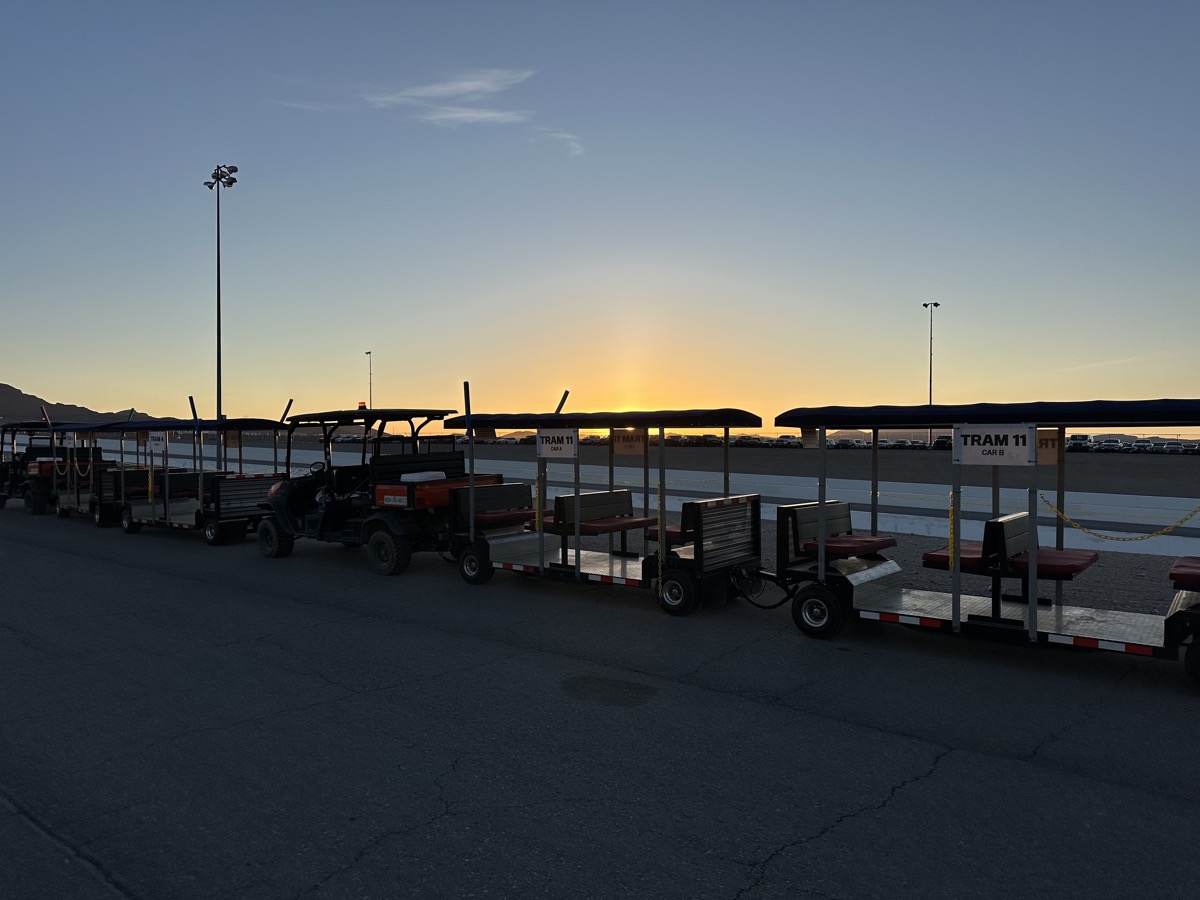
The math on a 10-game NFL home schedule. If you run 4 FlexTrams on a continuous loop between remote lots and the main gate — pre-game, during, and post-game — that's 4 drivers replacing 15-20 golf cart operators. Over 10 home games, you eliminate roughly 150-200 individual cart-driver shifts. The labor savings alone typically offset the cost of the tram system. The fan experience improvement, the liability reduction, and the sponsorship revenue are upside.
Sponsorship: the parking lot is the last unmonetized touchpoint
Stadium naming rights. Concourse signage. Digital ribbon boards. Luxury suite branding. Helmet decals. Sponsored halftime shows. If there's a surface or a moment at a football game, someone's selling it.
Except the parking lot.
The ride from the remote lot to the gate is 5-10 minutes of captive attention. The fan is seated, relaxed, and transitioning from the drive to the game-day experience. It's exactly the kind of moment brands pay for — and right now, it doesn't exist as a sponsorable asset because there's no system to attach it to. A fleet of unmarked golf carts isn't a sponsorship platform. A branded tram system on a fixed, visible route is.
We're seeing this consistently across our deployments: once a tram system is running, sponsors approach venues asking to wrap the vehicles, brand the tram stops, and integrate into the ride experience. Park-and-ride programs where fans pay a nominal fee for a tram pass — bundled with parking or sold separately — create a new revenue line from infrastructure that was previously a pure cost center.
The World Cup will change the conversation
This summer, millions of people worldwide will watch what happens when 70,000 fans try to navigate a stadium campus that wasn't designed for pedestrian-first access. Every operational success — and every failure — will be visible. Host cities are investing unprecedented amounts in transit, shuttle networks, and multimodal fan mobility. As Metro Magazine reported, moving stadium crowds requires detailed transit strategy, data analysis, and collaborative partnerships — and the 2026 World Cup is pushing coordination across at least 10 regional transit partners in LA alone.
When football season starts in September, every stadium ops director will have just watched the largest live demonstration of onsite transportation challenges ever staged. The question venue operators need to ask right now is simple: does our game-day parking operation look like a system, or does it look like something we've been doing out of habit?
FlexTram is deployed at some of the largest, most complex live events in the country — from Coachella and EDC to NASCAR and NFL venues. We've replaced 300+ golf cart fleets with 8 trams at a single site. We run on asphalt, dirt, grass, and gravel. We deploy in hours and store when the season ends.
If you're a stadium operations director, a college athletic director, a parking and transportation manager, or anyone responsible for the game-day fan experience at a football venue — the conversation to have is a simple one: how many carts are in your lot, and what would it look like to replace them with a system?
Preseason starts in July. Let's talk before it does.
— The FlexTram Team
Common questions
Why are golf carts still the standard at football stadiums?
Golf carts became the default because of low acquisition cost and simplicity. But they were designed for individual, on-demand dispatch — not for moving large groups on a schedule. With utilization hovering around 30%, stadiums are paying for four seats of capacity and filling one. The model breaks down at scale.
How does FlexTram improve post-game egress?
A tram loop running continuous post-game sweeps gives fans a visible, lit, staffed option for reaching remote lots. It accelerates lot clearing because fans reach their vehicles faster, reduces pedestrian-vehicle conflicts by consolidating foot traffic on the tram route, and gives crowd management teams a predictable, controllable flow instead of chaos.
Is FlexTram ADA compliant for stadium operations?
Yes. FlexTram vehicles are ADA accessible as standard — not as a special request. A scheduled tram on a fixed loop with posted routes and predictable timing means every fan, regardless of mobility, knows where to board and when the next ride arrives. This delivers a fundamentally more compliant operation than ad hoc golf cart courtesy service.
Can FlexTram generate sponsorship revenue?
Yes. The ride from a remote lot to the gate is 5-10 minutes of captive attention — exactly the kind of moment brands pay for. Once a tram system is running, sponsors approach venues to wrap vehicles, brand tram stops, and integrate into the ride experience. Park-and-ride programs create an additional revenue line from infrastructure that was previously a pure cost center.
When should stadium ops teams start planning for fall?
Now. NFL kickoff is September 9, college football returns in late August, and preseason camps open in July. The 2026 FIFA World Cup this summer will put stadium transportation under a global microscope, making operational gaps visible in a way they've never been before. The time to rethink your game-day parking shuttle is before preseason — not during it.
Explore solutions
Ready to rethink your game-day fleet?
Tell us about your venue — parking layout, capacity, current shuttle setup — and we'll build a custom plan for fall.