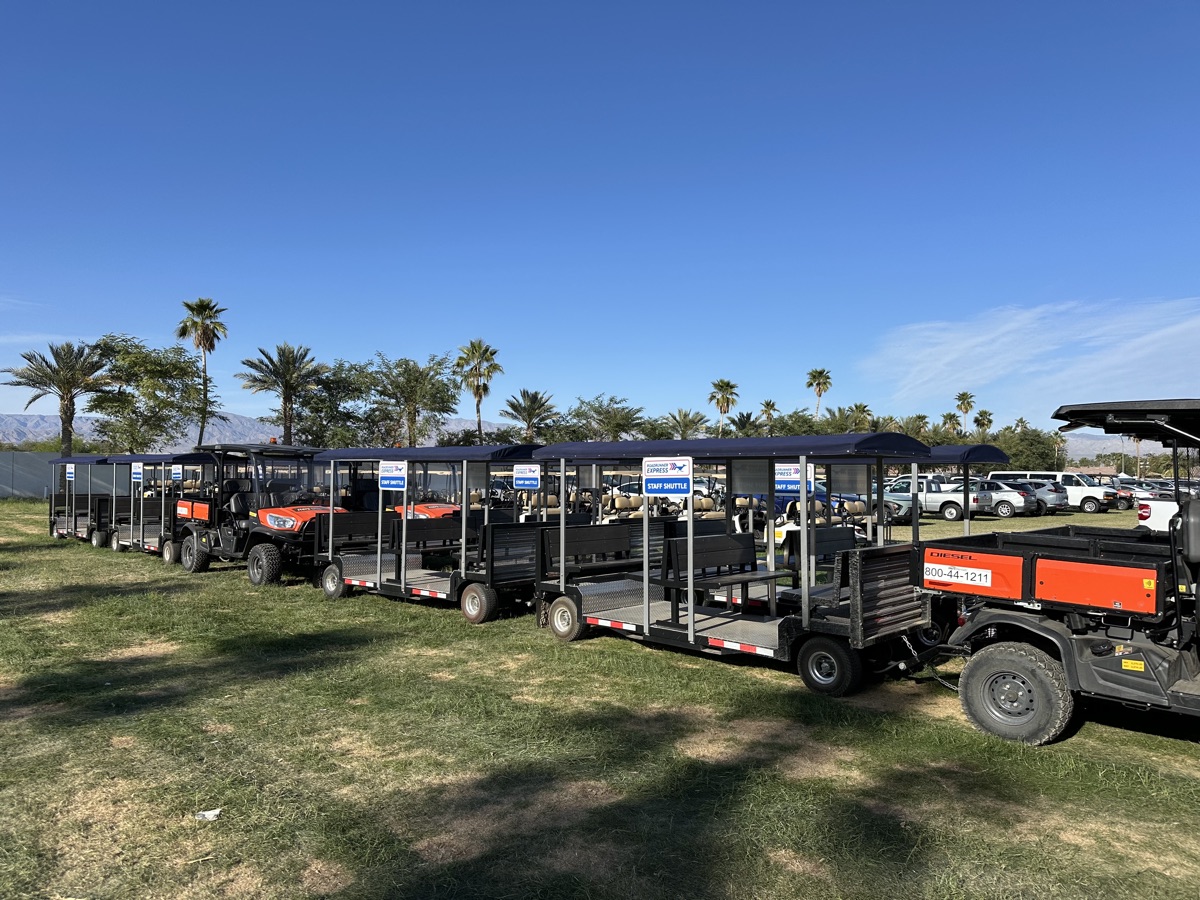
The onsite transportation paradigm is changing.
Here's why.
At FlexTram, we're introducing systems, not rentals. These systems are a direct response to the changing nature of spaces where large numbers of people gather. Our vehicles are the entry point to a systems-level approach built around five core ideas: putting fans first, driving standardization, introducing predictability, reducing cost and liability, and uncovering found revenue.
Fans first — they deserve it
If you attend a large event in the US, you'll likely notice something missing. You've waited all week — perhaps all month, and for major events, all year. You arrive, you park, and then... you walk. And walk. And walk.
Here's the problem: if a patron is willing to pay top dollar for parking, tickets, concessions, and merchandise, that investment comes with a reasonable expectation. The experience they paid for should be the experience they have.
This is the foundation of a fundamental shift in onsite transportation. The experience should be total. Once a patron arrives at the event site, they should feel like they've truly arrived — not like they have a new set of problems to solve. Friction should be near zero. And perhaps counterintuitively, that starts in the parking lot.
Putting the fan experience first is the biggest change underway in live events. Large events are inherently dynamic, but fans should be shielded from that complexity as much as possible. In a mobile-first, tech-centered world, fans — rightfully — expect to be served. Not in some general sense, but directly. That particular fan should have what they need to enjoy their event.
Which leads us to the next shift rippling across the live event space.
Standardization — systems over components
For venue managers, event producers, cruise terminal operations crews, labor companies, and many others, onsite transportation has long been an afterthought. The reason is an honest miscalculation about the value of standards in dynamic spaces.
A useful rule of thumb: in dynamic environments, everything is in flux — so work hard to control what you can. Equipment standardization is one of those things. When the basics are consistent across every event — whether a cruise ship arrival, a concert, or a football game — expectations are manageable, schedules are forecastable, and operations run far more smoothly.
So why are golf carts still so ubiquitous? Because they were an easy fix. Low acquisition cost, simple to operate, no learning curve for patrons. But these vehicles have an inherent flaw: they are designed for individual, on-demand dispatch — not for moving large numbers of people efficiently, predictably, and on a schedule. That single limitation is the root cause of the cost, liability, and operational headaches we see again and again.
Predictability — the foundation of everything else
For many operators — event spaces, planned communities, warehouses, factories, universities — a single six-seat golf cart, maybe two or three, is all that's needed. In those cases, the golf cart may well be the right tool. But the moment more than 20-25 people need to be moved, the cart solution breaks down.
The core issue is predictability. Most cart fleets are dispatched on demand: someone needs a ride, they call, a cart is sent. That works at low volume. It's unmanageable at medium to large volume.
Consider a client of ours in Southern California who runs a massive live event. Their cart inventory had grown to over 1,300 units — a lot of golf carts when no golf is being played. These carts were distributed among vendors, staff, and sponsors with little oversight. Management had no idea who was operating them, where any cart was at any given time, or where fuel costs were going. Predictability had completely broken down.
We introduced eight of our vehicles and helped cut their inventory by 300 units. The reason eight vehicles could replace hundreds of carts comes down to utilization. Our vehicles run fixed, scheduled routes — like a mini transit system — meaning every seat is filled on every run, and every run is planned in advance.
By contrast, the average utilization rate on those six-seat carts was around 30%, meaning nearly three quarters of every cart's capacity was being paid for and left empty. A scheduled, route-based system doesn't just move more people — it moves them more efficiently, with full visibility into where every vehicle is and when.
Cost and liability — the iceberg of hidden expenses
Once predictability breaks down, cost and liability follow quickly — and neither scales linearly.
The cost picture is straightforward: one cart is manageable, but 1,300 is a serious line item. And the question worth asking is how it ever got to that point. For most operators, there was simply no subject matter expert to turn to, other than the golf cart rental company whose incentive is to rent you more carts. Our incentive is the opposite: drive cost down through efficiency, maximizing utilization so that every seat is filled every time.
Liability is more insidious. It compounds with every failure of predictability and oversight. When you don't know who is operating your vehicles, where they are, or whether they're being used as intended, you've lost control of your risk exposure. Dynamic environments already carry enough inherent risk — so control what you can. Fewer operators, moving in predictable patterns, on a schedule communicated clearly to both staff and patrons. That's how you contain liability before it becomes a problem.
Found revenue — it was there the whole time
Once you've solved for predictability and utilization, the same infrastructure that used to be a cost burden becomes a revenue opportunity. The logic is simple: a well-run transportation system doesn't just save money — it creates value that others want to be associated with.
Sponsors are always looking to reach relevant, captive audiences — and transport is, by design, exactly that. Passengers have to be in the vehicle to be transported, so why not engage them with a relevant sponsor in the meantime? We see this consistently. Once a system is in place, sponsors approach venues asking to brand the vehicles and tram stops. It's typically a significant cost offset and integrates neatly into the venue's existing sponsorship menu.
We're also seeing the emergence of miniature Park-and-Rides at stadiums, Dock-and-Rides at terminals, and Camp-and-Rides at festivals. For a nominal fee, patrons are offered a genuine alternative to a long walk — and when the service is excellent, it sells itself. Done right, what starts as a convenience becomes a revenue line that patrons are happy to support.
Over the coming weeks and months, we'll break down each of these areas in greater depth — they each deserve a closer look.
— The FlexTram Team
Common questions
Why are golf carts still so common at large events?
Golf carts became the default because of low acquisition cost and simplicity. But they were designed for individual dispatch, not moving large groups on a schedule. Once an operation exceeds 20-25 people, the cart model breaks down in cost, predictability, and liability.
How does a tram system reduce transportation costs?
A single tram carries up to 27 passengers with one driver, replacing 5-10 golf carts and their drivers. This consolidation typically reduces driver labor by 50-80% while moving the same number of people on predictable, scheduled routes.
What is "found revenue" in onsite transportation?
Once a tram system is running efficiently, sponsors approach venues to brand vehicles and tram stops — creating a revenue stream from what was previously a cost center. Venues are also launching paid Park-and-Ride, Dock-and-Ride, and Camp-and-Ride services that patrons are happy to pay for.
What does "systems, not rentals" mean?
Rather than renting individual vehicles, FlexTram provides a complete transportation system: fixed routes, scheduled service, standardized equipment, and operational intelligence. The vehicle is the entry point to a systems-level approach that addresses cost, liability, guest experience, and revenue.
How does equipment standardization help in dynamic environments?
In dynamic environments, controlling what you can is critical. When equipment is standardized across every event — same vehicles, same routes, same operational playbook — expectations become manageable, schedules are forecastable, and operations run far more smoothly regardless of the specific venue or event type.
Explore solutions
Ready to rethink your fleet?
FlexTram offers rentals, long-term leases, and turnkey transportation plans for events and venues of any size.