The World Cup is 60 days out.
Is your campus ready?
Sixteen host cities are spending billions to get fans to the stadium. Almost nobody is talking about what happens once they arrive.
June 11. That's when the first whistle blows in Mexico City and the largest sporting event ever staged begins rolling across three countries, 16 cities, and 104 matches over 39 days.
Every host city has a transit plan. Rail extensions, bus fleets, rideshare corridors, temporary road closures, dynamic traffic routing, even helicopter shuttles. The logistics are staggering. Kansas City leased 200 buses. Dallas is chaining commuter rail to charter buses to a 10-minute walk. LA is deploying 330 additional buses and building park-and-ride networks from scratch. Transit agencies are running extra service hours before and after matches, coordinating across 10+ regional transit partners in some markets.
The NACFE — the North American Council for Freight Efficiency — published an operational analysis of what it'll take to move fans at this scale, calling the World Cup the ultimate stress test for game-day logistics across three countries.
But here's what nobody's solving: fan-first mobility.
A fan parks in a satellite lot — or gets dropped at a bus hub — and then walks. Half a mile across asphalt. In June heat. With kids. In a crowd of 70,000 people all funneling toward the same gate. No wayfinding. No signage. No ride. Just a long walk through a parking lot.
That walk is the first real moment of the fan experience. And right now, across almost every host venue, the plan for that moment is: nothing.
Ingress is only half the problem
Every venue operations director knows the fundamentals: ingress is the flow of fans into a venue, egress is the flow out, and bottlenecks are what kill both. Throughput — the rate at which people move through choke points — determines whether your event runs smoothly or becomes the kind of experience fans don't come back from.
The transit plans are genuinely impressive. Cities are coordinating across agencies, modes, and jurisdictions at a scale that hasn't been attempted for a U.S. sporting event. But they all share the same blind spot — they treat the stadium perimeter as the finish line.
Kansas City's host committee CEO Pam Kramer captured the challenge in a SportsTravel Magazine feature:
"The number of parking spaces is going to be greatly reduced because of the overlay that FIFA has. So how we get them to try public transit and know that they're going to have to take a bus — it's going to require a massive communication effort."
— Pam Kramer, CEO, Kansas City Host Committee · SportsTravel Magazine
Kramer is describing the macro problem — getting fans to the campus at all. But her point about reduced parking reveals a second, less visible challenge: when parking is constrained and fans are funneled through fewer lots, the density at each lot increases. More people in fewer spaces, all needing to cover the final stretch to the gate. The macro transit plan creates a micro transportation problem that nobody's staffed for.
The bus drops you off. The train lets you out. The rideshare kicks you to the curb at a designated pick-up/drop-off zone. And then you're on your own in a sea of people, navigating temporary fencing, security checkpoints, and parking lots the size of small towns. There's no onsite transportation system connecting the drop-off to the gate. The crowd management plan covers what happens inside the building. What happens between the curb and the turnstile is a gap.
For able-bodied fans, it's an inconvenience — but venue managers know inconvenience drives down fan satisfaction scores and repeat attendance. For fans with mobility challenges — and ADA compliance isn't optional at a FIFA event — it's a barrier. Most host stadiums offer wheelchair escort service inside the venue, but many provide limited or no accessible courtesy transportation between the parking lot and the gate. Fans using mobility devices who can't park in ADA-designated stalls are often directed to remote lots with a courtesy shuttle that runs first-come, first-served — if it runs at all.
For families with young children, that half-mile walk in the heat is the moment the day starts going sideways. For VIPs who paid thousands for hospitality packages, it's the first signal that the premium experience may not match the premium price. For event sponsors investing in on-campus activations, it's missed foot traffic — fans rushing past sponsor zones to reach their seats before kickoff.
The math is simple. At a venue like MetLife Stadium (capacity ~82,500), if even 15% of fans arrive via remote lots and bus hubs, that's over 12,000 people who need to cover the last stretch on foot — per match. Across the tournament, that's hundreds of thousands of individual moments where the experience either works or it doesn't. And every one of those fans is forming an impression of your venue.
Post-event egress: where reputations are made
If ingress is the overlooked problem, post-event egress is the unforgivable one. When 70,000 fans pour out of a stadium simultaneously, the parking lot becomes the single biggest bottleneck in the entire operation. This is where crowd management plans live or die.
Venue operators who run large-capacity events know the playbook: phased lot release, traffic signal coordination with local law enforcement, dedicated egress lanes, and shuttle dispatch to clear lots efficiently. Some festivals even program entertainment near exit gates to stagger the crowd release — using programming as a pressure valve on transportation infrastructure.
But here's the piece that's still missing at most venues: the gap between the gate and the car. A fan exits the stadium at 10 PM. Their car is in a satellite parking lot half a mile away. It's dark. They're in a crowd. The path isn't lit, isn't staffed, and isn't served by any kind of transportation. That 15-minute walk through a dark parking lot is the last memory of the event — and it's where slip-and-fall incidents, pedestrian-vehicle conflicts, and "I'm never coming back" decisions happen.
A continuous tram loop running post-event sweeps from gates to remote lots turns that dead zone into a lit, staffed, branded touchpoint. It accelerates lot clearing. It reduces pedestrian-vehicle conflict during the most chaotic moment of the operation. And it gives your crowd management team a visible, predictable flow to work with instead of 12,000 people dispersing in every direction.
What "campus ready" actually means
Stadium districts during the World Cup aren't stadiums. They're temporary cities. Fan festivals, hospitality villages, broadcast compounds, security perimeters, clean zones, sponsor activations, media centers — all layered on top of parking infrastructure that was designed for NFL tailgating, not FIFA overlay. The onsite footprint at some venues will span hundreds of acres.
The NACFE analysis makes a key observation: these campus environments actually create ideal conditions for fixed-route onsite transportation. Stadium districts, fan festivals, and park-and-ride hubs create repeatable, short routes — pre-game shuttles, in-game delivery, and post-game egress metering on a loop that resets every match day.
Moving people across that campus — from satellite parking to gates, from fan zones to hospitality areas, from ADA drop-offs to accessible seating entrances, from sponsor activations back to the concourse — requires onsite transportation that can deploy fast, run a predictable route fans can count on, scale to crowd size in real time, and disappear when the tournament moves on.
Golf carts can't do it. They're designed for individual on-demand dispatch, not high-volume fixed routes. A fleet of 50 carts means 50 drivers, 50 insurance policies, and 50 vehicles weaving through pedestrian traffic in a space where crowd density is the primary safety concern. Average utilization hovers around 30% — three-quarters of every cart's capacity is being paid for and left empty. And venue managers rarely know where all their carts are, who's operating them, or whether they're being used as intended. That's a liability exposure that compounds with every cart you add.
Shuttle buses can't do it either. They're too large to navigate internal campus roads and temporary overlay environments. They require dedicated lanes, turning radii, and permanent stop infrastructure that doesn't exist when the venue is reconfigured for every event.
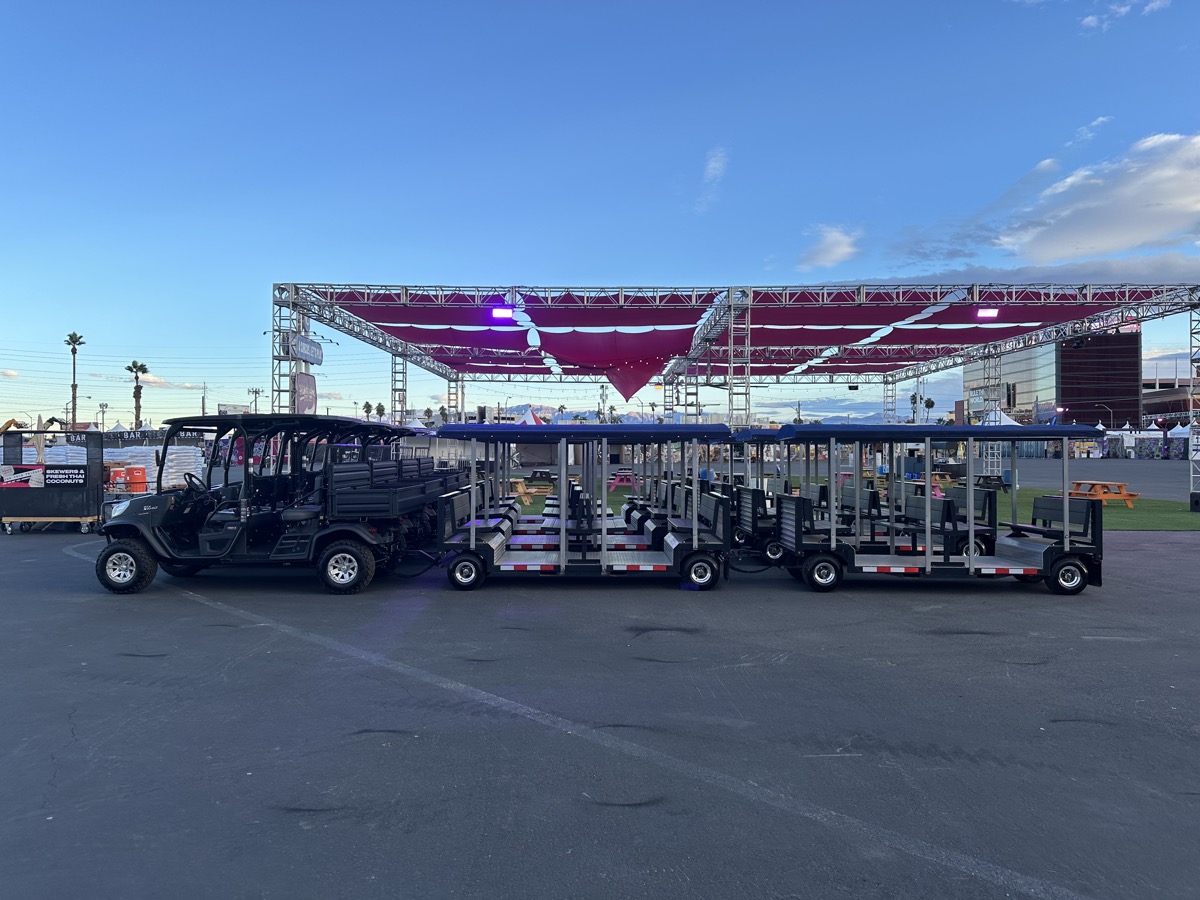
What works is what theme parks figured out decades ago: a compact, high-capacity tram on a fixed loop. One driver. Up to 27 passengers. ADA accessible as standard — not as a special configuration. Deploys in hours on asphalt, dirt, grass, or gravel. Stores compactly when the event ends. Fans always know where to board and when the next one arrives, because the route is fixed and the schedule is predictable — like a micro transit system purpose-built for your campus.
The sponsorship angle nobody's talking about
Venue operators know that if there's space, it can be sold. Sponsorship revenue from stadium naming rights, digital signage, concourse branding, and hospitality packages is a mature business. But onsite transportation has been invisible to sponsors because it's never been systematized — it's just a scattered fleet of carts with no brand presence, no predictability, and no captive audience.
Once you run a tram system on a fixed loop, that changes. Passengers have to be on the vehicle to be transported — which means a captive, relevant audience for the 5-10 minutes of every ride. Vehicle wraps, branded tram stops, in-ride digital displays, and co-branded park-and-ride programs become a natural extension of the venue's existing sponsorship menu. What was a pure cost line becomes a revenue opportunity that sponsors approach you about.
For the World Cup specifically, where global brands are spending record amounts on stadium and fan festival activations, a branded tram system connecting fan zones to gates is exactly the kind of high-visibility, high-frequency touchpoint that justifies premium sponsorship rates.
We're already on the ground
FlexTram is deployed at some of the largest, most operationally complex live events in the country — Coachella, Stagecoach, Lollapalooza, EDC, Bonnaroo, NASCAR, and dozens more. We've replaced fleets of 300+ golf carts at a single venue. We run in parking lots, on dirt, through crowds of hundreds of thousands, in extreme heat, at night, on surfaces that change from event to event.
We also provide engagement data, operational intelligence, and commerce extensions through FlexTram Smart Systems — giving venue operators the kind of real-time visibility into onsite transportation that they already have for ticketing, concessions, and crowd flow inside the building. The parking lot and campus perimeter shouldn't be the last analog zone in a smart venue.
If you're involved in venue operations, stadium management, host city logistics, overlay planning, crowd management, or fan experience for any of the 16 host stadiums — or for the fan festivals, hospitality programs, and sponsor activations surrounding them — this is the conversation to have now. Not in May. Now.
The transit plan gets fans to the campus. What gets them from the campus to their seat — comfortably, safely, accessibly, on time — is a different problem. And it's the one we solve.
— The FlexTram Team
Common questions
What is the fan-first mobility gap?
The fan-first mobility gap is the space between where transit drops fans off — a bus hub, satellite lot, or rideshare zone — and the stadium gate. Transit plans focus on getting fans to the campus, but almost no venue has a system for moving people across that final stretch. For fans with mobility challenges, families with young children, and VIPs expecting a premium experience, this gap is where the fan experience breaks down.
How does FlexTram handle World Cup-scale events?
FlexTram is already deployed at some of the largest live events in the country — Coachella, Stagecoach, Lollapalooza, EDC, Bonnaroo, NASCAR, and dozens more. Each tram carries up to 27 passengers with one driver on a fixed, predictable loop. The system deploys in hours on asphalt, dirt, grass, or gravel and scales to crowd size in real time.
Is FlexTram ADA compliant?
Yes, FlexTram vehicles are ADA accessible as standard — not as a special configuration. This matters especially at FIFA events where ADA compliance is mandatory. Most host stadiums offer wheelchair service inside the venue, but many provide limited accessible transportation between parking areas and the gate. FlexTram fills that gap.
Can FlexTram be used for sponsorship?
Yes. Once a tram runs on a fixed loop, passengers become a captive, relevant audience for the duration of every ride. Vehicle wraps, branded tram stops, in-ride digital displays, and co-branded park-and-ride programs become a natural extension of a venue's existing sponsorship menu — turning a pure cost line into a revenue opportunity.
How quickly can FlexTram deploy?
FlexTram systems deploy in hours. The vehicles operate on asphalt, dirt, grass, or gravel — no permanent stop infrastructure required. They store compactly when the event ends, making them ideal for temporary overlay environments like World Cup stadium districts where the campus configuration changes between events.
Explore solutions
Let's talk about your venue.
We're booking World Cup deployments and post-tournament operations now. Tell us about your site.