Your Uber drops you 25 minutes from the stadium.
That's not a rideshare. That's a hike.
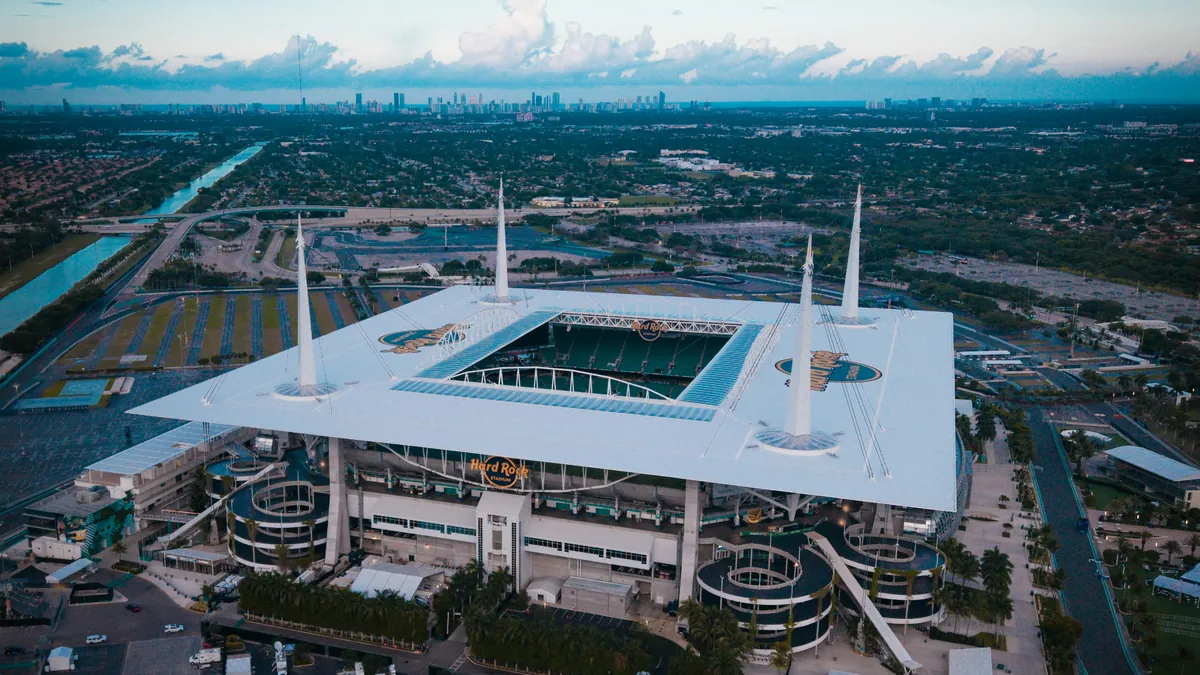
Hard Rock Stadium's own rideshare lot is a 25-minute walk from the gate — and for the World Cup, rideshare isn't permitted at the stadium at all. Seven matches, including a quarterfinal and the third-place final, in 100-degree Miami heat-index conditions. The regional transit gets fans close. The last stretch is still on foot.
Hard Rock Stadium's own guidance spells out the normal-operations reality of getting a rideshare there: "Rideshare drop-off and pickup is located in Lot 30 on NW 37th Ave, which is an off-site lot with an estimated 25 minute walk from the stadium." Lot 30 sits roughly 1.5 to 2 miles from the gates. (Hard Rock Stadium)
Twenty-five minutes. From the stadium's own designated rideshare lot. That's a 25-minute walk before the match and a 25-minute walk after — fifty minutes of walking, round trip, for a fan who specifically chose rideshare to avoid the parking hassle.
For the World Cup, the situation is even more constrained. The Miami-Dade Sheriff's Office announced that rideshare drop-offs and pickups will not be permitted at the stadium at all. Regular rideshare users are routed to a designated zone outside the security perimeter, then walk or transfer to a shuttle from there. Only riders on a paid Uber Shuttle option get delivered closer. (NBC Miami / Miami-Dade County)
Hard Rock Stadium is hosting seven World Cup matches this summer — four group-stage games, a Round of 32 match, a quarterfinal, and the third-place final. The venue has been renamed "Miami Stadium" for the tournament. And the rideshare lot is a 25-minute walk away. (FIFA)
The stadium that was built entirely around car access has restricted car access for the biggest event it has ever hosted — and the rideshare alternative starts with a 25-minute walk in South Florida heat.
Suburban stadium, urban problem
Hard Rock Stadium sits in Miami Gardens — a residential city 17 miles north of downtown Miami and the beach. It's not the Miami that tourists picture. It's not near South Beach, Brickell, or Wynwood. It's a suburban neighborhood of single-family homes, strip malls, and six-lane arterials.
There is no direct Metrorail connection. Miami-Dade County never built its rail network out to Miami Gardens. The closest rail connections — the Aventura Brightline Station, the Golden Glades Multimodal Transit Station, and the Dr. Martin Luther King Jr. Plaza Metrorail Station — all require a shuttle transfer to reach the stadium. (Miami-Dade County)
On a normal Dolphins Sunday, the model is straightforward: fans drive, park in one of the 25,000-plus on-site spaces, tailgate, and walk to the gates. The stadium was designed for cars. The road network around it was designed for cars. The entire operational model assumes cars.
For the World Cup, the car model has been restricted. The Miami-Dade Sheriff's Office announced extensive road closures on match days: NW 199th Street closes at 5:00 a.m., the Florida Turnpike Exit 2X is accessible only to vehicles with a valid parking pass, and stadium parking requires advance purchase plus a match ticket. Rideshare drop-offs aren't permitted at the stadium itself. (NBC Miami)
The Miami Game Day Express
To fill the gap, Miami-Dade County and the FIFA Host Committee created the Miami Game Day Express — a free shuttle service for verified ticket holders, operating from four transit hubs: the Dr. Martin Luther King Jr. Plaza Metrorail Station, the Golden Glades Multimodal Transit Station (the major hub for fans arriving from Fort Lauderdale and Broward County), the Aventura Brightline Station (for fans arriving by Brightline from Orlando, West Palm Beach, and beyond), and the Seminole Hard Rock Hotel & Casino, where fans park at Lot 70 and ride in. (Miami-Dade County)
The shuttles are free and dedicated to verified ticket holders. Staff begin scanning tickets and boarding fans at each hub four hours before kickoff. And credit where it's due: Miami-Dade has done more than most host cities to make regional transit work — free shuttles, extended Metrorail hours, Metromover running late for Fan Fest, Brightline connections from across South Florida.
But the system gets the fan to the stadium perimeter. From there, the pattern is familiar: shuttles deposit passengers at drop-off areas near the edge of the campus, and fans walk the rest of the way — through the security screening, past the reconfigured parking areas, to the actual gate.
That last stretch is the same last-mile gap we've documented at MetLife, AT&T Stadium, Houston's NRG Park, and Gillette in Foxborough — where one road in and a 75% parking cut turned the arrival into a test of Route 1. In Miami, it comes with a variable the others don't.
South Florida heat is not a footnote
Here's the dimension that separates Miami from every other World Cup host city: the heat.
Hard Rock Stadium is an open-air venue. The roof canopy shades most seats, but the approach — the parking lots, the pedestrian corridors, the security queues, the shuttle drop-offs — is fully exposed. Average highs in Miami Gardens run 90°F in June and 91°F in July, humidity routinely exceeds 70%, and the afternoon heat index regularly tops 100°F.
The fan dropped in the rideshare lot faces a 25-minute walk in those conditions. The fan who parks in an outer lot and walks through the security perimeter faces 15–20 minutes. The fan who takes the free shuttle and walks from the drop-off to the gate faces 10–15 minutes. All of it exposed, all of it in the sun.
For international fans from Northern Europe — England, Scotland, Norway, Germany — these are conditions they've rarely faced at a football match. European football is a fall-winter-spring sport played in temperate climates; a World Cup match in 91°F heat with 70% humidity is a fundamentally different physical experience than a league game at 55°F in October.
And for elderly fans, fans with mobility limitations, families with young children, and anyone with a heat-sensitive health condition, the walk from the transit node to the gate isn't just uncomfortable. The combination of heat, humidity, sun exposure, exertion, and dehydration across a 15–25 minute walk can produce heat-related illness in vulnerable populations. It's a health risk.
Planning a mega-event transportation system?
FlexTram deploys onsite transit systems for major events, tournaments, and mega-venue operations — from single-day deployments to month-long engagements. Equipment rentals, full-service operations with trained drivers, and turnkey transportation plans available.
The F1 precedent
Hard Rock has experience with mega-events beyond the NFL. The Formula 1 Miami Grand Prix has run on a purpose-built circuit around the stadium campus since 2022, drawing 250,000-plus fans across a race weekend.
As we documented in our analysis of F1 fan transportation, the Miami Grand Prix has faced its own onsite transit challenges — long walks from parking and shuttle drop-offs to the circuit entrances, pedestrian congestion on the campus pathways, and ADA access limitations. The World Cup matches will use the same campus infrastructure the F1 race already stress-tests every year. The lessons about onsite fan movement at this specific venue apply directly.
The same pattern. The third city.
This is the third World Cup host city we've mapped. The details differ — MetLife has a walking ban on the surrounding highways, Arlington has zero fixed-route transit, Miami has a 25-minute walk from the rideshare lot in triple-digit heat index — but the pattern is identical.
Significant investment in getting fans TO the venue: road closures, shuttle systems, train service, transit hubs, rideshare coordination, parking management — regional plans assembled by multiple agencies at costs measured in the millions.
And the last stretch — the walk from the transit node, the shuttle drop-off, the rideshare lot, or the parking space to the actual stadium gate — left to the fan's feet. At MetLife, through a reconfigured sports complex. At AT&T Stadium, across sun-baked asphalt in 97-degree heat. In Miami, a 25-minute walk in 100-degree heat-index conditions.
As Fortune wrote about the World Cup transportation situation nationally: "not a transportation solution but a metaphor of a country improvising because it never built the thing it actually needed."
A tram running continuous loops inside the Hard Rock campus — from the shuttle drop-off areas to the gates, from the outer parking lots to the entrance, and between key points inside the security perimeter — fills the gap the free shuttle and the Brightline connection don't reach. The regional transit gets fans to the Miami Gardens area. The onsite transit gets them from the drop-off point to their seats. Post-match, the same system runs in reverse: continuous sweeps from the gates to the shuttle and parking areas, keeping fans moving on a visible, scheduled route instead of streaming through a dark campus in the heat searching for their connection.
Free shuttle from Aventura. Free shuttle from Golden Glades. Free shuttle from MLK Plaza. And once you reach the stadium campus, that last stretch to the gate — through the security perimeter, past the reconfigured lots, in 100-degree heat index — is still on foot. It doesn't have to be.
— The FlexTram Team
Frequently asked questions
How many World Cup matches is Hard Rock Stadium hosting in 2026?
Hard Rock Stadium — renamed "Miami Stadium" for the tournament — is hosting seven 2026 FIFA World Cup matches: four group-stage matches, one Round of 32 match, one quarterfinal, and the third-place (bronze) final. The venue is in Miami Gardens, about 17 miles north of downtown Miami, with no direct Metrorail connection.
Where is rideshare drop-off at Hard Rock Stadium, and how far is the walk?
Under normal event operations, Hard Rock Stadium directs rideshare drop-off and pickup to Lot 30 on NW 37th Avenue — an off-site lot roughly 1.5 to 2 miles away, which the stadium's own guidance describes as an estimated 25-minute walk from the stadium. For the World Cup, the restriction is tighter: the Miami-Dade Sheriff's Office has stated that rideshare drop-offs and pickups will not be permitted at the stadium at all. Riders are routed to a designated zone outside the security perimeter and walk or transfer to a shuttle from there.
What is the Miami Game Day Express?
The Miami Game Day Express is a free shuttle service for verified World Cup ticket holders, created by Miami-Dade County and the FIFA Host Committee. It operates from four hubs: the Dr. Martin Luther King Jr. Plaza Metrorail Station, the Golden Glades Multimodal Transit Station (Tri-Rail), the Aventura Brightline Station, and the Seminole Hard Rock Hotel & Casino (Lot 70). It's a well-designed system for getting fans from the transit hubs to the stadium — but it delivers them to the perimeter, where the walk to the actual gate begins.
Why is heat a specific concern for the Miami World Cup matches?
Hard Rock Stadium is an open-air venue in South Florida. The roof canopy shades most seats, but the approach — parking lots, pedestrian corridors, security queues, shuttle drop-offs — is fully exposed. Average highs in Miami Gardens run 90–91°F in June and July, humidity routinely exceeds 70%, and the afternoon heat index regularly tops 100°F. For international fans from temperate climates and for elderly fans, families with young children, and people with heat-sensitive health conditions, a 15–25 minute walk in those conditions is a genuine health risk, not just a discomfort.
How could an onsite tram system help at Hard Rock Stadium?
The regional transit — Brightline, the free Game Day Express shuttles, Metrorail connections — gets fans to the Miami Gardens area. A tram running continuous loops inside the Hard Rock campus closes the gap those services don't reach: from the shuttle drop-off areas to the gates, from the outer parking lots to the entrance, and between key points inside the security perimeter. It turns the exposed 15–25 minute walk in 100-degree heat-index conditions into a short ride, serves ADA passengers by default, and runs continuous post-match sweeps back to the shuttle and parking areas. FlexTram deploys for the tournament window without permanent infrastructure.
Related reading
The regional transit gets fans close. The last stretch to the gate is the part nobody designs.
FlexTram deploys onsite transit systems for major events, tournaments, and mega-venue operations — from single-day deployments to month-long engagements. Equipment rentals, full-service operations with trained drivers, and turnkey transportation plans available.