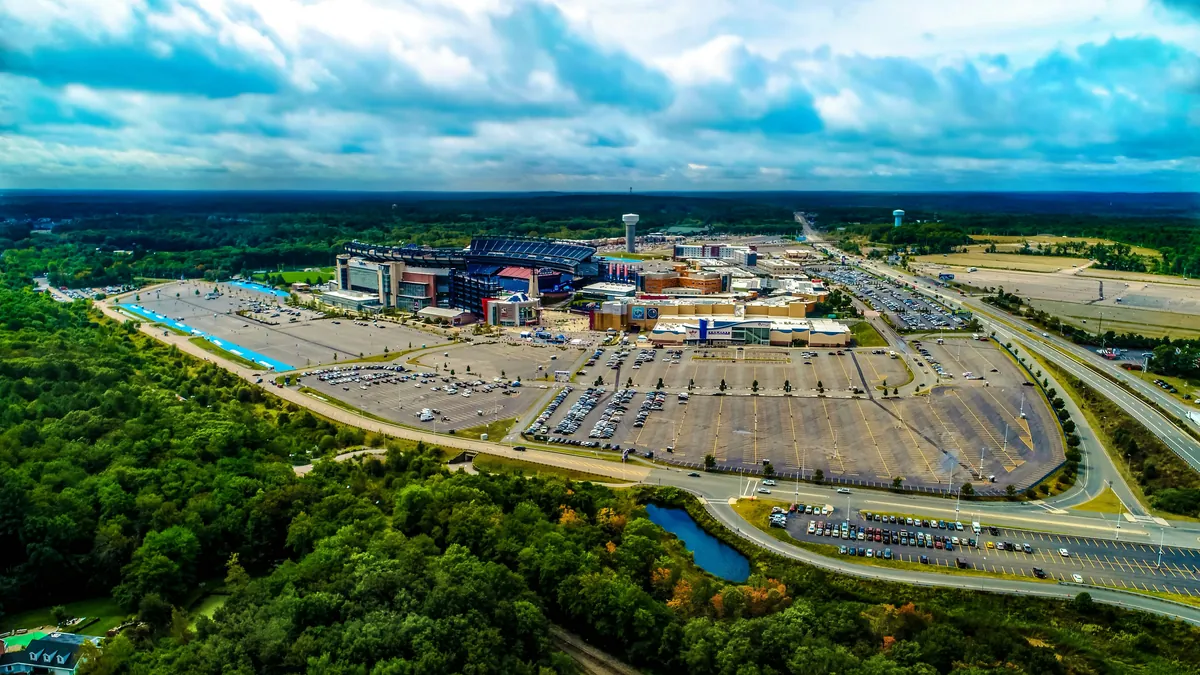
Gillette Stadium is 28 miles from Boston. There's one road in.
And they cut the parking by 75%.
Foxborough isn't Boston — no subway, no regular bus, one gridlock-prone road in. FIFA gave it seven World Cup matches, renamed it "Boston Stadium," and cut the stadium's 20,000 parking spaces to roughly 5,000. The $80 train and $95 bus get fans to the complex. The last 10 minutes to the gate is still a walk.
Foxborough is not Boston. It's a small town about 28 miles southwest of the city. There is no subway. There is no regular bus service. The stadium sits off Route 1 — a road that becomes gridlocked when 65,000 fans converge for a Patriots game. "No car, no problem" is a harder promise to keep when the venue was designed entirely around cars. (Boston 25 News)
This is the venue FIFA chose to host seven World Cup matches — five group-stage fixtures, a Round of 32, and a quarterfinal — from June 13 through July 9. England, France, Morocco, Scotland, Norway, Haiti, and Ghana played here. The stadium was renamed "Boston Stadium" for the tournament, even though it's not in Boston. (CBS Boston)
And for the World Cup, the stadium's roughly 20,000 on-site parking spaces were cut to about 5,000 — a 75% reduction to the official lot. FIFA security zones, broadcast compounds, and event operations consumed the rest. The FIFA-managed spaces that remained ran around $175 per vehicle (premium and hospitality lots cost more), with roughly 5,000 additional spaces in independent lots along Route 1 — all reservation-only, all requiring a same-day match ticket. (NBC Boston)
Twenty thousand spaces down to five thousand. At a venue with one road in and one road out. In a town with no public transit.
Massachusetts Highway Administrator Jonathan Gulliver was direct: "The guarantee is that there's going to be a lot of extra traffic." Meanwhile, Kraft Sports + Entertainment COO Jim Nolan offered a different message — that fans who typically drive to Foxborough for Patriots games "should feel free to do the same for the World Cup." Two officials, two contradictory messages, one road. (CBS Boston)
Every transit mode Massachusetts assembled — train, bus, rideshare, parking — delivers the fan to the edge of the Gillette complex. Not to the gate.
The transit plan gets you to the edge
MBTA Boston Stadium Train: $80 round trip. Fourteen express trains per match, departing every 15 minutes from South Station in downtown Boston — no intermediate stops, about a 60-minute ride, roughly 20,000 passengers per match (about a third of the stadium). Advance purchase only, and only with a same-day World Cup ticket. The train delivers fans to the improved Foxboro Station, described by the host committee as "less than a 10-minute walk to the stadium." (MBTA)
Boston Stadium Express Bus: $95 round trip. The host committee's official bus service, with pickups from 20-plus locations across Greater Boston — hotels, Logan Airport, the Rhode Island Convention Center. Buses departed 3–4.5 hours before kickoff and delivered fans to a drop-off within the Gillette complex — followed by the walk to the gate. (Boston 25 News)
Rideshare: designated drop-off in Lot 16. Adjacent to Patriot Place, the mixed-use development next to the stadium. Fans were dropped at Lot 16 and walked to the entrance from there.
Every one of these modes got the fan to the Foxborough complex — the train station, the bus drop-off, the rideshare lot, the parking space. From there, the last 10 minutes was the walk.
70% from outside Boston. Most had never been here.
The host committee estimated that roughly 70% of attendees traveled from outside the Greater Boston region. Many were international fans — supporters of England, France, Morocco, Scotland, Norway, Ghana, and Haiti — who had never been to Foxborough, never navigated Patriot Place, never experienced Route 1.
These fans came from cities where the stadium experience is fundamentally different. England fans from London, where Wembley has a dedicated Tube station a five-minute walk from the gate. France fans from Paris, where the Stade de France has two RER stations and a Métro stop nearby. Scotland's Tartan Army — so accustomed to walking from the train to the pub to the ground that they chartered their own school buses rather than pay full transit fares. (Fortune)
These fans expect to step off the train and be at the stadium. At Foxborough, they stepped off at Foxboro Station and began a 10-minute walk through a complex they'd never seen — past Patriot Place retail, through parking areas reconfigured for FIFA operations, past security perimeters, toward a gate they needed signage to find. European football grounds are embedded in urban neighborhoods with pubs, plazas, and pedestrian corridors that create a natural gathering space between the station and the gate. The walk from Foxboro Station to the gate doesn't pass through a neighborhood. It passes through a parking lot.
Planning a mega-event transportation system?
FlexTram deploys onsite transit systems for major events, tournaments, and mega-venue operations — from single-day deployments to month-long engagements. Equipment rentals, full-service operations with trained drivers, and turnkey transportation plans available.
Weekday matches on one road
Here's the operational detail that set Foxborough apart: most of its matches kicked off on weekday afternoons and early evenings — including the June 29 Round of 32 and the July 9 quarterfinal. That put World Cup traffic on Route 1 in direct overlap with evening commuter traffic on I-95 and I-495, the regional highways that feed Route 1 from both directions. (CBS Boston)
On a normal Sunday Patriots game, Route 1 is a controlled chaos the region has managed for decades — dedicated traffic patterns, rehearsed police details, a fan base that knows the roads and the timing. A weekday-afternoon World Cup match with 65,000 mostly-unfamiliar fans arriving by train, bus, rideshare, and car simultaneously — while local commuters try to get home from work — is a different problem entirely. Route 1 is essentially a two-lane approach serving a 65,000-seat venue. The pre-match window tested its capacity; the post-match window, when every mode reversed course at once, tested it harder.
Post-match: the queue in Lot 4
After the final whistle, fans heading to the MBTA queued in Lot 4 near the Foxboro Station entrance. Trains departed every 15 minutes, beginning about 30 minutes after the match ended — so a minimum half-hour wait before the first train, plus the walk from the stadium to Lot 4, plus the boarding queue. The MBTA assigned boarding groups A through E; fans in later groups could wait well beyond an hour. (Boston FWC26)
Take the opening match — Haiti vs. Scotland, a 9:00 p.m. kickoff on June 13, ending around 11:30 p.m. Extended MBTA service ran late, but fans returning to Boston wouldn't reach South Station until 1:00–2:00 a.m. at the earliest, and those transferring to suburban Commuter Rail lines faced "very limited" connecting service. The post-match experience was the inverse of the arrival: walk to the transit node, wait in a queue, board, and ride back — a process that could take two-plus hours after the final whistle. (MBTA)
The last 10 minutes nobody planned
The MBTA says the walk from Foxboro Station to the stadium is "less than 10 minutes." The host committee describes the bus drop-off as bringing fans "within a 10-minute walk of the matchday action." The rideshare lot is Lot 16 at Patriot Place. Ten minutes of walking, in each direction, for 65,000 fans, through a complex reconfigured with FIFA security zones, broadcast compounds, and operational infrastructure that wasn't there for the last Patriots game.
It's the same gap we documented at MetLife Stadium, AT&T Stadium, Hard Rock, and Houston's NRG Park: extraordinary investment getting fans TO the venue, and a walk from the transit node to the gate that nobody designed. The difference at Foxborough is that the walk passed through a complex most fans — 70% from outside the region, many from outside the country — had never navigated, that looks nothing like the European grounds they know.
A tram running a continuous loop between Foxboro Station, the bus drop-off, the Lot 16 rideshare zone, and the stadium gates — on a fixed route, on a posted schedule, with ADA access as standard — turns that 10-minute walk from a navigation exercise into a ride. The international fan who steps off the train doesn't consult a map; they board the tram. The family with a stroller doesn't cross a parking lot; they board the tram. The elderly fan who rode an hour from South Station doesn't then walk 10 minutes through an unfamiliar complex; they board the tram.
Post-match, the same system runs in reverse — continuous sweeps from the gates to the transit nodes, keeping fans moving on a visible, lit route instead of streaming through a darkening complex trying to find Lot 4, the bus stop, or the rideshare zone. It deploys for the tournament window and leaves. The same model that works at festivals, stadiums, and industrial campuses works at Foxborough.
The biggest sporting event in New England history
The host committee called this "the biggest sporting event in New England history." Seven matches. England and France. A quarterfinal. Sixty-five thousand fans per match, most from outside the region.
The MBTA expanded service. The host committee launched a bus network. The state upgraded traffic signals and urged fans to leave the car home. MassDOT stood up real-time traffic monitoring. The collective investment in getting fans to Foxborough was substantial. The investment in moving them through the last 10 minutes — from the train station, the bus drop-off, and the rideshare lot to the stadium gate — was a walk.
28 miles from Boston. One road in. 75% of the parking gone. An $80 train, a $95 bus, $175-and-up parking. And the last 10 minutes? That's on foot.
— The FlexTram Team
Frequently asked questions
How many World Cup matches did Gillette Stadium host in 2026?
Gillette Stadium — renamed "Boston Stadium" for the tournament — hosted seven 2026 FIFA World Cup matches: five group-stage fixtures, a Round of 32, and a quarterfinal, running June 13 through July 9. Teams that played there included England, France, Morocco, Scotland, Norway, Haiti, and Ghana. The stadium is in Foxborough, about 28 miles southwest of downtown Boston, with no subway and no regular bus service.
How did fans get to Gillette Stadium for the World Cup?
Every mode delivered fans to the edge of the Gillette complex. The MBTA ran "Boston Stadium Trains" — 14 express trains per match from South Station to Foxboro Station, about 60 minutes, $80 round trip, advance purchase only. The host committee ran a "Boston Stadium Express" bus ($95 round trip) from 20-plus Greater Boston locations. Rideshare was routed to a designated drop-off in Lot 16 at Patriot Place. Driving meant roughly 5,000 FIFA-managed parking spots (around $175, premium lots more) plus about 5,000 independent lots along Route 1, all reservation-only with a same-day match ticket.
Why was parking so limited at Gillette Stadium for the World Cup?
The stadium normally has roughly 20,000 on-site parking spaces. For the World Cup, FIFA security zones, broadcast compounds, and event operations consumed most of them, leaving about 5,000 FIFA-managed spaces — roughly a 75% cut to the official stadium lot. Approximately 5,000 more spaces were available in independent lots along Route 1. All required an advance reservation and a same-day match ticket, and non-ticket holders were turned away. Massachusetts officials urged fans to take transit rather than drive.
How far is the walk from Foxboro Station to Gillette Stadium?
The MBTA and the host committee describe the walk from the newly improved Foxboro Station to the stadium as "less than a 10-minute walk." The bus drop-off and the Lot 16 rideshare zone at Patriot Place are similar distances. For the World Cup, that walk ran through a complex reconfigured with FIFA security zones and operations infrastructure — past Patriot Place retail and repurposed parking areas — that most fans, roughly 70% of them from outside the Boston region, had never navigated before.
How could an onsite tram system help at Gillette Stadium?
A tram running a continuous loop between Foxboro Station, the bus drop-off, the Lot 16 rideshare zone, and the stadium gates — on a fixed route, on a posted schedule, with ADA access as standard — turns the 10-minute walk from a navigation exercise into a ride. The international fan who steps off the train doesn't need a map; the family with a stroller doesn't cross a parking lot; the elderly fan who rode an hour from South Station doesn't then walk 10 minutes through an unfamiliar complex. Post-match, the same system runs continuous sweeps from the gates back to the transit nodes. FlexTram deploys for an event window without permanent infrastructure.
Related reading
Every transit mode gets fans to the complex. The last 10 minutes is the part nobody designs.
FlexTram deploys onsite transit systems for major events, tournaments, and mega-venue operations — from single-day deployments to month-long engagements. Equipment rentals, full-service operations with trained drivers, and turnkey transportation plans available.