Houston got the transit right.
The campus is still 350 acres.
Houston did the regional transit better than any other 2026 World Cup host city — a $1.25 train straight to the stadium. And its seven matches still played out on a 350-acre campus where the walk from the station to the gate is a 10-minute hike in the heat. The venue that got everything else right proved the inside-mile point anyway.
Here's something you couldn't say about MetLife, AT&T Stadium, or Hard Rock: Houston's regional transit actually worked.
The METRORail Red Line ran directly from downtown Houston to the NRG Stadium Park/Astrodome station — about 20 minutes, $1.25, no transfer required. METRO ran increased frequency and extended late-night service through the tournament, and invested roughly $10 million in transit upgrades, including a 14-mile "Green Corridor" connecting the EaDo Fan Festival, downtown Houston, and the stadium by rail and shaded pedestrian trails. (METRO Houston / FOX 26 Houston)
Houston did its homework. The regional transit plan was, by American World Cup standards, genuinely impressive.
And then the fan stepped off the train at the NRG Park station and looked around. The campus is 350 acres.
Houston solved the 6-mile problem — downtown to the stadium — with a $1.25 train. The half-mile problem inside the campus was still a walk.
The largest parking-lot problem in the World Cup
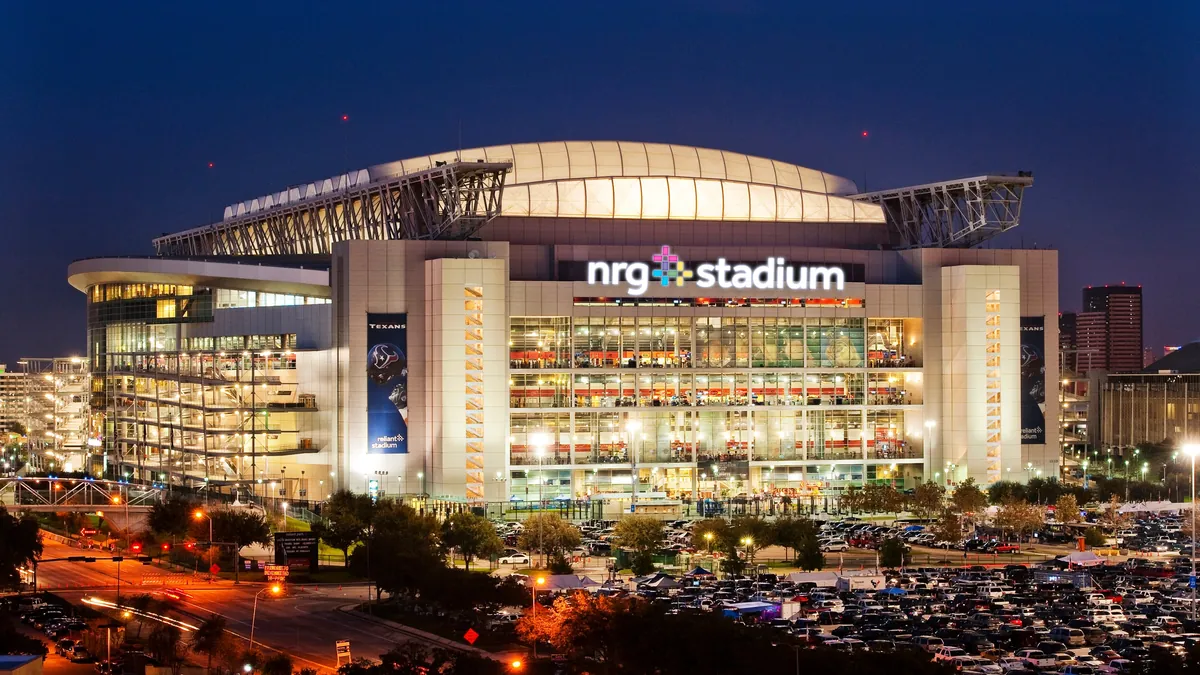
NRG Park — renamed "Houston Stadium" by FIFA for the tournament — is not a stadium. It's a complex. Four major venues spread across 350 acres: NRG Stadium (about 72,000 seats in soccer configuration, with a retractable roof), NRG Center (1.3 million square feet of convention and exhibit space — nearly 30 acres under one roof), NRG Arena (about 8,000 seats), and the historic NRG Astrodome, still standing adjacent to the stadium. (NRG Park)
The complex includes roughly 26,000 parking spaces — one of the largest parking operations in professional sports. The lots surround the stadium in a massive ring of color-coded zones radiating outward in every direction. The walk from the far end of the outer lots to the stadium gates can exceed half a mile. (Visit Houston)
The METRORail station sits at the northeast edge of the complex. From the platform, the walk to the stadium gates is described as "a short walk" by METRO and "a brief 10-minute walk" by transport guides. Ten minutes from the transit station. Longer from the outer parking lots. Across a 350-acre campus that includes four major buildings, loading docks, multiple road crossings, and the footprint of a convention center that is itself 30 acres.
The Rodeo already proved the point
Here's the detail that validates the entire argument: the Houston Livestock Show and Rodeo — the largest event NRG Park hosts annually, drawing millions of visitors over about 20 days — already runs trams inside the parking lots.
The RodeoHouston parking guide states it explicitly. The Yellow Lot: parking-lot tram available. The 610 Lot: parking-lot tram available. For ADA overflow, attendees are directed to the Yellow or 610 Lots, "which offer ADA-accessible trams equipped with wheelchair ramps." (ABC13 Houston / Houston Livestock Show and Rodeo)
The Rodeo runs trams because the campus is too large for some visitors to walk from the parking lots to the venues. This isn't a theoretical argument. The largest annual tenant at NRG Park already deployed the solution — trams in the lots, ADA-accessible, with wheelchair ramps.
The World Cup brought seven matches to the same 350-acre campus, with fans arriving from 48 countries, many of whom had never been to NRG Park. The Rodeo audience is predominantly Texan — they know the campus, the lots, the walk. The World Cup audience was predominantly international — they knew none of it. If the Rodeo needs trams on the campus, the World Cup did too.
Planning transit for a mega-venue campus?
FlexTram deploys onsite transit systems for major events, tournaments, and mega-venue operations — from single-day deployments to month-long engagements. Equipment rentals, full-service operations with trained drivers, and turnkey transportation plans available.
Seven matches, one campus, the roof closed
NRG Stadium hosted seven FIFA World Cup matches: five group-stage fixtures, a Round of 32, and a Round of 16, running June 14 through July 4 — including a knockout match on Independence Day. Germany, Portugal, the Netherlands, Sweden, Saudi Arabia, Uzbekistan, and other nations played in Houston, where the city's large Latin American community helped create one of the most electric atmospheres of any World Cup venue. (Houston Public Media)
One advantage Houston had over most host cities: the retractable roof. NRG Stadium is one of the few 2026 venues with a retractable roof and full air conditioning, and it kept the roof closed for its World Cup matches, creating a climate-controlled indoor environment. Inside the stadium, fans were comfortable. Houston's notorious summer heat — average highs of 93–95°F with humidity that pushes the heat index above 100°F — stopped at the turnstile.
Outside the stadium was a different story. The walk from the METRORail station to the gate. The walk from the parking lot to the entrance. The walk from the rideshare drop-off to the security screening. The post-match walk back to the station or the lot — where METRORail waits ran 20–30 minutes. All of it happened in Houston's summer heat, on asphalt, in direct sun, across a 350-acre campus. The stadium solved the heat problem for the match. Nobody solved it for the walk to the match.
The pattern — with a twist
Houston is the fourth World Cup host city we've analyzed in this series. At MetLife, the problem was a reconfigured complex with no published pedestrian map. At AT&T Stadium, it was the largest city without fixed-route transit hosting the most matches. At Hard Rock, it was a 25-minute walk from the rideshare lot in triple-digit heat index. At Gillette, it was one road in, no local transit, and 75% of the parking gone.
Houston's version is different — and in some ways more instructive — because Houston actually did the regional transit right. The METRORail worked. The pricing was fair ($1.25, versus MetLife's $98 or Miami's paid shuttle). The Green Corridor concept was thoughtful. The host committee had a plan.
And the campus is still 350 acres. The walk from the station to the gate was still 10 minutes. The walk from the outer parking lots was still longer. The walk still happened in 95-degree heat-index conditions. And the largest annual event at the campus already runs trams in the lots because the distances require it.
The lesson from Houston isn't that regional transit failed. It's that regional transit succeeding doesn't eliminate the inside-mile problem. Even when the train runs to the stadium, the fan still has to get from the station to the gate. Even when parking is available, the fan in the outer lot still walks half a mile. Even when the system works at the regional level, the campus-level problem remains.
As we wrote in "The Properties Got Bigger. The Plan Didn't," there is a size threshold beyond which a property cannot function without onsite transit. At 350 acres, NRG Park crossed that threshold years ago. The Rodeo knows it.
What a system looks like at NRG Park
A tram system running inside the NRG Park campus closes the gap between the regional transit that works and the stadium gate — the same gap the next mega-event on that campus will face:
METRORail station to gates. A continuous loop from the Stadium Park/Astrodome station to the stadium entrances — turning the 10-minute walk into a 2-minute ride. The fan who took the $1.25 train from downtown doesn't then walk 10 minutes across a parking lot in the heat.
Outer parking lots to gates. A route serving the Yellow, 610, and outer lot zones — the same lots where the Rodeo already runs trams. The same need, the same campus, the same distances.
Post-match egress. Continuous sweeps from the gates to the METRORail station, the bus stops, and the parking lots. The fan who needs the next train rides to the station and boards, instead of walking 10 minutes through a darkening campus and then waiting on the platform.
ADA service as default. The Rodeo already runs "ADA-accessible trams equipped with wheelchair ramps" in the lots. The standard should be the same for any event — not a special service, but the default transit on every route, every trip.
The system deploys for an event window and leaves when it ends — the same model the Rodeo already uses seasonally, and the same one that works at festivals, stadiums, and industrial campuses.
Houston did the hard part
Houston invested in regional transit. It built the rail line. It created the Green Corridor. It priced the train at $1.25 — a fraction of what MetLife or the Miami shuttle cost. Houston did the hard part.
The last part — the half mile between the station and the gate, across a 350-acre campus, in 95-degree heat — is the easy part. It's also the part that's still waiting, at NRG and at every 350-acre campus like it.
$1.25 gets you to the campus. The walk across it is still free — and it still costs you 10 minutes in the Houston heat.
— The FlexTram Team
Frequently asked questions
How did fans get to NRG Stadium for the 2026 World Cup?
Houston ran the strongest regional transit of any 2026 World Cup host city. The METRORail Red Line connected downtown Houston directly to the NRG Stadium Park/Astrodome station — no transfer, about 20 minutes, at the standard $1.25 fare. METRO ran increased frequency and extended late-night service during the tournament and invested roughly $10 million in a 14-mile "Green Corridor" linking the EaDo Fan Festival, downtown, and the stadium by rail and shaded pedestrian trails. Off-site parking in the Texas Medical Center corridor handled overflow with longer walks or shuttle rides.
How big is NRG Park?
NRG Park is a 350-acre complex, not a single stadium. It contains four major venues: NRG Stadium (about 72,000 seats in soccer configuration, with a retractable roof), NRG Center (1.3 million square feet of convention space — nearly 30 acres under one roof), NRG Arena (about 8,000 seats), and the historic NRG Astrodome. The complex has roughly 26,000 parking spaces in color-coded zones radiating outward, and the walk from the far outer lots to the stadium gates can exceed half a mile.
Does the Houston Livestock Show and Rodeo run trams at NRG Park?
Yes. The Houston Livestock Show and Rodeo — the largest annual event at NRG Park, drawing millions of visitors over about 20 days — runs parking-lot trams. Its published guide lists tram service in the Yellow Lot and the 610 Lot, and for accessibility it directs attendees to the Yellow or 610 Lots, which offer ADA-accessible trams equipped with wheelchair ramps. The Rodeo runs trams because the 350-acre campus is too large for many visitors to walk from the lots to the venues.
Did NRG Stadium keep its roof closed for World Cup matches?
Yes. NRG Stadium is one of the few 2026 World Cup venues with a retractable roof and full air conditioning, and it kept the roof closed for its World Cup matches to create a climate-controlled indoor environment. Inside, fans were comfortable regardless of Houston's summer heat. Outside, the approach — the walk from the station, the parking lots, and the rideshare zones across a 350-acre campus — was fully exposed to average highs of 93–95°F and a heat index above 100°F.
How could an onsite tram system help at a 350-acre campus like NRG Park?
Regional transit succeeding doesn't eliminate the inside-mile problem. Even with a $1.25 train to the stadium, the fan still has to cross the campus from the station to the gate. A tram running continuous loops inside NRG Park closes that gap: a route from the METRORail station to the gates turns a 10-minute walk into a short ride; routes serving the outer lots mirror what the Rodeo already runs; post-match sweeps carry fans back to the station and lots; and ADA service is the default on every route. FlexTram deploys for a tournament or event window without permanent infrastructure — the same model the Rodeo already uses seasonally.
Related reading
Regional transit gets fans to the campus. The inside mile is the part that's still waiting.
FlexTram deploys onsite transit systems for major events, tournaments, and mega-venue operations — from single-day deployments to month-long engagements. Equipment rentals, full-service operations with trained drivers, and turnkey transportation plans available.