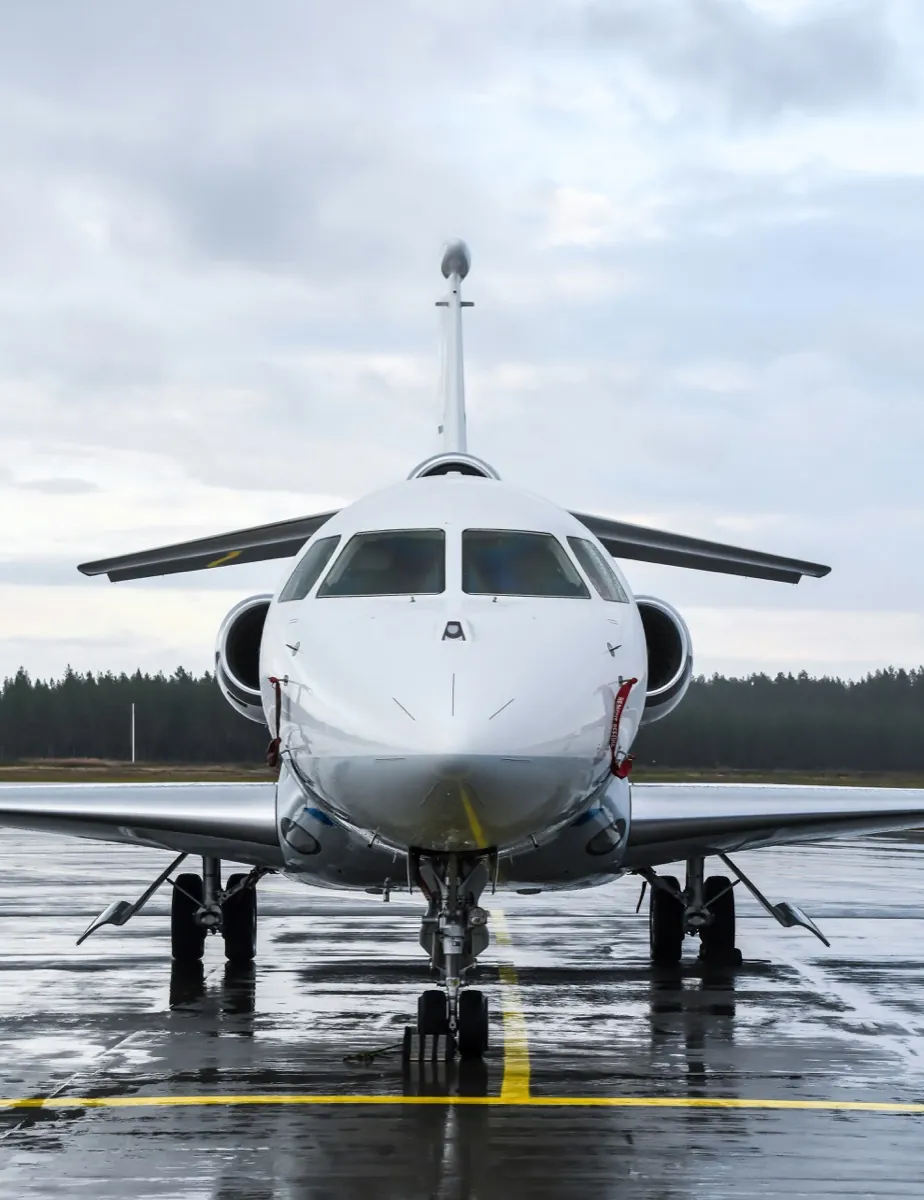
Your FBO sells a seamless experience.
It breaks the moment your passenger steps outside.
The entire value proposition of a fixed-base operator is built on one promise: skip the commercial terminal experience. No TSA lines. No baggage carousels. No concourse walks. You drive to a private terminal, walk through a lounge, and step directly onto the ramp to your aircraft.
That promise is what passengers pay for. It's what flight departments evaluate when they choose an FBO. It's what Signature, Atlantic Aviation, and every independent operator compete on — the seamlessness of the ground experience between car and cabin.
And for a single aircraft parked right outside the front door of a quiet FBO on a Tuesday morning, the promise holds.
But on a busy ramp? During a major event? When aircraft are parked on overflow pads 500 yards from the terminal? The seamless experience breaks — and it breaks at the exact moment the passenger steps outside.
What actually happens on the ramp
At most FBOs, the ground transportation plan between the terminal building and the aircraft is some combination of courtesy vans, golf carts, and the passenger's own feet. When the aircraft is parked close to the building, this works. The CSR walks the passenger out. The line crew handles the bags. The distance is 50 yards. Nobody thinks twice.
But "close to the building" is a luxury of low traffic. At busy FBOs — the kind that service high-volume corporate flight departments, charter operators, and transient traffic at major metro airports — aircraft frequently park on remote ramp pads, overflow areas, or secondary aprons that are a quarter mile or more from the terminal.
In those scenarios, the passenger experience looks like this: the CSR radios for a van. A line crew member drives the courtesy vehicle around. The passenger waits in the lobby. The van arrives. The passenger rides across an active ramp — past fuel trucks, GPUs, tow vehicles, and other aircraft being marshalled — and is delivered to their aircraft.
Or the passenger waits for a golf cart. Or the passenger walks, escorted by a line crew member, across the ramp in the heat, the rain, or the wind, pulling a roller bag over asphalt joints and painted safety lines.
None of this is what the passenger was promised. None of this is what the flight department expected when they selected this FBO. And none of it is visible in the glossy photos on the FBO's website — which show a Gulfstream parked 20 feet from the front door.
The event surge: when the model collapses
The gap between promise and reality becomes a chasm during major events.
When the Super Bowl, the Masters, the Kentucky Derby, Formula 1, or any major destination event hits a metro area, the local FBOs experience a traffic surge that stress-tests every part of their operation.
The numbers are staggering. During Super Bowl LX in the Bay Area in February 2026, WINGX data showed over 1,000 business jet arrivals across Bay Area airports in the four days leading up to and including game day — twice the normal February traffic. On the Monday after the game, nearly 600 business jet departures flooded the region, a 3x surge over typical daily averages. FlightRadar24 tracked 136 private jet departures from five airports in just the first seven hours after kickoff — an 1,136% increase over the previous Sunday. Hayward Executive Airport had to get creative with overflow parking to handle the crush. (GlobalAir / WINGX)
At the Kentucky Derby, Atlantic Aviation — the lone FBO at Louisville Muhammad Ali International Airport — recorded 812 landings over four days bracketing the 2022 race, the biggest Derby they had ever seen. Parking was pushed to maximum capacity, with additional aircraft forced into drop-and-go patterns because there was physically no room on the ramp. The following year, more than 250 aircraft were on the ground simultaneously during the 149th running. (Business Jet Traveler)
During Super Bowl LIV in Miami, Signature Flight Support handled 290 arrivals at Miami International alone — including three 747s, four 757s, and an A319. At Miami Opa-Locka Executive, aircraft lined a taxiway designated for overflow parking. Signature brought in 75 additional staff from other locations to manage the surge. Atlantic Aviation handled more than 400 aircraft at Opa-Locka and Boca Raton combined. (Business Jet Traveler)
During these events, the distance between the FBO terminal and the aircraft isn't 50 yards. It's often a quarter mile or more — across an active ramp jammed with aircraft, fuel trucks, catering vehicles, and ground equipment. The courtesy van that works on a Tuesday is overwhelmed. The golf carts are all deployed. The line crew is stretched across dozens of simultaneous arrivals and departures.
As one FBO software provider noted after the Kentucky Derby: the challenge during major events is simultaneously handling aircraft scheduling, fueling, billing, ground transportation, and passenger services at volumes five to ten times normal operations. (X-1FBO)
The passenger who flew private specifically to avoid the chaos of commercial aviation is now standing on a crowded ramp, waiting for a ride to their aircraft, surrounded by the exact kind of operational friction they paid a premium to skip.
Sizing ground transportation for event surge volume?
We work with FBOs, flight departments, and airport operations to plan crew and passenger ramp transport around the quiet Tuesday and the Super Bowl Monday. Tell us your based-vs-transient mix and we'll model the fleet.
The ramp is not a sidewalk
There's a safety dimension here that deserves its own conversation.
An FBO ramp is an active operational environment. Aircraft are being towed. Fuel trucks are moving between aircraft. GPUs are being positioned. Baggage carts are in transit. Line crew are marshalling arriving aircraft with hand signals. Jet blast zones exist around every running engine.
Walking a passenger across this environment — even with an escort — introduces a pedestrian into an industrial zone. During high-traffic periods, when the ramp is congested with aircraft, vehicles, and personnel, pedestrian exposure increases significantly. The more passengers walking the ramp, the more conflict points between foot traffic and vehicle operations.
FBOs manage this through training, escort protocols, and high-visibility procedures. But the underlying reality is that every unscheduled pedestrian crossing of an active ramp is a risk event. A fixed-route tram running a designated corridor across the ramp — on a path that's coordinated with line operations, visible to all ramp personnel, and carrying passengers in a vehicle rather than on foot — fundamentally changes the safety profile.
It's the same principle that applies at construction sites, warehouse shift changes, and stadium parking lots: consolidate pedestrian traffic onto a predictable, controlled route instead of dispersing it across an active operational area.
The hospitality standard vs. the transportation standard
Here's what makes the FBO context different from every other FlexTram vertical: the baseline expectation is luxury.
FBO passengers aren't festival fans who expect to walk a mile through dust. They're not stadium patrons who've normalized the parking lot shuttle line. They're high-net-worth individuals, corporate executives, and charter clients who chose private aviation specifically because they value their time, their comfort, and their experience.
The best FBOs understand this. They invest in terminal design — marble lobbies, pilot lounges, conference rooms, espresso bars. They invest in concierge services — catering, hotel reservations, restaurant bookings. They invest in ramp presentation — clean aprons, branded marshalling, professional line crews in pressed uniforms.
And then they move the passenger from the terminal to the aircraft in a 15-year-old golf cart.
The disconnect between the hospitality standard inside the terminal and the transportation standard outside the terminal is the FBO version of what we call the "front door problem." Every touchpoint has been designed except the one that connects the building to the aircraft. The lounge is a five-star experience. The ramp ride is an afterthought.
A branded, high-capacity tram running a fixed loop from the terminal to remote ramp positions — on a posted schedule, with covered seating, carrying up to 27 passengers — delivers a ground experience that matches the terminal experience. It says to the passenger: we designed this part too. The seamless experience doesn't break when you step outside. It continues all the way to the aircraft stairs.
The fleet math for multi-location operators
The largest FBO networks — Signature Flight Support (200+ locations), Atlantic Aviation (100+ locations), and the growing roster of mid-tier chains — face this problem at scale.
During normal operations, each location manages its own fleet of courtesy vehicles, golf carts, and crew cars. The fleet is sized for average traffic, not peak traffic. When a major event hits, the local fleet is inadequate, and the operator either rents supplemental vehicles or absorbs the service degradation.
A standardized tram platform across multiple locations changes this equation. During normal operations, a single tram running a terminal-to-ramp loop handles the daily flow with one driver. During event surges, additional vehicles are brought in from nearby locations or from a regional depot — the same vehicle platform, the same driver training, the same passenger experience.
The operational consistency matters for branded networks. A Signature or Atlantic Aviation passenger should have the same ground experience in Louisville during the Derby that they have in Teterboro on a quiet Wednesday. Standardized equipment is how branded hospitality networks — from Marriott to Hertz — deliver that consistency. The same principle applies to FBO ground transportation.
Planeside, every time
The promise of private aviation is simple: get the passenger from the car to the cabin with as few friction points as possible. FBOs have optimized every step of that journey except the physical transit between the terminal and the aircraft.
On a quiet day, the gap is small. On a busy day, it's visible. During a major event, it's the single biggest breakdown in the passenger experience.
The aircraft is a $40 million machine. The terminal is a $20 million facility. The ground experience between the two shouldn't depend on whether someone can find a golf cart.
Frequently asked questions
Why is FBO ground transportation a problem on busy ramps?
On a quiet day, aircraft park close to the FBO terminal building and a 50-yard walk or a short golf-cart ride is seamless. On a busy ramp, aircraft frequently park on overflow pads, remote ramp positions, or secondary aprons a quarter mile or more from the terminal. The existing ground transportation model — courtesy vans, golf carts, and line-crew escorts on foot — isn't sized for that distance or that volume. The private-aviation experience the passenger paid a premium for breaks at the exact moment they step outside the terminal.
How do major events like the Super Bowl or Kentucky Derby strain FBO operations?
Major destination events create 3x–10x traffic surges at local FBOs. During Super Bowl LX (Feb 2026), WINGX tracked over 1,000 business jet arrivals across Bay Area airports in four days — twice normal February traffic. FlightRadar24 recorded a 1,136% increase in private jet departures in the first seven hours after kickoff. During the Kentucky Derby, Atlantic Aviation at Louisville Muhammad Ali recorded 812 landings in four days, with more than 250 aircraft on the ground simultaneously during the 149th running. The ground transportation model that works on a Tuesday is overwhelmed on event weekends.
Is a tram safer than walking passengers across an active FBO ramp?
Yes. An active FBO ramp is an industrial operational environment — fuel trucks, GPUs, tow vehicles, marshalling personnel, jet blast zones. Every pedestrian crossing is a risk event. A fixed-route tram running a designated corridor, coordinated with line operations and visible to all ramp personnel, consolidates pedestrian traffic onto a predictable controlled path instead of dispersing it across the ramp. Same principle that works at construction sites, warehouse shift changes, and stadium parking lots.
Why does the FBO context require a higher ground-transportation standard than other venues?
Because the baseline expectation is luxury. FBO passengers are high-net-worth individuals, corporate executives, and charter clients who chose private aviation specifically to avoid the friction of commercial terminals. The FBO invests in marble lobbies, pilot lounges, espresso bars, concierge services, and pressed line-crew uniforms — and then moves the passenger from the terminal to the aircraft in a 15-year-old golf cart. The gap between the hospitality standard inside the terminal and the transportation standard outside it is the FBO version of the "front door problem."
How does a standardized tram platform work across multi-location FBO chains like Signature or Atlantic Aviation?
Large FBO networks size their daily fleets for average traffic, not peak traffic. A single tram running a terminal-to-ramp loop handles normal operations with one driver. During event surges, additional vehicles can be brought in from nearby locations or a regional depot — same vehicle platform, same driver training, same passenger experience. Operational consistency is how branded hospitality networks deliver reliable experience at scale; the same principle applies to FBO ground transportation. A Signature passenger in Louisville during the Derby should get the same ground experience as a Signature passenger in Teterboro on a quiet Wednesday.
Related reading
Right-size your ramp transport.
FlexTram offers rentals, long-term leases, and turnkey transportation plans for FBOs, private aviation facilities, and airport operations of any size. Tell us your based-vs-transient mix and event calendar — we'll design the system.